

Ten wpis jest również dostępny w języku:
 Polski
Hey! 
After Iraq and a few more stretches of desert routine, we noticed something shift. Things got a bit quieter in our heads. Not because everything suddenly became easy, but because we were entering a part of the journey where tension slowly turned into curiosity. Fewer question marks, more of that simple traveler mindset: okay, let’s see how life works here.
Kuwait showed up on the map as a short, very specific stop between bigger chapters of the trip. Small country, sure, but with its own character and a kind of energy you feel almost right away. A different rhythm on the roads, a different sense of order, a different city vibe. And that very Gulf-specific mix: heat, wind, wide modern roads, and everyday life that doesn’t try to prove anything to tourists.
We rolled into Kuwait City with a pretty simple plan: see it, feel it, no checklist chasing. And honestly? Take a proper break, preferably next to a hotel pool for a while 😂.
Where is Kuwait located?
Kuwait sits on the northern edge of the Arabian Peninsula, right on the Persian Gulf, squeezed between Iraq to the north and Saudi Arabia to the south. It’s a small country on the map, but with a very strategic address, especially if you’re traveling through the region overland.
Geographically, it’s pretty straightforward. A lot of flat desert, a long coastline, and Kuwait Bay, which historically gave this place its purpose as a port and trading hub. On paper it’s just 17,820 km², more compact than vast, but with enormous importance thanks to its oil wealth.
And it’s exactly this combination of location and oil that keeps Kuwait popping up in the background of modern Middle Eastern history. Not the kind from a thousand years ago, but the recent stuff many of us remember from the headlines. Kuwait gained independence in 1961, and for a long time Iraq questioned its status and borders. This isn’t history locked away in a museum, but tensions that simmered in the region for decades.
The turning point came in 1990, when Iraq invaded and occupied Kuwait, setting off a chain of events that led to the Gulf War in 1991. For a traveler, this is one of those places where history under your wheels suddenly feels very real. You’re riding on new roads, passing modern districts, while the memory of events from just a few decades ago is always there in the background.


How to get to Kuwait?
Between Iraq, Saudi Arabia, and the wider Gulf region, Kuwait might sound like a country squeezed in almost by accident. In practice, though, it’s a really convenient stop if you’re traveling overland through this part of the world. And we got the sense that Kuwait is slowly trying to move beyond being “the place you just pass through” toward becoming a place worth stopping in, even if only for a short while.
Tourism here still isn’t as obvious or polished as in the Emirates, or even Saudi Arabia, but you can see the direction things are heading. Kuwait is part of the broader Gulf Tourism Strategy 2023–2030 and has been openly saying it wants to attract more visitors from outside the region. In real terms, that means more initiatives, partnerships, and attempts to shape a clearer offer, without pretending there’s suddenly a full-blown tourism revolution happening.
The most concrete proof that Kuwait is easy to reach is pretty simple: the airport. In 2023, over 15.6 million passengers passed through Kuwait International Airport, with nearly 7.93 million arrivals alone.
Our motorcycle trip
We arrived here the way we usually do: on the motorcycle, crossing in from Iraq. In practice, there’s really just one main land border between the two countries – Safwan on the Iraqi side and Abdali on the Kuwaiti side.
If you’re curious about how that ride actually felt, the border chaos, and the less glamorous parts of the journey, we go into all of that in our Iraq travel diary.
If you’re planning to enter Kuwait not from Iraq but from Saudi Arabia, there are usually two main border crossings to consider:
Al-Nuwaiseeb: on the Saudi side it’s usually associated with the Al Khafji area, taking a more coastal route.
Al-Salmi: on the Saudi side it connects to Al Ruqi, a more inland route that’s often used when heading transit-style toward Riyadh. When we left Kuwait for Saudi Arabia on our way to AlUla, this was the crossing we used. Everything there went smoothly, quickly, and surprisingly pleasantly.

Other transportation options
Flying in is the easiest option, mostly because Kuwait International Airport (KWI) is a proper regional hub, not some tiny side airport… definitely not a Modlin situation 😄. In 2023 it handled around 15.6 million passengers, so traffic is very real. Locally, things are well organized too: Terminal 4 is used by Kuwait Airways, while Terminal 5 handles Jazeera Airways flights. On top of that, the airport is undergoing a major expansion program, with the new Terminal 2 expected to open in 2026.
As for airlines, the backbone is obviously Kuwait Airways and Jazeera Airways, but the list of carriers flying to Kuwait is much longer and includes plenty of well-known European and regional names. In the airport’s official listings you’ll find airlines like Turkish Airlines, Lufthansa, British Airways, Emirates, Etihad, Qatar Airways, flydubai, and even Wizz Air.
From Europe, you can fly to Kuwait directly from a handful of cities. London Heathrow has regular connections, usually several times a week, and Frankfurt offers direct flights operated by Kuwait Airways as well. Z Polski najczęściej w praktyce wchodzi w grę przesiadka, zwykle przez Dohę lub Dubaj.
Price-wise, it helps to have some rough expectations. For flights from Warsaw to Kuwait City with a connection, you’ll usually be looking at somewhere around 2,500–4,200 PLN, depending on the airline and the timing. If you’re already in the region, everything gets quicker and often cheaper. From Dubai there are plenty of direct flights, and typical prices you’ll see in search engines hover around USD 190–265 on the cheaper end, with higher fares for full-service airlines. Doha is a similar story — Jazeera can be noticeably cheaper, and common price ranges there usually sit somewhere between USD 155 and 260.
Bus, car, hitchhiking? In theory, yes. In practice, that’s more of an option for people living within the GCC or for those who genuinely enjoy hardcore overland travel. It’s doable, but time and logistics can easily kill the excitement. For a short city break, flying just makes way more sense.
Visas and documents
For us, Kuwait marked that point on the route where paperwork finally stopped being the main evening topic. After Iraq, you kind of instinctively expect some hidden catch, and then suddenly it turns out everything can be handled pretty normally 😅.
We’ve already put together a separate, detailed step-by-step guide on getting a Kuwait e-visa, so we won’t repeat it here. Below is just the quick must-know version, so you have a clear idea of what you’re dealing with before you start clicking through forms or end up standing in line at the border.
As of the date of writing this text, it looks like this:
- For Polish citizens (and EU nationals in general), Kuwait is pretty straightforward from a tourist point of view. You can apply for an e-visa through the Ministry of Interior system, or simply use a visa on arrival at the airport.
- Your passport must be valid for at least 6 months from the date of entry.
- The tourist visa fee in this system is usually 3 KWD.
- The visa is for single entry, and the tourist stay is for a maximum of 90 days (i.e., the classic “up to three months”).
- If you’re entering overland (like we did), it’s safest to have the e-visa sorted in advance. It saves you unnecessary stress at a place where you already have enough on your plate with insurance, vehicle paperwork, and all the usual border logistics.
It’s actually a good example of how the Gulf has been speeding up digitally. In 2025, Kuwait also relaxed the rules for expats living in GCC countries. From August 10, 2025, they can get a tourist visa on arrival at any entry point, as long as their GCC residency is valid for at least six more months. For us it’s more of an interesting detail, but for people based in the region it’s a pretty significant convenience.
And one more thing from the category “worth knowing, because you might be surprised”:
If you’re living in Kuwait as a family or planning a longer stay, it’s worth knowing that there are rules requiring written consent from the father for children to leave the country. This mainly applies to residents and expats, not short-term tourists popping in for a few days, but it’s still good to keep in mind — it can be checked when departing.
And in a more general, travel-friendly version: if you’re traveling with a child and you have different last names, or you’re flying with only one parent, it’s smart to carry a copy of the birth certificate and a simple consent letter from the other parent. In 99% of cases no one will ask — but that remaining 1% can really ruin your day.
Traffic conditions
Just like with visas, we’ve covered roads in Kuwait in a separate article. If we dumped all our riding notes here, plus practical tips for both cars and motorcycles, it would honestly turn into a small book. So if you’re looking for the full, detailed version, we point you straight to the expanded post.
The short version: driving in Kuwait is simply easy. The asphalt is mostly smooth, the roads are well designed, and the city doesn’t feel like chaotic traffic you have to “decode” first. This definitely isn’t a place where you’re fighting for survival on every street.
Most of the roadworks we ran into were near the border crossings. You can tell they’re fixing and resurfacing sections where the asphalt has simply seen better days.
SIM card
This time we went with the path of least resistance. We grabbed an eSIM from a random online provider before leaving Baghdad, mostly because we wanted coverage the moment we crossed into Kuwait. Two eSIMs with a small data package cost us around 20 PLN on a promo, and since we only spent three nights in the country, that minimalist setup was more than enough.
And that’s probably the most useful road-tip here: if you’re crossing overland and want internet right at the border, buying an eSIM in advance is by far the easiest option. No hunting for a mobile shop in the evening, no hoping for Wi-Fi at your first hotel, and no riding in blind.
If you prefer a physical local SIM, there are three main mobile networks in Kuwait: Zain, stc, and Ooredoo. Popular prepaid packages for everyday use often start at around 5 KWD for 30 days. And here’s the interesting part — those bundles can feel surprisingly expensive by European standards.
- Zain has an example offer of 5 KWD / 30 days with 30 GB and local minutes.
- stc has a similar price point, also 5 KWD for a 30-day package in the “go” variants.
- Ooredoo also has offers around 5 KWD for a reasonable monthly data package.
One thing to keep in mind is the paperwork: when buying a local SIM, you’ll usually need your passport to register the number. That’s standard across the Gulf, and there’s not much chance of skipping that step.
Our accommodation in Kuwait City
You could write a lot about accommodation in Kuwait, but for us it was pretty straightforward. We needed a place where we could properly rest after the ride, park the bike without drama, and not wonder whether the front desk would suddenly have “an issue” with anything. In the end, it worked out really well.
We stayed at Swiss-Belinn Sharq. Three nights cost us 1,191.37 PLN, which, for Kuwait and the standard we got, is hard to complain about. The beds were genuinely comfortable, and the staff let us park the motorcycle safely almost right at the entrance.
Breakfasts? Rather modest. Nothing terrible, but definitely not something we’ll remember as a food highlight of the trip. On the plus side, there was a nice little surprise on my birthday (September 15) — a small cake from the hotel. Jadzia ate it, because I’m lactose intolerant 😅.
And then there’s the topic that keeps coming back in the Middle East and often surprises people more than the room price itself: some hotel listings stating that couples must provide proof of marriage.
In Kuwait, the situation is… kind of ambiguous in practice, even though official statements sound pretty strict. The UK travel advice openly warns that sharing a hotel room as an unmarried couple can be considered illegal, and you might be asked to show a marriage certificate. Some hotels also write this directly in their booking info, citing “Kuwaiti law” and saying they’re required to keep a copy of the document.


Jedzenie w Kuwejcie
After a few days, even shawarma started to feel a bit overdone 😅. That’s the moment when even the best classic begins to lose its magic. After we finally made it to the hotel one evening, Jadzia opened Talabat (the local food delivery app), spotted Taco Bell, and the decision was basically made for us. A bit of indulgence, a bit of a reset after the road.
But let’s be clear about one thing: Kuwaiti cuisine does exist and it has its own character. This isn’t just “the same food you find everywhere in the Gulf.” There’s a lot of shared DNA with the region, sure, but also some very local touches shaped by centuries of trade and the country’s coastal setting. In short, you can clearly taste Arabic, Persian, and Indian influences here.
If we had to pick one dish that really tells Kuwait’s story, it would be machboos. It’s often seen as the country’s culinary pride — fragrant, spice-packed rice served with meat or fish.
Another thing that sets Kuwait apart from some of its neighbours is the stronger “sea” influence. Zubaidi (silver pomfret) is considered the national fish, and seafood dishes play a genuinely important role in local food culture, not just as a token menu option. A good example is mutabbaq samak — fish served with rice and caramelised onions. Simple, local, and very much from here.


Exchange office or ATM?
After Iraq, this part of the journey felt like taking off a heavy backpack. Suddenly you realize you don’t have to hunt for cash, do sketchy exchanges, or check three times whether a card terminal is even alive.
In Kuwait, card payments are easy and widely accepted. A foreign-currency card or something with reasonable exchange rates works best. We used Curve and Revolut, which turned out to be a solid choice, because a standard debit card from a regular bank can quietly eat away your money on poor rates and fees in places like this. Here, paying by card was genuinely possible almost everywhere. Even at souqs, in small stalls, terminals were often not an issue at all.
Cash? We didn’t use it at all. Sure, you can withdraw money from plenty of ATMs, but in our case there was simply no need.
And now for an important detail that can definitely catch you off guard. At some petrol stations, the terminals at the pumps only accept Visa cards issued in Kuwait or, more broadly, in GCC countries. We ran into this early one morning while heading toward Saudi Arabia. On Highway 70 there was basically just one station, our fuel level was getting low, and none of our cards worked when we tried to pay with the attendant.
What saved us in the end was a little shop on wheels parked nearby. Basically a van selling snacks, drinks, and random everyday essentials. These aren’t formal rest stops like you’d expect back home, more like mobile mini-markets that pop up where they actually make sense. We paid the guy running the van for the fuel, and whatever settlement needed to happen with the station was left to them.


Safety
We crossed into Kuwait and it felt like someone had turned the background noise down. After Iraq, that feeling hits fast. Less tension in your head, less instinctive scanning of everything around you. The city, the hotel, everyday things like food or getting around — none of it gave us any reason to stress.
That doesn’t mean there are zero warnings. There are some, like everywhere in the Gulf. Polish travel advice takes a cautious stance on Kuwait, mainly pointing to the broader regional situation. U.S. recommendations are more relaxed, while other Western countries sometimes highlight regional tensions and theoretical risks as well. For a traveller, it mostly boils down to a simple rule: stay aware and keep an eye on what’s going on if the political temperature in the region starts to rise.
The biggest risk you actually feel here is far more down to earth: the heat. Summer and September can really drain you. Water, breaks, air conditioning in your room, and planning your day with some common sense all matter. On a motorcycle it’s especially important, because the sun can wear you down more than the road itself.
Then there’s the driving style. On wide main roads, people drive dynamically, sometimes with an enthusiasm that can surprise you if you’re used to European habits. We didn’t see it as a threat, more as a reminder to ride calmly, stay defensive, and not assume everyone will read situations the same way you do.
A lot of our peace of mind also came from the formal side of things. Before entering Kuwait, we checked everything with the Kuwaiti embassy in Poland, and once on the ground we stayed in touch with our own embassy. Both were helpful and straight to the point. It’s not something you’d list under street safety, but it makes a huge difference to how relaxed the whole trip feels.
Climate and weather conditions
There’s no big philosophy to it. Kuwait has a desert climate, and summer can be ruthless even for people who think they already know what real heat is. Dry air, intense sun, relentless temperatures. Official Kuwaiti meteorological data shows summer highs regularly hovering around 45–46°C, with record temperatures climbing even higher.
The most human-friendly season runs roughly from late October to April. That’s when you can actually walk around the city, take photos without melting, and plan your days without going into full survival mode.
Winter is simply much more pleasant. Kuwaiti weather sources describe this period as a clear drop in temperatures, more clouds and occasional rain, plus a cooler north-westerly wind that makes being outdoors genuinely comfortable.
Spring and autumn hit that sweet spot. Still warm, still dry, but without the moment where you step outside and instantly regret it. If comfort is the goal but you don’t want cool winter evenings either, November, February, March, and early April sound like a very reasonable compromise.
It’s also worth keeping wind and dust in mind. Shamal, a strong north-westerly wind, can bring dust storms across Iraq and the Gulf countries, including Kuwait.


What is worth seeing in Kuwait?
It’s worth saying this out loud: Kuwait isn’t the kind of country where you plan a full week of sightseeing and still end up with a long “to-do later” list. And we don’t mean that in a negative way 😃. It’s simply a different kind of place. Calmer, quieter, better suited for catching your breath on the road than for chasing attractions from morning till night.
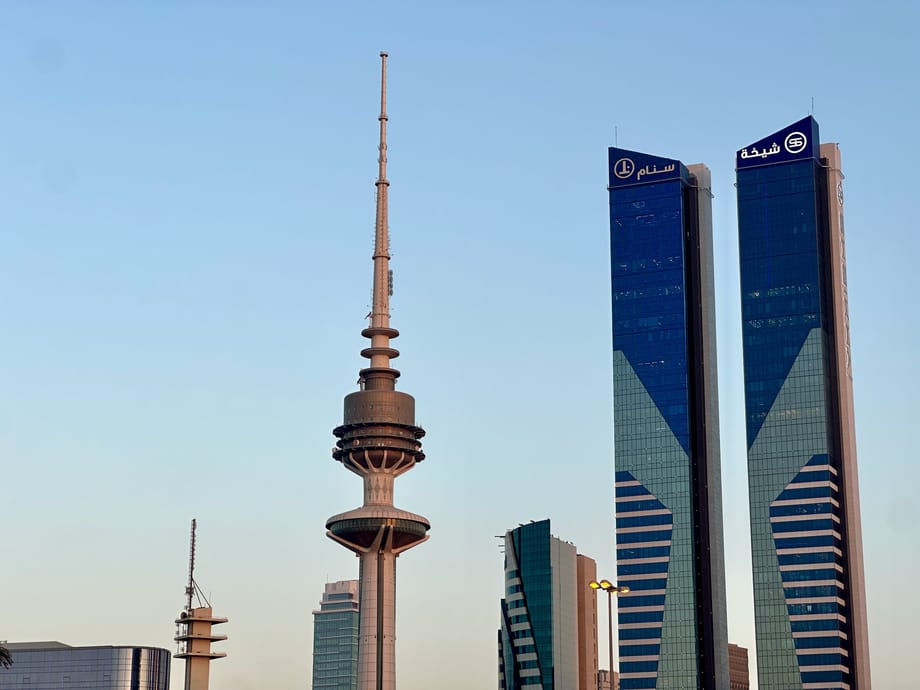
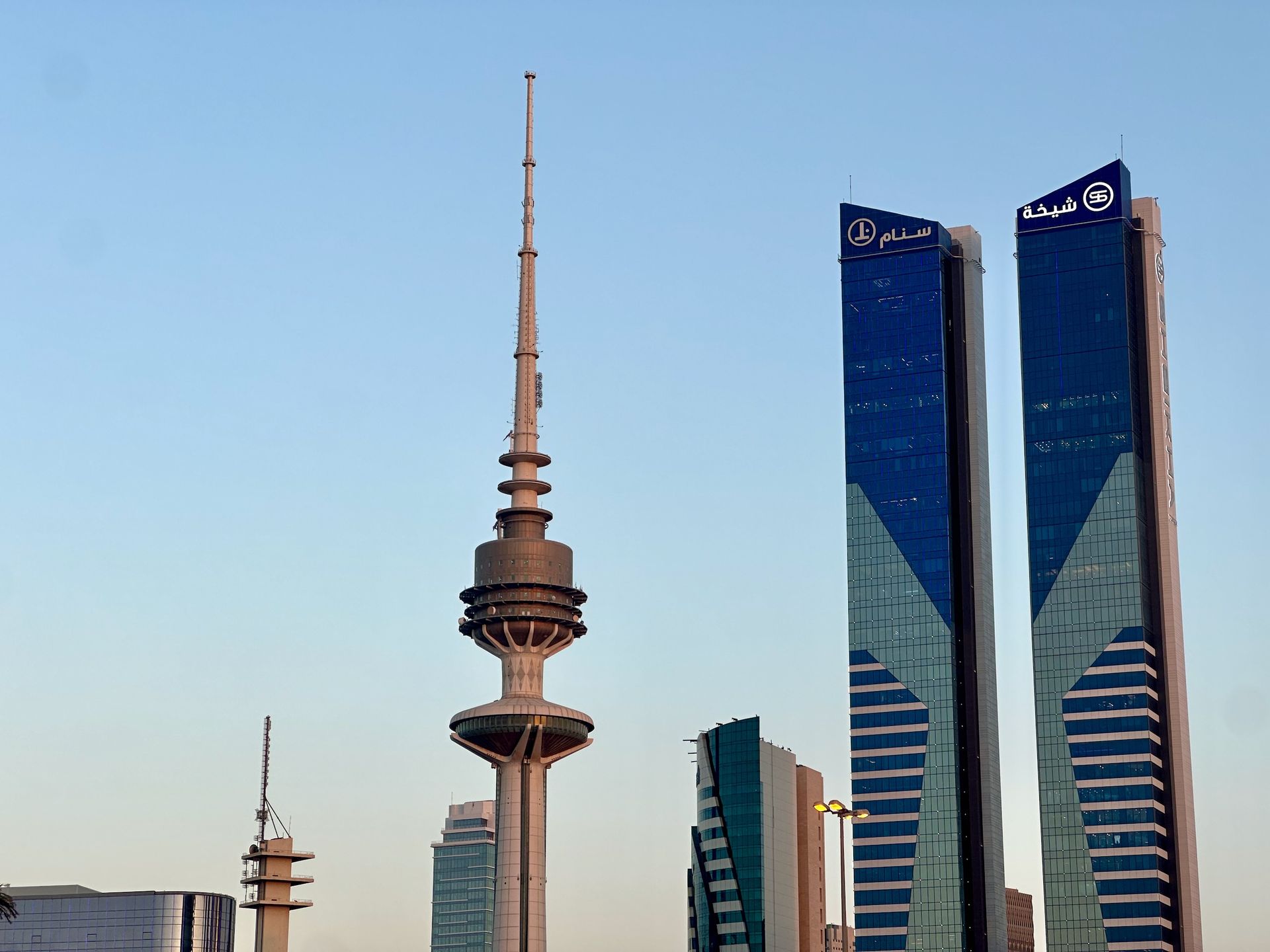
That worked really well for us, especially after the first thousands of kilometres on the road. Kuwait City gives off a nice sense of order and predictability. You can easily spend two or three days here, eat well, go for a walk, look out over the Gulf, and feel your body finally slow down and recover.
👉 If you want a ready-made list of places, with a clear mental map and our short, honest impressions, we’ve put together a separate post about things to see in Kuwait. It covers what actually makes sense for a short stay and what genuinely worked for us on the road. Think of it as a simple 1–3 day plan, without wandering around blindly.


Our summary
Before getting into our impressions of the country itself, we need to start with a few thank-yous — because without them, this part of the journey would have looked very different.
Huge thanks to the Polish Consul in Kuwait for helping us verify our notarised paperwork for the leased motorcycle. One clear phone call can calm your head more effectively than five forums and ten conflicting opinions. We’re also grateful to the Kuwaiti Embassy in Warsaw for their support and fast-track document legalisation. And after we got back home, I even had the chance to meet the Ambassador of Kuwait in Poland to talk about the trip and what this kind of travel actually looks like from the inside.
Big thanks also go to Tristar, the official BMW Motorrad importer in Kuwait, for taking care of our bike with a free service stop along the route. Gestures like that really stick with you. We’ve listed all the other partners who helped make Desert Horizons 2025 happen on a dedicated project page.
And Kuwait itself? A genuinely pleasant stop. Calmer, more orderly, and less focused on trying to impress at all costs. A bit like Qatar in its quieter, less flashy Gulf version. It’s not a country where you disappear for a full week and do ten new things every day, but as a two- or three-day reset on the road, it works perfectly.
If we ever ride through the Middle East again on a motorcycle, we’d happily give it more time. As a first impression, it was simply good.
And that’s it. Time to move on, because the next kilometres won’t ride themselves. The next chapter of our Desert Horizons 2025 journal takes us into Saudi Arabia, with AlUla waiting on the map. If you have any questions or need help with the practical side of things, feel free to reach out. If we can share something from our own experience, we will.