

Ten wpis jest również dostępny w języku:
 Polski
Hello!
If you ended up here and you’re planning your first motorcycle expedition, you’re probably at that point where your head is already on the road – but the practical side is still asking: what do I pack so I’m not hauling half my house, but I also don’t wake up somewhere mid-route thinking, “damn, I’m missing that one thing”?
We went through the same thing. Before we hit the road, we’d spent months reading guides, watching videos, scrolling forums, and writing lists that somehow got longer with every hour. On top of that, we talked to people who ride far: some said “take as little as possible”, others said “take everything”, and—as usual—the truth was somewhere in the middle.
That’s why this post is written in a normal, practical way. No “bring water and good vibes” talk—just clear categories and things that actually make sense on the road. I’m writing it mainly for people who are just starting out, whether you’re riding around Europe or you’ve got a plan like ours: to go beyond the EU border and keep things under control, without stressing about every unknown.
Our motorcycle trip
In our case, it wasn’t a last-minute decision. This trip was the result of longer planning and prep—gear and logistics. A weekend in the mountains forgives a lot. A long ride through several countries usually doesn’t: the weather changes, the rules change, and sometimes even “normal” everyday stuff works differently. After this trip we know one thing—quite a lot can be predicted if you approach it calmly and make a list that makes sense in real life, not just on paper.
Just to be clear—we’re not pretending this was the biggest motorcycle trip in the world. Some people ride around the globe and do yearly distances that make our numbers look small. Our September route was around 11,000 km—”only” that, but still enough to really appreciate simple solutions and to see what was a great call, and what turned out to be useless extra weight.
We also didn’t start from zero. We’d done other trips before—by car and on two wheels—so some habits (packing, managing the day, staying organised on the road) were already there. This expedition added a new layer: more paperwork, more borders, and more situations where a Plan B stops being “just an idea”.
That’s exactly the perspective behind this guide—written after we got back. We’ll show you how to pack smart for a longer motorcycle expedition when you sleep in hotels and ride mostly asphalt, but still want to be ready for breakdowns and surprises. This isn’t a survival course, because we don’t travel with a tent. But we’ll include a minimal “emergency overnight plan” too—just in case you end up on a stretch with no places to stay, or a delay blows up your plan.
If you want to get the full context of this trip, here are two places for links:
👉 Desert Horizons 2025 – information about our trip
👉 Where did the idea for such a trip come from in the first place?

Before you pack
The biggest beginner mistake is simple: you start with a packing list instead of answering two questions first—where are you going, and what kind of trip is it. Only then you’ll see what actually makes sense, and what is the classic “just in case” stuff that you end up carrying across half the world.
Before we left, our list was growing faster than the mileage counter. Only after a few days of riding fully loaded did we see what we really needed—and what was just extra weight taking up space in the panniers. That’s why this section comes before the packing list, so you don’t have to learn it the hard way.
It’s also worth deciding right away whether you’re riding solo or with a passenger. When you go as a pair, it’s easy to cut duplicates, because some gear can be shared: tools, a compressor, a first-aid kit, chargers, a power bank, and basic stuff for small breakdowns. Solo, you need a more careful approach—because nobody has a spare pair of gloves or an extra cable when your own stuff stops working.
Europe vs. outside the EU – what changes the list
In Europe, most things are simply easier. Passport-related formalities are less common, and if you’re missing something, you can usually buy it on the way without too much stress. The biggest difference is that problems hurt less logistically—you’re in a familiar system, and it’s much easier to have a Plan B.
Outside the EU, you get a whole set of things many people in Europe don’t even think about: extra documents, vehicle insurance, sometimes an international driving permit, local requirements, and more border checks. We’re not saying this to scare you. It’s just practical—details like this can eat your time and nerves if you don’t have them ready and within reach.
For us, Europe was mostly a “get through it” section, just to reach the next part without spending crazy money. We didn’t ship the bike straight to Turkey because that’s extra cost—and we had the bike on a lease, plus it was our first time riding this far from Poland on our own wheels. We preferred to stay in control of the whole ride and see for ourselves how the borders look along the way.
On the road we also learned something obvious—but only after the fact: we packed a bit too much. To lighten the bike and ride more comfortably, we shipped some of our stuff from Bulgaria back to Poland.
Why Bulgaria? Because it’s already in the EU, so shipping to Poland is an intra-EU shipment—no classic import paperwork and no customs duty. From Turkey it becomes more of an “import” situation, because it’s outside the EU, which can mean customs declarations and possible fees, depending on what you send and its value.
Climate and route length – heat, cold, distances
In Europe, the weather is a roulette. Mornings can be cold, midday gets warm, and by evening you can easily get rain. Even if Europe is just a “get-through-it” stage, a proper layering system still matters—one jacket for everything rarely works.
When you ride towards Africa or Asia, the climate is often easier to predict, but other problems show up: heat, strong sun, and fatigue from long riding days. Heading for the Middle East, we mainly looked at how much time we’d actually spend in Europe. We didn’t want to pack a full “all seasons” setup if Europe was mostly just a transit part.
Trip length changes everything too. A short ride forgives missing stuff—you can always somehow push through. On a longer route you get days of 500–800 km, and then you start to value things that sound basic but really matter: comfort in your gear, power for charging, hydration, and quick access to things in your panniers. At that point, the list stops being theory and becomes a tool that simply makes the ride calmer.

Documents and formalities
You won’t see it in the trip photos, but paperwork often decides whether you ride on calmly or end up standing by the roadside trying to figure things out. In the EU you can usually travel light, without much hassle. Outside the EU, extra documents come in—things you won’t sort out “quickly” over a coffee at a petrol station.
After coming back, we have one simple takeaway: you can fine-tune gear on the road, but paperwork is best sorted before you leave. Trial and error here can cost time, money, and a lot of nerves.
Basic set
EU and nearby (Schengen/EEA/Switzerland): in many places, a valid ID card is enough, and a passport is optional. In practice, it’s still worth keeping an ID document with you, because checks can happen.
Outside the EU: you enter the world of passports and country-specific entry rules. One important thing—many countries require your passport to be valid for at least 6 months from the date of entry, not from the date you leave. It’s worth checking this early, because a “barely valid” passport can ruin the whole plan.
On top of that, there are motorcycle documents:
- the registration document (the proper one, not a temporary slip) and a valid vehicle inspection. Nobody abroad will care about extra notes in Polish from a vehicle inspection station. And yes—border officers can even claim your registration is “invalid” just because they don’t understand it and see the date of first registration on it. 😅
- an authorisation letter if the motorcycle isn’t officially in your name (lease, rental, company bike). In the EU, a standard letter from the leasing company is usually enough. Outside the EU it can be different, and sometimes they want something more “official”: signatures, stamps, and sometimes even notarised. The further you go, the less sense it makes to hope it will “somehow pass”.
For us, the authorisation letter was a whole separate adventure, which is why we made a dedicated series about it. There’s some running around and paperwork, but it’s doable—you just don’t want to leave it for the last week.
If you’re entering a country that requires a Carnet de Passages (CPD), that’s one more document to sort out. In short, it’s like a “passport” for your vehicle and a customs guarantee at the same time. In countries that require it, a CPD lets you temporarily bring the motorcycle in without leaving a cash deposit at the border.

Copies and offline
It sounds boring until the classic happens: something goes missing, something ends up in the wrong pannier, and the internet stops working exactly when you need your policy number right now. You make document copies not because “it might be useful”, but because sooner or later it saves your nerves.
The minimal setup that really works:
- paper copies of the key documents: passport or ID, driving licence, registration document, leasing authorisation letter, and CPD if you have one. Keep one set in a different place than the originals, so you don’t lose everything at once.
- scans or photos on your phone, but not only in the cloud. Keep them available offline too—you might lose signal or run out of data.
International driver’s license
An International Driving Permit (IDP) isn’t a “second driving licence”. It’s an official translation of your Polish licence in a small paper booklet. It’s most useful outside the EU, where it’s easier to run into a situation where a police officer, a rental company, or an official doesn’t want to deal with a Polish plastic card and prefers a standard international format.
Getting an IDP in Poland is straightforward, you just don’t want to leave it for the last minute. You submit an application at your local office (usually the county office or city hall), add a photo, show your valid Polish driving licence, and pay the fee. In the form you also choose the version based on the convention: Vienna (1968) or Geneva (1949). If you’re riding through several countries and don’t want to guess, you can get both—just as two separate applications.
If you want it explained step by step, without guessing what to tick and what to prepare, we wrote a separate post about it.
👉 International driver’s license – how to obtain one in Poland (step by step)

Insurance and health
A lot of people skip this because “we’re riding carefully”, and then it turns out this is exactly the thing that saves your budget and your nerves. It doesn’t matter if you fly somewhere to chill by a pool or ride a motorcycle for a few thousand kilometres. An accident, a breakdown, or a silly bump can happen anywhere—and foreign bills can hurt.
On a motorcycle trip there’s one more thing: insurance often works differently than you’d expect. Your liability cover can have a wide range, while comprehensive or assistance might suddenly stop in a place you wouldn’t guess. That’s why it’s worth doing a quick policy check before you leave and confirming in the T&Cs where each one actually applies.
Vehicle insurance
First, let’s clarify the terminology, because these abbreviations are constantly confused:
- Liability insurance (OC): mandatory. In the EU, Polish OC is valid across EU countries (plus a few “extra” ones depending on the system), so this is your baseline.
- Green Card: it’s not a separate policy, just an international proof that you have liability insurance (OC). Some countries require it at entry or during a road check. In practice: you check the country list and you’ll know if you need it.
- Comprehensive (AC) / Personal Accident (NNW) / Assistance: these work according to the policy terms, exactly in the areas listed by your insurer. And this is where it gets tricky—your OC/Green Card coverage doesn’t have to match your AC or assistance territory.
This is especially important if your motorcycle is on a lease. Leasing usually requires a specific level of cover (for example AC), and on the road you might find that liability insurance “officially works”, but your AC ends earlier. We had weird cases where AC was valid up to some border—or even a symbolic point—and then it… came back in a country that was further away on the map.
If a country isn’t in the Green Card system (or doesn’t really honour it), you usually end up buying border insurance at the border. Most often you get TPL, basically the equivalent of our OC. Full “comprehensive” cover for a short period can be hard to arrange or expensive, and assistance is sometimes available as an add-on—it depends on the place.
You can also try to arrange local insurance, like we did via Hamraa Insurance in Iraq. Just assume from the start it won’t always cover the full value of the bike, and the terms won’t always be like what we’re used to in Europe.
EHIC vs travel insurance
The EHIC card is a great thing, but it only works in the EU/EFTA and under specific rules. It gives you access to public healthcare on the same terms as local residents. There’s a catch though: if locals have co-payments for visits, transport, or hospital stays, you pay them too. EHIC also won’t cover everything like mountain rescue, medical transport back to Poland, or treatment in private clinics.
Travel insurance is a different league, because it covers the stuff that gets really expensive in serious situations: medical transport, organising treatment, sometimes rescue actions, and in the worst case even bringing a body back home. These aren’t “nice extras”—they’re real costs that nobody will cover for free.
For longer-distance destinations, it’s also worth checking exclusions. Some policies can limit coverage if you travel against official warnings from the Polish MFA (MSZ), like “we advise against non-essential travel” or “we advise against all travel”. MFA publishes these notices, and insurers can refer to them directly in their terms.
One more topic many people leave “for later”, but on long trips it’s worth at least thinking through: what happens financially if the worst happens. If you have a mortgage, it’s good to know whether your life insurance actually covers it—and under what conditions (for example, whether motorcycle travel, specific countries, or MFA warnings exclude anything). Nobody likes thinking about this, but it’s better to have it sorted than to leave your loved ones with a mess.
Motorcycle and roadside assistance
Most problems are manageable if you think about them before you leave. On a long trip, “it’ll be fine somehow” rarely works—because even the best motorcycle can surprise you. And in places with fewer workshops or long delivery times for parts, a small neglect can turn into a big issue.
Pre-departure check
First: servicing and service intervals. On BMWs (and many big touring bikes), the service interval can be around 10,000 km. That’s not a small detail. On a longer route it’s easy to end up with a service due “somewhere on the way”, while you’re in a country where you don’t have a trusted workshop—or you simply don’t want to lose a few days waiting for parts and booking a slot.
We learned this the hard way. We reached Kuwait, and the service ended up being done in Riyadh, Saudi Arabia. And because we still planned a detour to Al Ula, we started counting kilometres so we wouldn’t go past the interval. Manufacturers can be picky about overdue services, and with a leased bike you really don’t want a “why was the service late?” conversation if something serious happens.
What to check before setting off, even if the motorcycle has recently been serviced:
- oil and filters (this is an absolute must);
- brake fluid and brake pads (especially if you are traveling with luggage and two people);
- condition of tires (tread is one thing, but tire age and possible damage are another);
- drive (chain/shaft), slack, leaks, general condition;
- battery and charging (because electronics can be a pain on the road);
- lights, fuses, basic electrical systems.
Before the trip we had the bike checked at BMW Motorrad Auto Fus in Warsaw, and that gave us peace of mind at the start. On a long route, it’s really worth beginning with a “clean slate” instead of relying on luck.

Tools
There is no point in taking your entire garage with you, but there is also no point in traveling empty-handed. A handy kit that allows you to:
- tighten something that has come loose
- make a temporary repair
- remove basic plastic parts/covers
- deal with a minor electrical fault
In our practice, the following set proved to be effective:
- small torx and hex keys suitable for motorcycles
- small ratchet or wrench with bits
- Leatherman / multi-tool
- cable ties in several sizes
- repair tape (the kind that sticks, not decorative)
- a small flashlight or headlamp (seriously, it’s worth its weight in gold in the evening)
- work gloves (because once you touch something hot or dirty, you’ll appreciate them)
The most important rule: pick tools for the bolts on your bike, not for what looks nice in a ready-made kit. It’s worth going through the most common bolts at home once and checking that you actually have the right bits for them.
Chain vs shaft
A lot depends on the bike’s design. We have a shaft drive, so regular chain lubing is off the table—same with all the cleaning after rain or dust. On long trips, it’s simply a kind of comfort you really start to appreciate.
Before that, we rode a Yamaha with a chain and we even had a Scottoiler to reduce the daily “spraying” and getting everything dirty. It worked, but it was still something you had to keep an eye on. A chain on a long trip means:
- regular lubrication
- tension control
- monitoring consumption
- dirt that likes to spread all over the wheel and suspension arm
A shaft drive needs less day-to-day attention, but it’s still worth checking from time to time for play, the overall condition, and any leaks. In short: with a chain, maintenance becomes part of your travel routine. With a shaft, it’s simply one less thing to deal with.
Tires and breakdowns
If we had to point to one thing that most often blows up a day’s plan, it’s tyres. One screw, a nail, or a nasty pothole and instead of riding on, you’re standing on the roadside trying to figure it out. The good news is you can prepare for most of these situations for little money and without carrying half a workshop.
And one more thing: there’s no point in overpaying just because the set has the BMW or Givi logo on it.
Repair kit
Your kit depends on what wheels and tyres you have. For tubeless tyres, the most common solution is plug strips (“worms”)—and this is something that can genuinely save your day on the road.
What is worth having in practice (the “sensible minimalism” version):
- tubeless tire repair kit (strings/pins + tools)
- small knife/blade for cutting the peg
- disposable gloves or thin work gloves (because glue and dirt get everywhere)
- optional: a small amount of adhesive/vulcanizing compound (some kits include it, some do not)
This kind of repair has one goal: to get you safely moving again, and then check the tyre properly later—whether the damage is acceptable or if it needs a real repair or replacement.
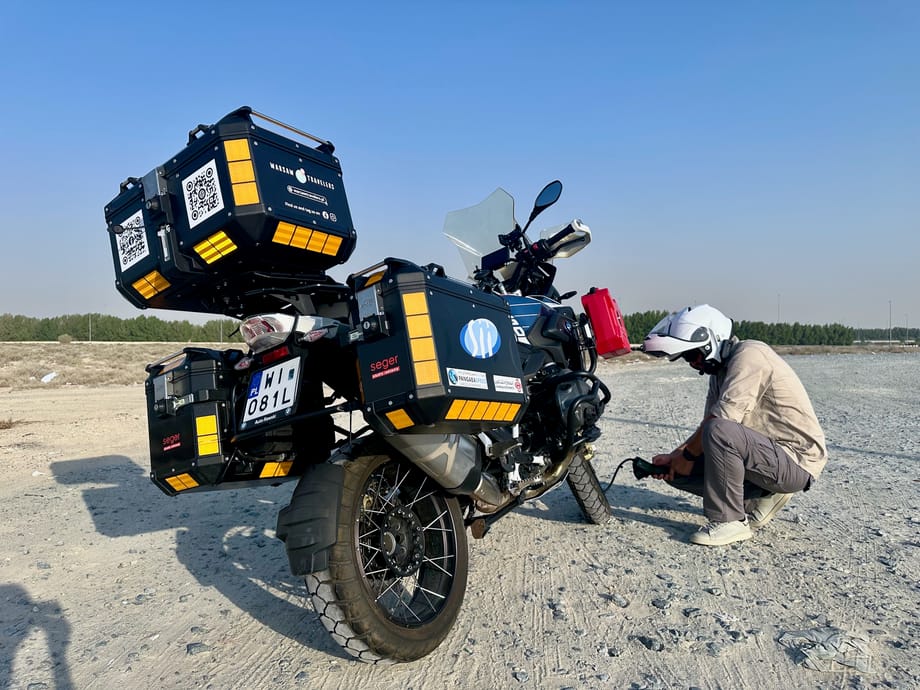
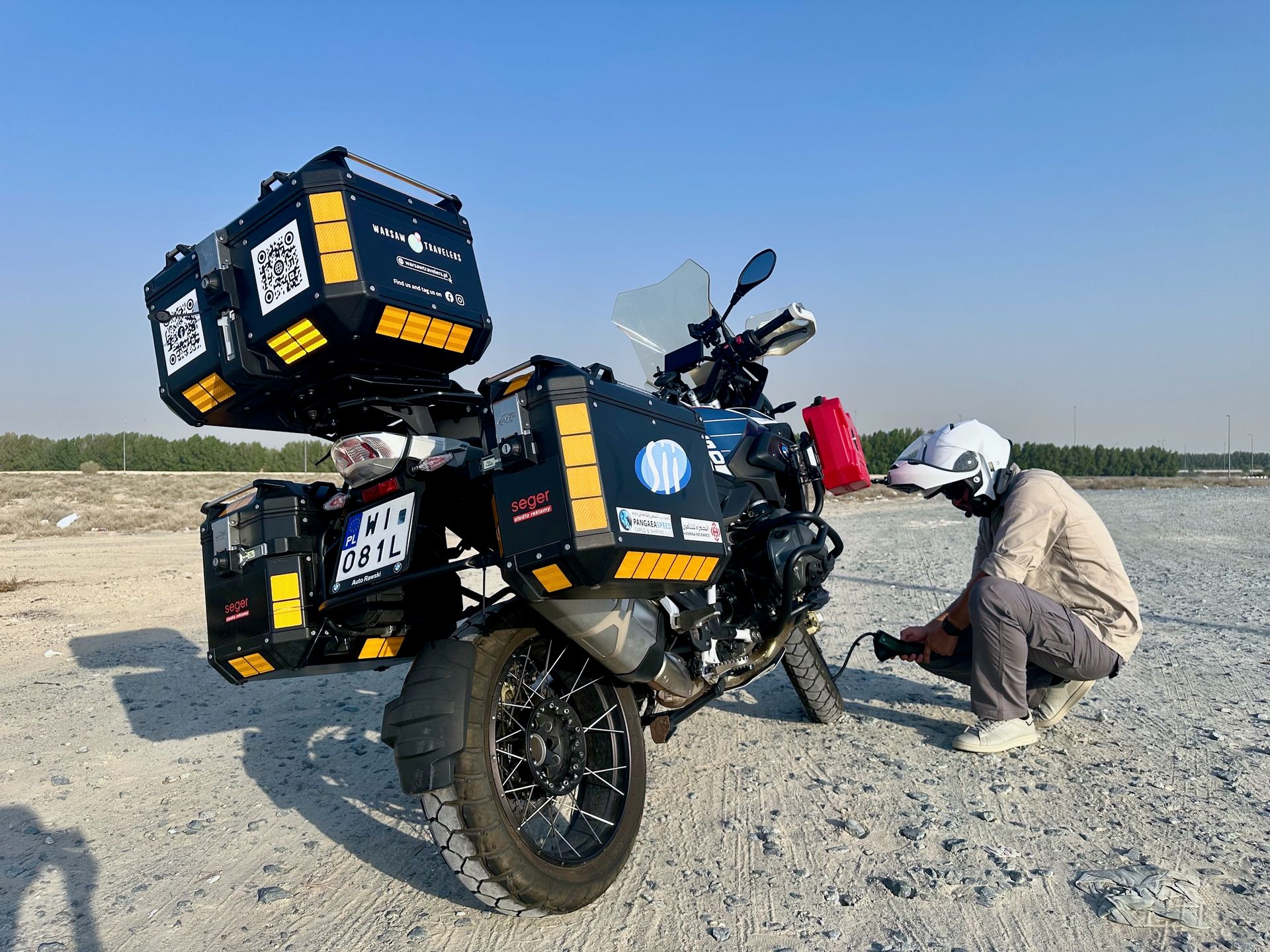
And a second thing: a plug alone isn’t enough if you can’t inflate the tyre back to the right pressure. We carried a Bosch pump with a small battery, charged via USB-C. We received it as part of our Desert Horizons 2025 cooperation from Mrs Olga Zabłocka, and in real life it was one of those pieces of gear that’s simply worth having within reach at all times.
Electrical engineering
On BMWs (and modern motorcycles in general), a weak battery can trigger temporary electronic errors. Suddenly you get ABS, traction control, or other warnings and it feels like everything has died. But often the cause is simple: a voltage drop during startup, or a battery that’s just having a bad day. After charging it up, the problem usually disappears.
What you should have and do to avoid panicking:
- Before departure, check the condition of the battery (especially after winter or after a long period of inactivity).
- check the terminals and connections (loose contacts can work wonders)
- carry a spare phone charging cable and one “emergency” cable that fits your gadgets (USB-C/micro/Lightning, depending on what you have)
- Add a few fuses if they can be easily replaced in your motorcycle.
A power booster/jump starter is another thing that can save your day—especially after transporting the bike or a longer stop. Just remember the basics: keep it charged, use it as instructed, and don’t short the clamps.
Navigation and safety
Still with us? Didn’t fall asleep? 😅 This chapter is really worth sorting out, because navigation and “peace of mind” on the road aren’t optional extras. Getting lost with no signal, or leaving the bike in a bad spot even for 20 minutes, can ruin your mood faster than your fuel level drops.
Fizyczna nawigacja i komunikator satelitarny
Our navigation setup is simple: a phone + an external screen with CarPlay/Android Auto.
CarPlay and Android Auto move selected apps from your phone onto a bigger screen and make them easier to use while riding (maps, music, calls, messages). The phone connects by cable or wirelessly, and on the screen you get big buttons and a clear interface.
Why do we prefer this over a classic motorcycle GPS? Because phone apps are simply more practical: you can search places faster, check points on the way more easily, and compare options quicker. Dedicated GPS units still make sense in specific cases, but for asphalt riding, hotels, and “real life on the road”, the phone wins on convenience.
We also have a Garmin Montana 700i, but we used it mostly as a satellite communicator. The inReach features (messages, tracking, weather, SOS) work via satellite, but they require an active subscription and a fairly open “view of the sky”. In an emergency, the SOS button connects you to Garmin Response, and you can communicate with them while you’re waiting for help.
For searching places like “is there decent food here” or “where can we stay”, these devices are just clunky. On a long trip, it can get frustrating.
Offline is easy to handle too. Phone navigation doesn’t have to eat a crazy amount of data, and offline maps can save you when the signal disappears or you’re still sorting out a local SIM. In Google Maps or Mapy.cz you can download an area in advance and use it normally on the road.
One thing to remember: sun + charging + navigation can overheat your phone. If it’s sitting on a mount (like a Quad Lock) in full sun, you might get a temperature warning, the screen can dim, or the phone may start limiting itself. Apple even recommends moving the device away from direct sunlight so it can cool down.
And this is where the CarPlay/Android Auto screen gives us an extra benefit: the phone can stay tucked away (pocket, tank bag), while the navigation is still right in front of you.
And charging: yes, the phone needs power. Even without an external screen, navigation with a bright display and GPS can drain the battery faster than you’d expect.

Anti-theft
We keep it simple: we don’t turn the bike into a fortress, but we also don’t pretend it will “watch itself”.
On the trip we had a Litelok X3 U-lock. Expensive and heavy as hell, but we bought it on purpose after watching a ton of tests. The manufacturer strongly highlights its resistance to angle-grinder attacks and their Barronium material.
In practice, we didn’t have the habit of locking the bike up everywhere. We rode through regions where travellers are rare, and people more often want to help and look after a guest than figure out how to steal something. Plus, you’re loaded up like a travelling market stall and it’s obvious from far away you’re on a long ride. In that kind of vibe, an “I don’t trust you” show can be simply unnecessary.
Does that mean theft doesn’t exist? Of course it does. There are places where it’s a real risk—especially bigger cities, sketchy areas around accommodation, or spots where bikes get stolen “for parts”. But often the target is something easier and cheaper, not always a big touring brick with panniers that you can’t exactly carry under your arm.
Besides the lock, we also had a Plan B with trackers: a GPS in the bike and two small location tags—one in the Apple ecosystem, the other in Google. The idea was simple: if something happens, we can track the bike in two ways, not rely on just one solution.
And one last thing that sounds weird at first, but starts to make sense over time: the best “security” can be the right insurance. Locks are there to slow down a thief and discourage an easy opportunity. Insurance is there so a theft doesn’t wipe your bank account to zero. Just make sure you check the policy terms in advance—some insurers require specific security devices, and the exact wording can make all the difference.
Clothes and personal belongings
It’s easy to fall into two extremes here: either you pack like you’re heading to the North Pole, or you bring “whatever” and after two days everything starts annoying you—from wet gloves to not having one normal hoodie for the evening. We kept it practical: clothes should work on the bike and after you get off it, not just look good in photos.
If we had to sum it up in one sentence: a layering system plus a sensible laundry plan beats a suitcase full of T-shirts “for every day”.
Layers and rain
On the bike, we mostly rode in Shima gear. We had the Shima Hero 2.0 touring set—plus touring pants for me, and Oxford riding jeans for Jadzia. For hot weather we also had lighter Shima Renegade 2.0 jackets—the nice thing is they’re not just “windbreakers”, but proper motorcycle jackets with decent protection.
We handled rain the classic way: a two-piece rain suit (jacket + pants) from Shima. It didn’t leak at all, but let’s be honest—putting it on mid-ride, on the roadside, in the wind is always a bit of a workout. Sure, you can go for a more expensive Gore-Tex setup and stay “condom-free”, but that depends on your budget and how often you actually ride in the rain. For us, this system simply worked.
At one point we made a move that improved comfort a lot: we shipped our heavier touring jacket back to Poland while we were still in Bulgaria, and from Turkey onward we stuck with mesh. We knew it would only get hotter, and at 35–40°C it’s not the time to prove anything in heavy touring gear.

Things after getting off the motorcycle
No big discovery here: once you get off the bike, you want to look and feel normal. We didn’t pack clothes for every single day—we went with a rotation setup: a few T-shirts and laundry. Merino T-shirts from Brubeck worked well for us, because even in warm weather they usually handle life on the road better than regular cotton. You also don’t end up smelling like a slaughterhouse. 😉
In practice, the following approach was sufficient for us:
- T-shirts for several days (e.g., 4–5) and laundry
- underwear and socks similarly
- one warmer item for the evening (because even in warm countries it can get windy or the air conditioning can do its job)
I rode through the Middle East in cargo pants. Comfortable, breathable, no “boiling” like in heavy touring trousers—but we should say it honestly: it’s a safety compromise. Even if the fabric is “reinforced for abrasion”, it’s still not the same as proper riding pants with protectors and materials designed for sliding on asphalt. You can ride like that, but it’s worth knowing what you’re giving up. Jadzia stayed in riding pants, and that’s simply the safer option.
Hygiene and laundry
Laundry is more work than just another T-shirt in your trunk. We handled it in three ways:
- accommodation with a washing machine and purchase of washing powder/liquid on site
- quick hand washing, if you just needed to freshen things up
- laundry/dropping off in town when it was most convenient
Just keep in mind that merino and technical synthetics prefer gentler detergents. If you wash them with whatever, you can wear them out faster (smell, loss of properties, fabric getting “stiff”).
Accommodation
We don’t travel “with a tent”, so this section won’t be about things like which tarp pole to buy or what sleeping mat to choose. Our approach is hotels and apartments, because after a full day of riding we simply want to sleep properly, eat something normal, and have peace of mind about our stuff. Still, accommodation can affect packing—because your needs in Europe are different than in countries where there are fewer options on the way and it’s easier to end up in a “okay, we need a Plan B” situation.
In Europe, you can usually be more relaxed—because even if something goes wrong, you’ll often find a decent option within a few dozen kilometres. Outside the EU it can be different, especially if you’re doing longer riding days and finish late, or you’re passing through areas with fewer hotels. Then it’s not only about “is there a bed”, but also: can you leave the bike safely, and do you end the day without stress.
Our hotel setup
Our minimum is simple: a place with parking and the option to leave the bike somewhere that makes sense. Best case, you can park close to the entrance, on the property, under CCTV, or behind a gate. Underground parking is a luxury, but in practice it’s more important not to leave the bike “out in the open” where anyone can walk up and mess with it. What else? Well, the hotel pool, of course. 😅
What worked for us as a routine:
- When making a reservation or sending a message to the facility, we immediately ask about parking for motorcycles (whether it is available, where it is located, whether there is a gate/CCTV).
- Upon arrival, we first tidy up the room and only then park the motorcycle in its final location, preferably with the consent of the staff (at the back, in the garage, in a locked area).
- We take everything from the motorcycle at once: inner bags/inserts from the panniers or one or two bags, so that we don’t have to make five trips through the reception and parking lot.
- If the parking lot is mediocre, it is sometimes better to pay extra for accommodation in a better location than to save a few dollars and spend the whole night wondering if someone is hanging around your motorcycle.
And one more detail that may sound trivial: the location of the parking lot is often more important than the “standard of the hotel”. You may have a great room, but if your motorcycle is parked on a dark street, your peace of mind will go down the drain.
Summary
If you made it this far, you’ve got the most important part already: the idea that a “packing list” doesn’t start with shopping—it starts with the route, your riding style, and how much peace of mind you want when something goes wrong. Our expedition made one thing very clear: the biggest stress doesn’t come from missing one more T-shirt, but from missing paperwork, having no breakdown plan, and running out of energy because everything is stuffed in randomly.
If you’ve got your own tricks, you’d add something to this list, or you think we overdid it somewhere (or the opposite—something’s missing), drop it in the comments. What’s one thing you’d add to a first motorcycle expedition packing list, and why?