


Ten wpis jest również dostępny w języku:
 Polski
Hey 👋
If you ended up here, you’re probably wondering what to see in Marrakesh on your first trip. We spent a few days there, did a lot of walking, a bit of driving, got annoyed more than once, but in the end we saw a handful of places that genuinely stayed with us — and those are the ones we want to show you here, in our own way, without the brochure-style hype and without throwing in every possible sight just for the sake of it.
In this post, we’ve put together the places we actually visited and that, in our opinion, make sense if it’s your first time in Marrakesh or if you just want to pick a few solid spots for a short stay. If you’re looking for a broader take on the trip itself — where we stayed, the car, internet, food, costs, and our overall impressions of Marrakesh — make sure to check out our earlier post where we summed up the whole stay.
Lalla Hasna Park
This was one of the calmer places to start with, before we properly stepped into the more intense side of Marrakesh. The park sits just a stone’s throw from the Koutoubia Mosque and the medina itself, so it’s a very good place to begin your walk from that side of the city, especially if you want a moment to get your bearings first.
There were quite a few stalls with random bits and pieces around, but the crowd was still manageable — mostly tour groups moving at a slow pace towards the old city. The park’s name most likely refers to Princess Lalla Hasnaa, so you can treat that as a small historical side note. It’s not the kind of place you’d cross half the city for, but as a starting point for a walk or just a short breather in the shade, it works really well.

Koutoubia Mosque
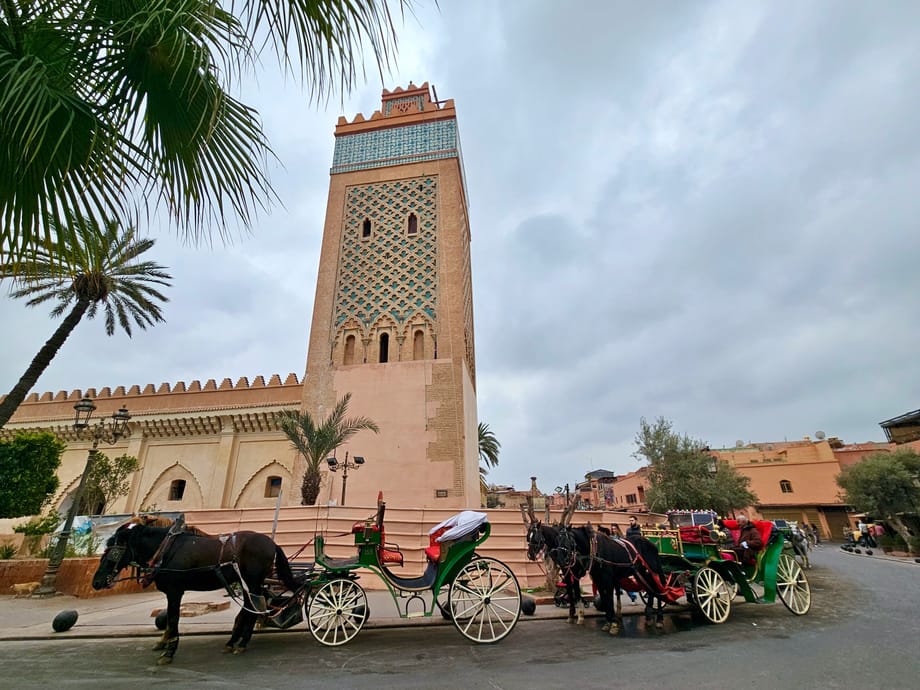
Koutoubia catches your eye almost as soon as you arrive, even if you’re not looking for it on purpose. The mosque’s minaret dominates the area and works as a perfect landmark that keeps coming back into view. It’s the largest structure of its kind in the city, and the version you see today has been standing there since the 12th century, back in the Almohad period.
We didn’t go inside — and you won’t either unless you’re Muslim, because the mosque is closed to non-Muslim visitors. Most people simply see it from the outside, walking around the walls as part of a stroll through this part of the city.
What makes Koutoubia most interesting is its history, which goes beyond its religious role. The name itself comes from the Arabic word for booksellers, because there used to be a major book market around the mosque. That says a lot about the place — it wasn’t just a closed religious site, but a part of the city that had always been tied to trade and cultural life as well.
It’s also worth knowing that Koutoubia’s minaret became a model for other famous structures in the region, including the Giralda in Seville and the Hassan Tower in Rabat. So this design genuinely had an impact on architecture well beyond Marrakesh itself. The tower is around 77 metres high, which makes it pretty hard to miss in the city skyline.


Jemaa el-Fnaa
It’s hard to find a more central spot in Marrakesh. Sooner or later, you’ll end up here anyway, even if you’re not planning to — all roads in this part of the city seem to lead to this square eventually. Jemaa el-Fna is Marrakesh in a nutshell: a full mix of noise, smells, food stalls, and a crowd that never really disappears. UNESCO added it to the list of intangible cultural heritage, and honestly, it makes sense — the formula has been the same here for centuries: trade mixed with street performances and local chaos.
The square isn’t just there for tourists — it also works as a natural centre of everyday life for locals. The main post office is right there, for example, so alongside all the chaos, the city’s normal daily life is just carrying on as usual.
Even the name Jemaa el-Fna is still debated by historians. One of the most common interpretations links it to something like the “Assembly of the Dead” or the “Square of Execution,” referring to public executions that once took place there. It sounds harsh and anything but postcard-friendly, but in a strange way it fits Marrakesh perfectly — a city that can be fascinating, but also pretty overwhelming at times.
One last thing we want to mention here, because it really didn’t sit well with us. You’ll still see people on the square with monkeys on leashes and other animals being used as photo props. Honestly — this is not entertainment. Barbary macaques are kept there in the heat and noise, chained up just to squeeze a few dirhams out of tourists. It looks bad, and it feels bad too. Our recommendation is simple: ignore it, don’t take photos, and don’t pay for that kind of “interaction.” There’s no reason to support that business.


Souk Semmarine
Souk Semmarine is basically the gateway to the commercial heart of the medina. If you’ve never been to this part of the world before, get ready for something far more intense than a European market. Forget the idea of a simple square with a few stalls — this is a huge web of narrow alleyways, workshops, and hidden passages that really pulls you in. Semmarine is one of the main arteries of that whole maze, and for most people it’s their first real contact with Moroccan trade.
Even though it wasn’t our first souk and we more or less knew what we were getting into, we still managed to get properly lost in there. You feel like you’re walking straight ahead the whole time, and then five minutes later you have no idea where you came from or whether you’re just going in circles. That’s exactly where the charm of the place lies — and, at times, the mild frustration too.
That apparent chaos does have its own internal logic, though. Historically, different parts of the souks specialised in different crafts, and you can still clearly feel that as you walk through them. As you move from one alley to the next, the “industries” change — from textiles and clothing, to piles of spices and perfumes, and then to workshops where people work with metal, wood, or leather.
What we liked most was the fact that alongside all the souvenir stuff clearly aimed at tourists, there’s still plenty of proper everyday work going on. One person is welding something, someone else is cutting patterns into leather — and that’s exactly what makes the place feel alive rather than just staged for photos.
If you’re planning to buy anything, make sure you have cash on you. Even though card terminals are fairly normal in the more modern parts of Marrakesh, once you’re deeper inside the souk, dirhams in your wallet are simply the only reliable option. Bargaining also goes more smoothly that way, and you don’t waste time asking every other stall whether they take cards.


Marrakech Museum
At the Marrakech Museum, the conditions were actually pretty manageable — unlike some of the more crowded places, here you could breathe normally and take a proper look around without fighting for every square metre. We paid 50 MAD per person in cash to get in, and in our opinion, that’s a fair price for what you get inside.
The museum is housed in the former Dar Mnebhi Palace, built in 1894. The residence once belonged to Mehdi Mnebhi, who served as Minister of War under Sultan Moulay Abdelaziz. The history of the place is actually quite unusual — after Morocco gained independence in 1956, the palace was turned into… a girls’ school. It wasn’t until the 1990s that the Omar Benjelloun Foundation restored the building and opened the museum you see today.
The central courtyard with its massive copper chandelier is easily the main highlight here. The thing reportedly weighs around 1,200 kilos and hangs above a beautifully decorated floor, surrounded by zellige tilework and carved cedar wood. Even if you’re not in the mood to study every display case filled with ceramics or old jewellery, it’s still worth coming in just for the architecture alone. The building is a textbook example of a high-end turn-of-the-century residence, where every detail was clearly meant to show off the owner’s status.
Beyond the main courtyard, it’s worth stepping into the smaller rooms and the former hammam as well. There are often contemporary art exhibitions there, which creates a nice contrast with all the traditional decoration and the Carrara marble. It’s a good place to catch your breath from the noise of the medina before heading further towards the madrasa or the souks.


Bahia Palace
Bahia is one of those places in Marrakesh that you simply end up seeing, but it’s worth setting your expectations early. At times, it’s genuinely impressive, especially if you like mosaics, carved cedar ceilings, and that whole kind of Moroccan grandeur that looks great in photos. The name “Bahia” means “Brilliance” or “The Beautiful,” and looking at the details, it’s pretty clear that the people behind it were aiming high from the very beginning.
What makes the palace especially interesting is that it wasn’t built by a sultan, but by two powerful grand viziers. First came Si Moussa in the 1860s, and then his son, Ba Ahmed, a figure who was almost legendary in his own right — the kind of behind-the-scenes power who effectively ruled the country on behalf of the young Sultan Abdelaziz. Ba Ahmed kept expanding the palace over the years, buying up more plots as he went, which is why the whole complex feels a bit irregular in layout.
One story often repeated is that the vizier was obsessively jealous of his four wives and dozens of concubines, so the palace’s 160 rooms were supposedly designed in a way that kept them from running into one another by accident in the corridors.
The biggest impression comes from the vast Marble Courtyard, the Cour d’Honneur — this was where officials were received and where the family’s power was put on display. It’s worth knowing, though, that what you see today is only a shadow of the palace’s former glory. When Ba Ahmed died in 1900, chaos broke out inside the palace. Sultan Abdelaziz, seeing a chance to enrich himself, ordered the vizier’s residence to be looted.
Everything of value — furniture, silks, jewellery, the lot — was carried out within a matter of days. That’s why what you’re seeing today is mostly the shell: beautiful floors, walls, and ceilings, but without the original furnishings that once filled the place.
As for the practical side of it, tickets are 100 MAD per person, and in our case only cash worked. Online systems technically exist, but on the ground nobody seems especially invested in them. The place is usually packed — it’s one of the most popular attractions in the city — so you can forget about getting a photo without someone in the background unless you’re standing at the gate right at 9:00. Last entry is around 4:30 pm, but the earlier you get there, the fewer elbows you’ll be taking to the ribs while trying to look at those famous zellige mosaics.


El Badi Palace
El Badi Palace is basically just walls now, but the sheer scale of them still makes a serious impression. If Bahia was luxury on full display, El Badi feels more like proof of a grand vision that didn’t survive. We happened to be there when the place was packed, so any idea of a quiet walk along those huge pools went out the window. Even so, these massive ruins have a raw quality you won’t get from polished-up museums.
The ticket is 100 MAD per person and, as usual, it’s best to have cash ready. The palace was built in the 16th century on the orders of Sultan Ahmad al-Mansur of the Saadian dynasty. The name “El Badi” means “The Incomparable,” and at the height of its glory, the palace really was meant to live up to that. Historical accounts speak of 360 rooms decorated with gold, turquoise, and Carrara marble. One of the more interesting details is that the sultan reportedly paid for some of that marble with sugar — literally weight for weight. That gives you a pretty good idea of the level of wealth involved.
Unfortunately, that golden age didn’t last. About a century later, the next ruler, Moulay Ismail, decided to move the capital to Meknes and quite literally stripped El Badi apart piece by piece. The looting is said to have lasted as long as 12 years — that’s how long it took to remove the valuable metals, marble, and decorative elements and reuse them in his new palace. What you see today is only the skeleton of that former power, but you can still explore the old underground prisons and climb the walls for a view over the city.
Make sure to look up at the tops of the defensive walls too. The palace has become home to dozens of storks, which have built huge nests up there. Their clattering is probably the most distinctive sound in El Badi. Even though what you see now is mostly open spaces with orange trees planted in the sunken areas, it’s still easy to imagine how enormous this whole complex must once have been before it turned into a free construction-material warehouse for the next ruler. If you have the time, also step into the room with the minbar from the Koutoubia Mosque — it’s one of the few surviving masterpieces of craftsmanship there, and the precision of it is genuinely impressive.


Bab Agnaou
Bab Agnaou catches your eye almost immediately when you head towards the Kasbah district. It’s one of the nineteen gates leading into the medina, dating back to the 12th century and the Almohad period. At the time, it served as the main ceremonial entrance to the royal part of the city, which explains why it looks far more decorative than many of the other, much simpler gates.
The sandstone it was built from has weathered heavily over time and turned a rusty colour, but you can still clearly see the intricate carvings and Quranic inscriptions in Kufic script. The name “Agnaou” is interesting too — in Berber, it can mean “mute” or refer to Black people, most likely in connection with the sultan’s guard who were once stationed in this area.
At the very top of the gate, just like on the walls of El Badi Palace, storks have more or less moved in permanently. Their huge nests against the backdrop of centuries-old decoration are one of those views that capture Marrakesh really well — a mix of deep history and nature just doing its thing in the middle of the city. Walking through that massive arch only takes a moment, but it’s worth slowing down there for a second to take in the scale of the city’s former power.

Menara Gardens
The Menara Gardens are a bit outside the very centre, so be ready for a longer walk or a quick taxi ride — unless you’re staying near Menara, in which case it’s really just a walk 😄. The place is completely different from Majorelle. Instead of exotic plants and bold colours, you get a huge olive grove and a large water basin that sits at the heart of the whole complex.
The origins of this place go back to the 12th century and the Almohad period. The central basin wasn’t created just to look pretty — it was part of a clever historical irrigation system that still brings water to the surrounding trees through old underground channels known as khettaras. The pavilion with the distinctive green roof, the one that shows up on countless Marrakesh postcards, dates in its current form to the 19th century, when it was rebuilt on the orders of the sultan.
The biggest asset of Menara is the view. On a clear day, the snow-capped peaks of the High Atlas rise right above the pavilion’s roof — easily one of the most iconic sights in the whole country. It’s worth knowing, though, that the gardens themselves are more about a calm walk in the shade of olive trees than admiring perfectly trimmed flowerbeds. Locals from Marrakesh love coming here for picnics, so the atmosphere feels much more relaxed and genuinely local than in the packed palaces of the medina.


Jardin Majorelle
A visit to this garden is pretty much a must, but it’s worth knowing what actually grows there, because Majorelle put a lot of effort into bringing in rare plant species. The most striking part is the huge cactus collection — dozens of varieties, from small round ones to towering giants that look more like sculptures than plants. Right next to them, there’s a dense, tall bamboo grove that gives excellent shade and makes it feel a few degrees cooler inside the garden than outside. On the water, in the shade of the pavilions, you’ll see lotus flowers and water lilies, while above it all rise date palms and Washingtonia palms.
All that greenery is made even stronger by the legendary Majorelle Blue — that distinctive, intense ultramarine shade used on the villa walls and flower pots. The artist drew inspiration from the colour of traditional Moroccan tiles and the dye used in Berber clothing. It’s such a bold colour that even on a cloudy day, the garden seems to glow with its own light.
The place also has its fashion chapter. In 1980, when the garden had fallen into decline and was about to be demolished to make way for a hotel, it was saved by Yves Saint Laurent and Pierre Bergé. Saint Laurent loved it so much that after his death in 2008, his ashes were scattered in the rose garden here. You’ll find a modest memorial there in the form of a Roman-style column dedicated to him.
Kilka konkretów przed wejściem:
- Tickets are online only: forget about buying them at the entrance. The booking system on the official website is quite strict — you buy your ticket for a specific time slot, and it’s worth doing that a few days in advance.
- Price: At the moment, it’s 170 MAD for the garden alone (around 68 PLN). If you want to add the Berber Museum or the Yves Saint Laurent Museum, you’ll pay more accordingly, although the combined tickets work out better.
- Crowds: The garden gets very busy. The best bet is to go in the first hour after opening, around 8:00 am, or with one of the last entry slots before closing. In the middle of the day, be prepared for a full-on slalom between people hunting for the perfect Instagram shot.
Despite its huge popularity and the crowds getting a bit tiring at times, Jardin Majorelle still holds up on pure aesthetics. It’s not the kind of botanical garden where you stop to read every plant label — it’s more like a carefully designed oasis that shows just how lush and exotic a space you can create in the middle of a desert city.


Yves Saint Laurent Museum
If Jardin Majorelle feels like a living painting, then the YSL Museum is an architectural masterpiece. The building, designed by Paris-based Studio KO, is anything but a generic box. Its terracotta brick façade is meant to resemble woven fabric — all those raised forms and patterns echo the weave of textile threads. It was also the first building in Africa dedicated entirely to the work of a single fashion designer.
Inside, you’ll find the permanent exhibition, which really captures the essence of Yves Saint Laurent’s work. There are iconic designs on display, including the Mondrian dress and the famous Le Smoking — the first women’s tuxedo — along with plenty of sketches, photographs, and accessories. The collection is rotated regularly, with garments being changed every few months so light doesn’t damage them, which is probably why the exhibition doesn’t feel huge all at once.
It’s also worth paying attention to the temporary exhibition hall, where they actually do enforce the no-photo rule. That space is used for contemporary art, photography, and design, and it often shifts the feel of the whole museum. There’s also a beautiful research library with more than 6,000 books, plus an auditorium where films about the designer’s life are shown.
Logistyka i ceny:
- Tickets: Just like with the garden, booking online is mandatory. There’s no ticket desk on site. The current price for the museum alone is 130 MAD (around 52 PLN). If you’re planning to visit both, the best option is to get a combined ticket for the Garden + YSL Museum + Berber Museum, which works out better overall.
- Pro tip on timing: we can confirm that people in Morocco can be fairly relaxed about these things. If there isn’t a huge queue outside and it’s not too busy inside, the staff may not care that much about the exact time on your ticket and can let you in straight away. It’s worth trying if you happen to be in the area a bit earlier.
- Café: At the back, there’s Le Studio — a café inspired by the designer’s studio in Paris. It’s pricey, but very stylish if you want a short break in a more fashion-focused setting.


What to See in Marrakesh – Our Final Verdict
To sum up our time there, Marrakesh is the kind of city you really need to explore on foot if you want to feel what it’s actually like. We clocked up a serious number of steps there and probably burned a record number of calories, but thanks to that, we saw everything up close, without any filters.
A quick Marrakesh reality check:
- Biggest highlight: definitely Jardin Majorelle. Even with the crowds and the need to book tickets in advance, that oasis leaves the strongest impression. It’s beautifully maintained, intensely green, and simply feels completely different from the rest of the dusty city.
- Biggest letdown: the Menara Gardens. Compared with Majorelle, they feel fairly underwhelming — less well maintained, and apart from the iconic view of the basin with the Atlas Mountains in the background, there isn’t all that much going on. It’s a decent option for a free walk, but don’t expect anything spectacular.
- Souks: Even if you’re not the shopping type at all — and we definitely aren’t — walking through those labyrinths is an experience in itself. You can find absolutely everything there, from genuinely beautiful handmade pieces to complete kitsch. It’s worth going in for no other reason than to see how the whole thing works from the inside.
Verdict? Marrakesh for a first trip — and probably not the last — is absolutely top-tier. The city can wear you out with its noise and chaos, but it makes up for it with history, architecture, and an atmosphere you won’t really find anywhere else. If you’re looking for a place that pulls you out of your everyday routine and hits you with a lot of stimuli in the best possible way, this is a very good choice.
We came back tired, but with the feeling that we got as much out of that trip as we possibly could. For a first Moroccan trip, we’d call that mission accomplished.