
Ten wpis jest również dostępny w języku:
 Polski
Our first contact with Iraqi Kurdistan
So here we are, entering what was probably the most anticipated stage of our motorcycle trip – and one we wouldn’t have even considered for ourselves not so long ago. For us, Iraq existed mainly as headlines in the news: war, bombings, maps covered in red danger zones. More like a place your eyes skip over on a map than a spot you highlight with a marker thinking, “this will be our next stop.
That changed the moment we started planning our route to Oman. We looked at the map, realized we didn’t have many realistic options… and suddenly the obvious thing hit us: Iraq is literally on the way. Instead of crossing it off immediately, we started digging a bit deeper – what’s the situation in Iraqi Kurdistan, can you actually cross it on a motorcycle, how are other travellers doing it? The more we read, the less it looked like a “crazy idea” and the more it felt like a challenging but doable part of the journey.
Where is Erbil located, and what exactly is Kurdistan?
If your brain still jumps to schoolbook associations like: Mesopotamia, the Euphrates, the Tigris, somewhere there Babylon – and then a long blank space until “the Iraq War on TV”… well, you’re in good company. We started with pretty much the same collage of images rather than an actual, concrete map in our heads.
Erbil sits in northern Iraq, roughly between Turkey and Iran, just a little “below” the Turkish border. It’s a large city – the capital of a region officially called the Kurdistan Region of Iraq. And here’s where it gets interesting, because this isn’t “just another province”.
Kurdistan is, in short, a region inhabited mostly by Kurds – a nation without its own state, living across the borders of several countries: Iraq, Turkey, Iran and Syria. In the Iraqi part, the Kurds have secured a high level of autonomy: they have their own parliament, their own government, their own security forces, their own flag, their own checkpoints on the roads and their own entry rules. Formally it’s still Iraq, but in practice it feels a bit like a “state within a state”.
For a traveler, this simply means that when you enter Iraqi Kurdistan, you arrive in a place that’s run differently, noticeably calmer than the rest of the country, and much more used to seeing foreigners. A different language on the streets (Kurdish plus Arabic), different flags flying over buildings, different stories people carry – but in your passport, the stamp still says “Iraq”.


How to get to Kurdistan?
Before anyone seriously starts planning a route, we really recommend checking your own foreign ministry’s travel advisories. As of the time of writing, Poland’s MFA advises against all travel to the Republic of Iraq, including the Kurdistan Region of Iraq, so any trip in this direction is a conscious decision made by an adult – not a “spontaneous weekend in Prague”. In this post we’re simply showing how we did it and what the technical options look like from the Turkish side – the safety side of things is covered separately.
We’re deliberately sticking to routes “from the Turkish side”, because the situation at other borders (for example the Syrian side) is fluid and heavily dependent on current politics and ongoing conflicts. These are areas where you need fresh, first-hand information – not generic advice from the internet.
Our motorcycle trip from Poland
For us, it all started on August 29, when we left Warsaw on the motorcycle and headed towards Oman. Iraq — or more precisely, Iraqi Kurdistan – wasn’t a separate “trip”, but one of the key stages of the whole route. First the classic push through Europe, then Turkey, which becomes less and less “postcard-like” with each passing day and more rugged and mountainous.
We entered Iraq from the Turkish side through the Ibrahim Khalil / Habur border crossing – the main and busiest land crossing between Turkey and Iraq, located about 10 km from the city of Zakho and roughly 210–213 km from Erbil.
The whole border experience – the crossing itself, the checkpoints, the paperwork, the conversations during inspections — is a story of its own, and we already have separate posts about it: our 🇮🇶 Iraq travel log, and another entry 🏍️ with the behind-the-scenes logistics and a big thank-you to the 🤟 partners who helped make this route possible in the first place.

By plane
For most people, the simplest option is to just fly into Erbil International Airport (EBL). It’s the region’s main airport, and as of November 2025 it offers direct connections to around 30 cities across Europe, Africa, the Middle East and parts of South Asia.
For example, from Turkey you can fly regularly with airlines like Turkish Airlines and Pegasus on direct routes from Istanbul to Erbil. From Europe, there are also direct flights – for instance from Berlin (UR Airlines) and Vienna (Austrian). Otherwise, you can simply connect through major hubs like Istanbul; from Warsaw, Turkish Airlines sells tickets with a layover there. Return fares usually start at around 550 USD.
By bus
If you don’t want to drive your own vehicle but still prefer land travel to flying, there are long-distance buses from Turkey directly to Erbil. Sample data from ticket sales services show that:
- Coaches operated by companies such as Lider İstanbul and Özlem İstanbul Turizm run from Istanbul to Erbil.
- the journey takes approx. 16-24 hours (depending on the source and route),
- Prices start at around $60-70 one way.
We also looked for other sources describing connections from smaller cities in southeastern Turkey (Mardin, Diyarbakır, Silopi) to Erbil and other cities in the Kurdistan Region, but this is already a rather dense network of regional carriers.
Visas and documents
We’ve already broken down the topic of Iraqi visas in detail in our separate guide – that’s where we send you for the full, up-to-date step-by-step instructions 📑. Here, we’ll just give you a small “spoiler” and a general overview of how things work.
When it comes to documents, the absolute minimum usually looks like this:
- a passport valid for at least 6 months from the planned departure from Iraq,
- approved e-visa printed out (not in PDF format on your phone),
As of the date of writing, there are two visa systems in Iraq: the federal system and the Kurdish system.
To make things even more interesting, as of March 1st, 2025, Iraq has phased out the classic visa-on-arrival for many countries (including EU member states) and switched to an e-visa system – you now have to apply online first, then travel. At the same time, there is still official information stating that the Kurdistan Region offers its own visa (either an e-visa or a visa on arrival at the airport) for citizens of several dozen countries, including EU nationals – Poland included.
What does this mean in practice?
- If someone plans to visit only Kurdistan, the regional (Kurdish) visa is completely sufficient. It’s valid exclusively within the Kurdistan Region and does not allow entry to Mosul, Baghdad, or the southern parts of Iraq.
- If your route goes beyond Kurdistan, then you’ll need a visa that covers the entire country – the federal e-visa, which is also recognized when entering or leaving through the Kurdistan Region. In our case, we used the federal visa, and it was accepted without any issues at the land border.


Road conditions and vehicle formalities
For a longer, from-the-saddle look at the asphalt, road quality, traffic and what it’s actually like to ride there 🚗 we’ll redirect you to our separate post (🛣️ that’s where we gathered all the practical tips). Here, we’re focusing only on the key facts and the paperwork.
- Checkpoints and inspections: In the Kurdistan Region (KRI), checkpoints are a normal part of travel – you’ll see them both at city entrances and along major roads between towns. Security officers may ask for an ID, so keep your passport handy and be prepared for a few extra questions at larger checkpoints. Do not photograph or film military or government infrastructure.
- Dirt roads or do we stick to asphalt? We stuck exclusively to paved roads. Outside the main routes, Iraq still has areas contaminated with unexploded ordnance and improvised devices – so this is a firm recommendation not to leave designated roads or take “shortcuts.” If you spot anything suspicious, don’t touch it. In Iraq, the emergency numbers for reporting such findings are 182 (Directorate of Mines) and 115 (Civil Defense).
- Closures and detours: Roads can (but don’t necessarily have to) be temporarily closed or subject to additional checks – so plan some buffer time and be aware that the route “according to Google” won’t always match reality. And speaking of which… Google Maps navigation doesn’t actually work here – but we explain that in detail in the guide we linked above.
- If you plan to record your ride (GoPro/dashcam), remember that filming near military or government facilities is prohibited.
Vehicle documents
The vehicle and its documents are a separate issue. When driving your car or motorcycle, you must have the following with you:
- registration certificate,
- national driver’s license (and international driver’s license-you can read about how to obtain one in Poland in our guide at this link),
- If the vehicle isn’t registered in your name, you’ll need an authorization letter from the owner. For leased cars, this usually means asking the leasing company to issue a notarized permission for travel outside the EU / to the specific country. After that, the authorization must be legalized at the Iraqi embassy.
SIM card
From our experience: we bought a physical SIM card at a Zain store in Erbil; our 10 GB package cost around 50 PLN. The day before, just to “reach the city,” we grabbed a small, cheap package from a random virtual eSIM operator (a few złoty for 1–2 GB) simply to have maps on the way.
What you should know “officially” if you want to do the same:
- In Iraq, SIM card registration is mandatory; operators must verify the customer’s identity, hence the requirement for documentation and data registration, including for foreigners.
- When issuing a number at the point of sale, Zain records the data in the MEFS system and directly informs the subscriber that a photograph and fingerprint are being taken.
- To purchase a Zain prepaid card, you will need to present your passport or other local identity documents (for tourists – a passport). You may also be asked to provide your address of residence.
- Tourist eSIMs bought online (usually running on Korek/Asiacell/Zain) are convenient, but they’re generally more expensive per gigabyte than a local prepaid SIM. As a reference point: a 10 GB eSIM from Ubigi costs around 22 USD for 30 days – while Breezesim charges as much as 89 USD for the same amount. So if you care about costs, a local physical SIM card can be much cheaper.
Where did we stay in Erbil?
We stayed at Hotel MyFlower 3 on Kirkuk Road, right across from Tablo Mall (two nights for 113 USD, paid in cash). The hotel has an underground garage, so that’s where we parked the bike. The location is perfectly fine for a first look at the city and easy to find on the map. There are a couple of small grocery shops nearby and even one liquor store. The view from our room was pretty nice too. The only downside was the breakfast – very “school cafeteria” vibes. Jadzia grabbed a little something to nibble on, but nothing really appealed to me.
In Iraq (and throughout Kurdistan), hotels very often prefer cash payments – usually in US dollars. Card terminals do exist, but they often add an extra fee, so it’s better to treat your card as a backup option rather than your main method of payment. From our experience: bring dollars with you and don’t count on being able to pay for everything with a card.
When it comes to hotel standards, one thing worth asking about when making a reservation is the power supply. Power outages still happen occasionally in the region, which is why many hotels rely on their own generators or UPS systems. This matters more than you’d think – in 40-degree heat, the difference between “we have a generator” and “the AC is temporarily off” can turn a night into a small survival challenge.
The entire Kurdistan Region is currently implementing the Runaki program, which aims to provide fully stable 24/7 electricity and gradually phase out private generators. In practice, many districts of Erbil already have reliable power as of 2025, but hotels still tend to use backup systems – so it’s worth checking this when choosing your accommodation.


Eating in Erbil – what, where, and how much
To start with – our absolute must near the Citadel: Koktel Restaurant. We walked in absolutely starving and ended up having a huge, genuinely warm feast – the kind of hospitality you later tell your friends about. This is our completely subjective recommendation 😃. And for what you see in the photos, we paid around 17 USD.


The three pillars of Iraqi cuisine are rice, stewed dishes and stuffed vegetables. Rice – often the local timman anbar variety – is cooked so it stays fluffy, with a crispy layer at the bottom of the pot called hikakeh, which is actually the most anticipated part of the meal.
Then come the stews and soups (like fasolia – white beans with meat, harissa with wheat and poultry, or various lentil soups), and the whole family of dishes like dolma and kubba: vegetables stuffed with spiced meat and rice, often cooked in a tomato-and-pomegranate sauce, as well as bulgur or rice shells shaped into balls or half-moons filled with meat. In many culinary texts, dolma is even described as the “most iconic Iraqi dish,” with a long tradition of being prepared and shared in large batches.
The second icon is masgouf – the famous “Iraqi fire-grilled fish,” usually carp, slit open and butterflied, marinated with things like lemon and tamarind, then slowly roasted over glowing wood embers. Aside from that, everyday staples include kebabs, various Iraqi-style biryani, maqluba (the upside-down pot of rice, vegetables and meat), and plenty of flatbreads – the kind you use to scoop up every last bit of sauce from the plate.
If we narrow it down to the north of the country, where Erbil is located, there’s also a strong Kurdish influence. Descriptions of Kurdish cuisine highlight the use of fresh herbs, rice, grilled meats, different versions of biryani, and local breads, as well as dishes that are essentially Kurdish takes on “Iraqi classics” – like dolma with lots of pomegranate, kubbe, or herb-rich stews. It explains why in Erbil you get both the familiar baseline of Iraqi food and a noticeable local twist.
How much does it cost? A meal in a budget restaurant in Erbil costs around 10,000 IQD (about 27 PLN), while a dinner for two in a mid-range place (three dishes, no drinks) is roughly 31,000 IQD (around 86 PLN). A bazaar-style kebab will be much cheaper.
If you want to order food to your hotel, you can use the Talabat app. You can pay either in cash or by card (we tested Revolut – it worked, though other options like Curve may not).
A small side note: although Iraq is a country with strongly conservative customs, you’ll find liquor stores and even alcohol-serving bars in Erbil and across the Kurdistan Region. If you feel like a beer or a bottle of wine in the evening, you can get one – just keep in mind that payment is usually in cash.
People and hospitality
We couldn’t go without mentioning how we were received in Kurdistan. It was the first country where both of us had this very clear feeling: “okay, we’ve never experienced this level of hospitality anywhere else”. From the first smiles at the border, through the checkpoints, all the way to simple walks around Erbil – not once did we feel like walking wallets. We felt more like guests people genuinely wanted to look after.
We saw literally just a handful of tourists from outside the Middle East. And the numbers reflect that: most visitors to the Kurdistan Region are Iraqis from other provinces or people coming from Iran; travellers from Europe or the US are still a tiny minority. That’s why Western faces here spark curiosity rather than calculation.
This hospitality isn’t some “tourist-friendly politeness”, but something deeply rooted in Kurdish culture. For Kurds, a guest isn’t just a visitor – it’s someone you take responsibility for. In Kurdish tradition, you give them the best you have: the best seat, the best food, your time and attention. Any language barrier pretty much disappears, because what matters most is simply the fact that you’re there.
Where does it come from? In short: from history and from the mountains. For centuries, Kurds lived in communities where welcoming a stranger was a matter of honor. And honor – alongside hospitality and courage – is one of the core pillars of their value system. Add to that the experience of persecution – from arabization to the mass repressions under Saddam – which, paradoxically, only strengthened the need for solidarity and empathy toward others. That’s where the famous Kurdish saying comes from: “We have no friends but the mountains”. That one line sums up their history, and why they value anyone who comes to them with goodwill.
In practice, the result is always the same: you feel good there – genuinely good. Like you’re in a place that wants to get to know you, not take advantage of you. And that’s probably the biggest surprise of the whole trip.


The practical truth about money in Iraq
If you’ve been reading us for a while, you know we’re big fans of handling travel expenses with a good multi-currency card. In Iraq, that strategy falls apart a bit. Sure, the tech works – phones work, apps work – but the financial system follows its own rules here.
If you’re counting on paying by card and using ATMs without any trouble, Iraq will make you rethink that within a day. It’s still a cash-driven country, and the reason your card won’t go through isn’t “no terminals” – it’s the way the country’s financial policy works. From 2024, the Iraqi central bank strongly restricts the flow of dollars, and some local banks have been placed on the list of institutions subject to US sanctions. In practice, transactions with foreign cards often simply do not go through.
ATMs that accept foreign Visa or Mastercard cards are extremely rare. Your best bet is the Bank of Baghdad – we managed to withdraw cash there (with a fee of about 2.75 PLN), but many other ATMs simply reject foreign cards without any explanation. That’s why the smartest strategy for travellers is to bring U.S. dollars with you from home.
And the U.S. dollar is basically a premium currency in Iraq. Hotels, restaurants, taxi drivers, exchange offices – everyone accepts it. In fact, exchange rates at local money changers are often better than what your bank would give you, and the condition of the banknotes matters: crisp, new $100 bills get you the best rate, while worn $20s or $50s are valued noticeably lower.
Euro? You can exchange it, but the rate is worse. Outside Kurdistan people often don’t want EUR at all – they prefer USD. And for most small everyday expenses (coffee, street food, a short taxi ride) you’ll be paying in Iraqi dinars anyway.
And speaking of taxis – there’s no Uber in Iraq, but Careem works perfectly fine, including in Kurdistan. And the good news: you can pay for your rides directly in the app with a debit or credit card issued in the EU.
One more thing worth keeping in mind: when leaving Iraq, there’s a legal limit on how much cash you can take with you – up to 10,000 USD without a customs declaration. If you’re entering the country with a higher amount, you must declare it already at the border.

Insurance
One of the trickiest parts of preparing for Iraq was getting insurance. Polish insurers were very clear: they didn’t want to cover us. For them, Iraq is still classified as a “conflict zone”, with exclusions for war-related incidents and terrorism. And since the Polish MFA officially advises against all travel to Iraq, most standard travel insurance either won’t apply or comes with so many disclaimers that it’s basically useless.
Fortunately, there is a built-in safety net — at least at the minimum level. The Iraqi government requires every visitor to have emergency insurance. If you’re entering on a federal e-visa, this insurance is issued to you automatically, and the provider is Hamraa Insurance. In theory, the policy covers up to 10 million IQD (about $6,600) for hospitalization, 15 million IQD (about $10,000) in case of death, and basic medical evacuation. It’s not a full replacement for proper international insurance, but it does mean you’re not entering the country completely unprotected.
Safety – what you need to know
Iraq’s recent history speaks for itself. As recently as 2014–2017, the front line against ISIS was just 55 km from Erbil, so any concerns about safety are completely understandable. And yes – the Polish Ministry of Foreign Affairs still advises against travelling to Iraq, including the Kurdistan Region. But to be totally honest: not for a single moment during our stay did we feel unsafe.
From our perspective – and from what we learned on the ground – Erbil is one of the safest major cities in all of Iraq. Street crime is virtually nonexistent. After ISIS was pushed back in 2017, the region stabilised significantly, and today the biggest real risk is… traffic accidents, because driving can get chaotic.
Checkpoints are simply part of everyday life- you’ll see them at city entrances, along major roads and near strategic facilities. Every officer we met was polite, curious and genuinely helpful. We didn’t have a single unpleasant interaction.
When it comes to taking photos, common sense goes a long way. Avoid photographing checkpoints, military facilities or security personnel unless you’ve been explicitly allowed to – and yes, that rule really matters here. In Iraq, this isn’t something people just “let slide”; breaking it can turn into a serious headache very quickly. It also happens that military buildings sit right next to tourist spots, so it’s always worth checking what’s in your frame before you hit the shutter.
Tourist-wise, Erbil is easy and surprisingly comfortable – but the borders with Turkey and Iran are a completely different story. Turkey actively patrols parts of the border areas as part of ongoing operations against the PKK, and these zones can be sensitive and change quickly. This is not the kind of place you visit out of curiosity or “let’s see what’s there.” Your best move is simply to stay away from those regions altogether.


Climate and weather conditions
When we were riding into Erbil in September, the daytime heat was just brutal – that classic, dry oven feel where the asphalt starts to shimmer and you suddenly appreciate every tiny patch of shade. And that pretty much sums up the region’s climate. Erbil has very hot, dry summers and cooler, partly rainy winters. Climate data shows temperatures ranging from about 3–5°C at night in winter to well over 40°C during summer days; in July and August, average highs often reach 43–45°C, and some days push past 45°C.
On a broader scale, that’s pretty much the climate pattern across most of Iraqi Kurdistan: winters (December–March) bring rain, and the mountains can even get a decent amount of snow; spring is mild, green, and pleasant; and summer through early autumn is almost entirely rain-free and extremely dry. Regional climate descriptions emphasize that rainfall is concentrated in winter and spring, while in summer and early autumn rain is rare, and temperatures in some cities (like Dohuk) regularly average around 42°C at the peak of the season.
If we’re talking about “when to visit”, then for standard city exploring (Erbil + nearby spots, without chasing snowy mountain peaks), the most comfortable seasons are spring and autumn – roughly March to May, and then from late September through the end of October/November. During these periods, daytime temperatures usually sit around 20–25°C, and the nights stay pleasantly mild.
What to see in Erbil?
If you are in Erbil for a layover, focus on the city center. Everything revolves around one place-the old citadel and the bazaar right next to it.
Erbil Citadel
ar. قلعة أربيل / 📌 Pin on Google Maps – click here.
The Erbil Citadel sits on a distinctive mound right in the middle of the city – a place often cited as one of the longest continuously inhabited urban sites in the world, with history reaching back to around the 5th millennium BCE. Most of what you see today dates to the 19th–20th century, but that „city-on-a-hill” atmosphere is still absolutely there. And it’s not just lokalna duma – in 2014 the citadel was inscribed on the UNESCO World Heritage List as the historic heart of Erbil.
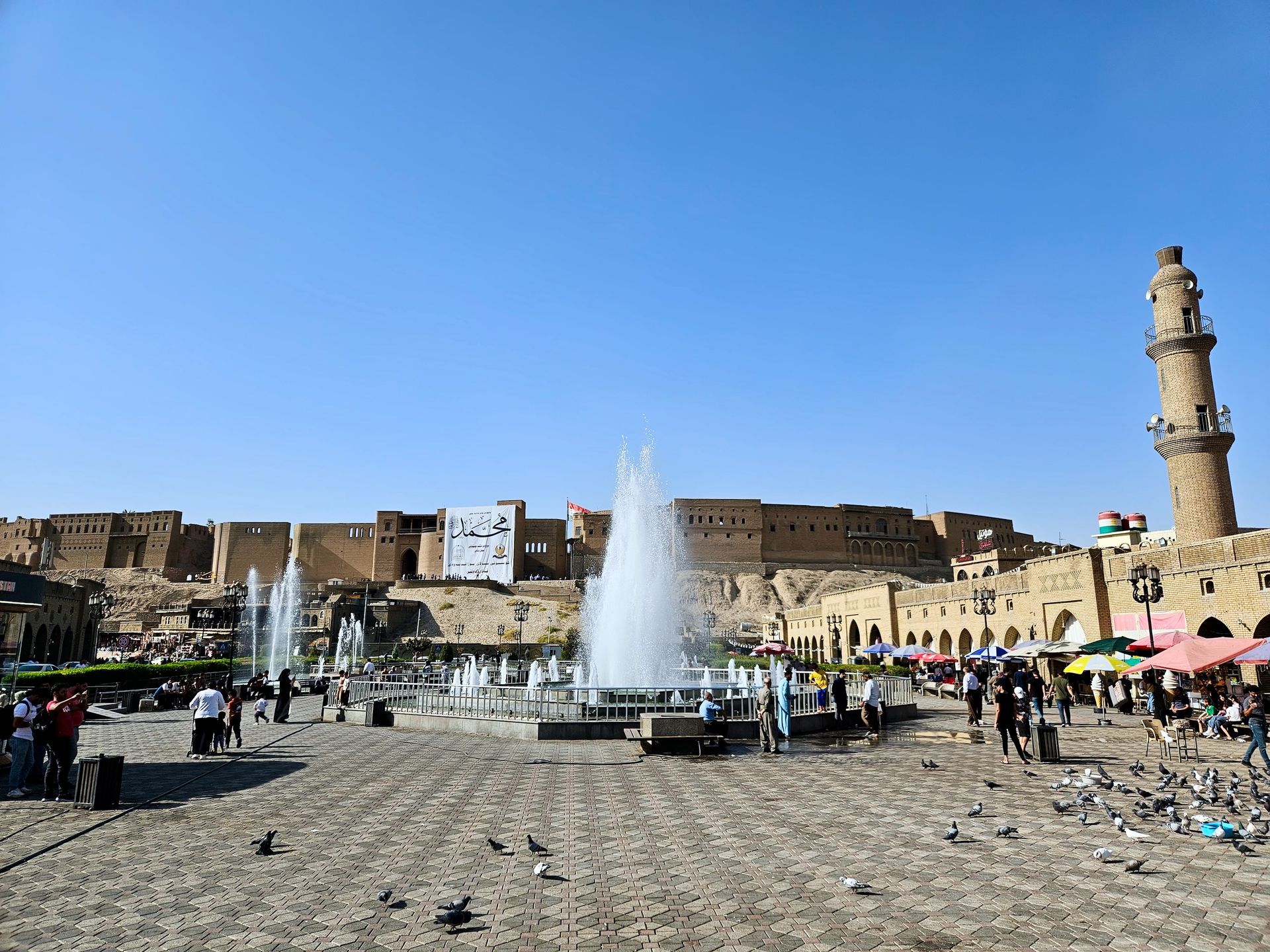
When we visited in September 2025, the citadel itself was closed – so all we could do was walk around it and take photos from the streets below. Even in that “from the outside only” version, it’s absolutely worth coming here: from street level you get a great view of the long, continuous facades forming the citadel’s outer “wall”, and the southern side spills naturally into the busy everyday life of the city. Under normal circumstances, when the citadel is open, you’ll find several small museums inside (including the Kurdish Textile Museum, a traditional hammam, and a few smaller exhibitions).


Qeyserî Bazaar
ar. سوق القلعة القديم – بازاڕی قەیسەری / 📌 Pin on Google Maps – click here.
This is where “living” Erbil really begins. Qeyserî Bazaar is a classic qaysari-type covered market – a maze of narrow corridors just south of the citadel, where one corner smells of spices and tea, the next of fresh meat, and the third is lined with fifty identical metal teapots hanging in a row. The bazaar has been here since at least the 12th century: it was expanded in 1195 by Sultan Muzaffar al-Din Gökböri as an extension of the citadel. Today it’s a dense network of tin-roofed alleys where something happens in every direction – from goldsmiths flashing their displays on both sides, to bakers whose bread scent carries down the entire street.


Clock tower (Tawerî Katjmêr)
ar. تاوەری کاتژمێر / 📌 Pin on Google Maps – click here.
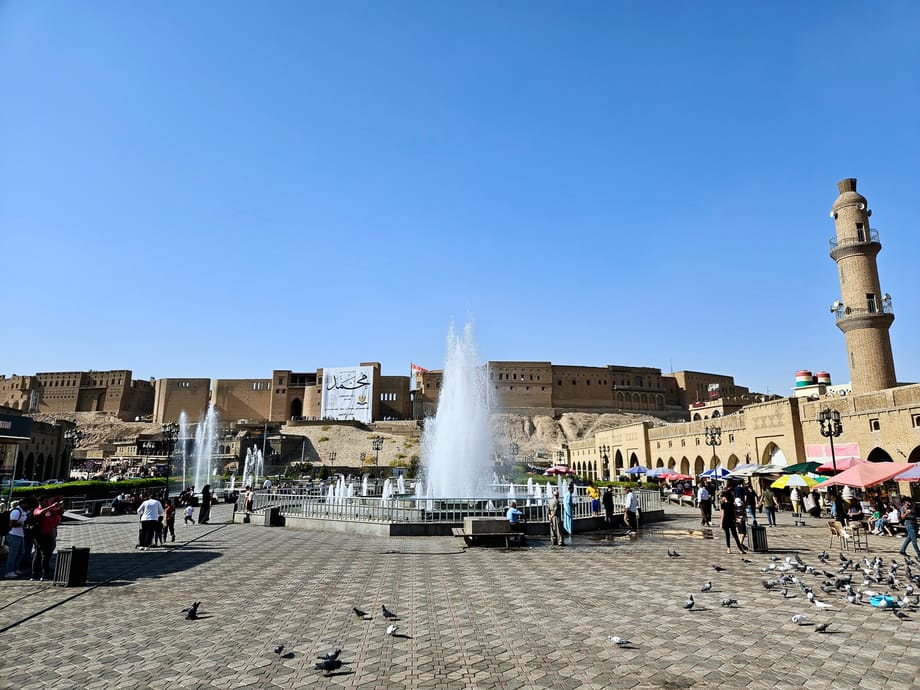
Just a few steps from the bazaar you’ll find the square with the clock tower and fountains – probably the most “postcard-famous” spot in Erbil. It’s a large open plaza with rows of benches, lots of greenery, and several lines of fountains that turn into a pretty photogenic show in the evening when the tower lights up.


Jalil Khayat Mosque
ar. جامع جليل الخياط / 📌 Pin on Google Maps – click here.
Jalil Khayat Mosque sits a bit further from the Citadel, along 60 Meter Street, but it’s definitely worth the walk or a quick taxi ride – it’s the largest mosque in Erbil, built as a tribute to Jalil Khayat and completed in 2007 by his sons. Architecturally, it’s a mix of influences from the Blue Mosque in Istanbul and the Muhammad Ali Mosque in Cairo: a large central dome, several semi-domes, two slender minarets, and a whole lot of Abbasid–Ottoman decorative details that make the interior genuinely impressive.
We ended up arriving on foot and happened to walk straight into a funeral – lots of people, heavy foot traffic, and black mourning banners hung around the area with information about the deceased. Because of the atmosphere and the crowd, we decided to just observe the mosque from the outside rather than try to go in. Those black condolence banners are actually a common sight in Iraq: they publicly announce someone’s passing and often mention the person’s tribe, community, or sometimes a political party or movement they were associated with. So this wasn’t an “exceptional situation” – it’s simply part of the local way of marking a funeral in public space.


Let’s keep going – next stop Baghdad
We left Erbil with a bit of a mindfuck feeling. This was nothing like the Iraq we had imagined. The images we all carry from the news – tents, ruins, rockets overhead – were sitting somewhere in the back of our heads. And suddenly you’re standing in a perfectly normal city: a few residential and office towers, restaurants, traffic jams, people heading to work. Every time we told someone we were going to Iraq, the reaction was the same: “But… why?” After this stop we already knew one thing – this is a country that can flip your expectations 180 degrees.
If it weren’t for the expensive visa for the whole country, we’d probably be back here pretty quickly. And honestly – even that cost starts to fade once you remember how we felt on the ground. The care, the curiosity, that uniquely “pampering” Kurdish hospitality… not once did we feel like someone was trying to scam us or take advantage. The only real “warning moment” came when the hotel manager casually mentioned that older motorcycles without proper security can be an easy target. In our case, with a more modern bike and solid locks, we slept just fine.
Iraq landed very high on our “we’ll definitely come back someday” list. Maybe on a future route through Jordan, maybe once things calm down in Syria — we’ll see. This time, though, it was time to keep going. The thermometer showed 41°C, so we decided it was the perfect moment to hop back on the bike and head towards Baghdad XD. If you’re curious what our stay in the 🇮🇶 Iraqi capital looked like, check out the next post. See you in the Iraqi part two.