

Ten wpis jest również dostępny w języku:
 Polski
Continuing our exploration of Iraq
After Erbil it was time to keep heading south. The plan was simple: ride the bike into Baghdad, see the capital from the inside and get at least a glimpse of what everyday life actually looks like here, instead of relying on news headlines. Obviously, a couple of days isn’t enough to “fact-check” a whole country and everything it’s been through over the years… but it’s a start.
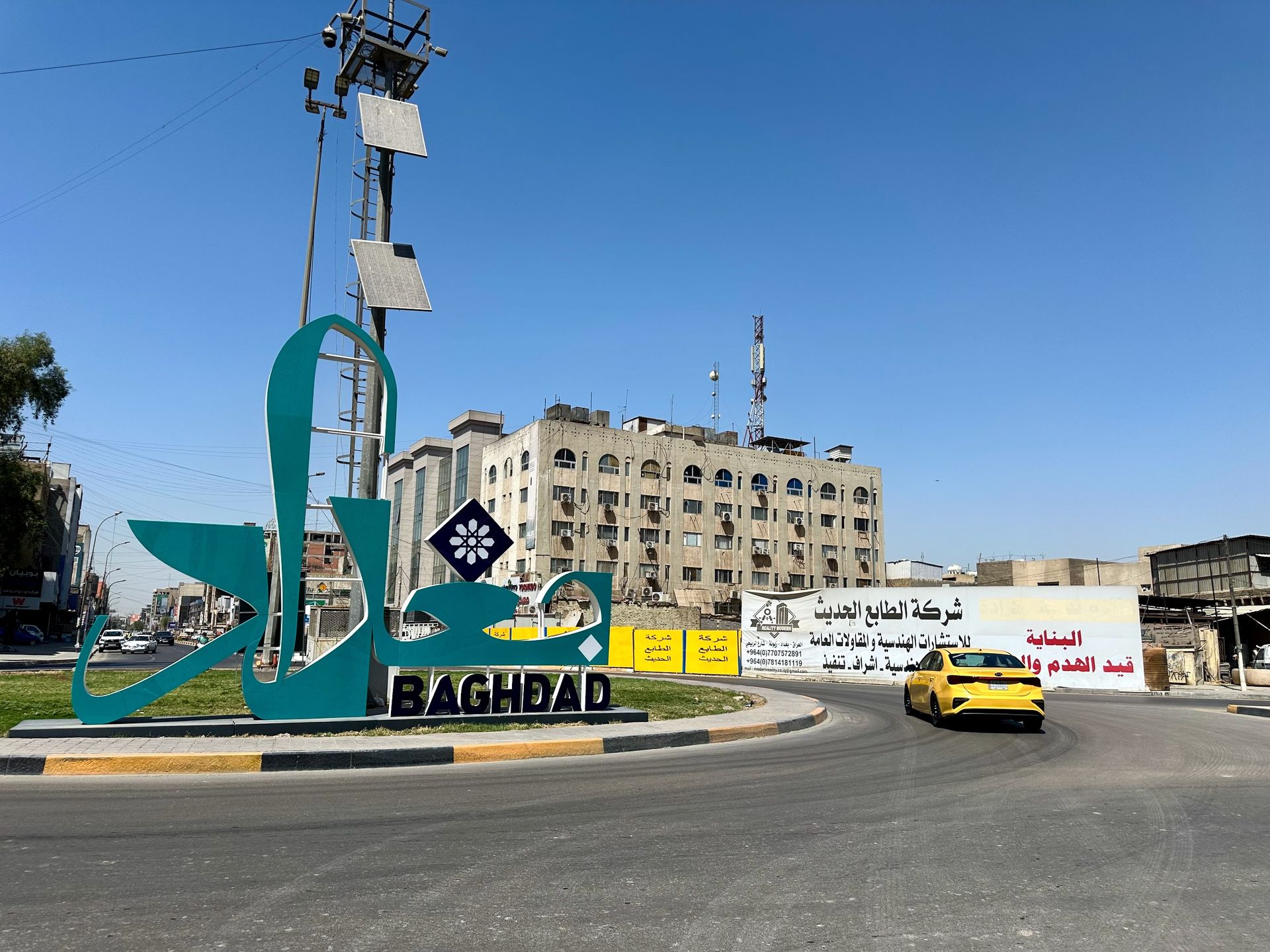
In September the sun in Iraq just doesn’t let go. By the time we rolled into Baghdad we were a bit cooked, sweaty and full of questions. How are we going to feel here? What does the city actually look like? Is it really as “heavy” as people imagine when they hear the word “Baghdad”? And one more thing we were very curious about: how big is the difference between Federal Iraq and Kurdistan once you’re actually on the ground.
Fair warning: there will be a lot of photos 😁 Before we dive in, we really want to say thanks to the Embassy of Iraq in Warsaw for helping us with the paperwork for our bike, to the Al Hamraa Insurance team for treating us like humans, not just a case number, and to everyone who chipped in and helped make this trip happen.
Where is Baghdad located?
Baghdad is the capital of Iraq and the country’s biggest city. It sits more or less in the middle of the country, on a flat plain cut in half by the Tigris River. The Tigris splits the city into two main parts: Karkh on the west bank and Rusafa on the east. Altogether, around 7–8 million people live in the greater Baghdad area, which means roughly one in five Iraqis calls this city home.
Historically, this is one of the most important cities in the region. Founded in the 8th century, Baghdad was the capital of the Abbasid Caliphate and for a long time one of the biggest cities on Earth – a major centre of science, trade and culture during the so-called Islamic Golden Age. Later it was smashed by the Mongols, then passed through different empires (including the Ottomans), until in the 20th century it became the capital of modern Iraq.
In the times we actually remember, the word “Baghdad” usually pops up in the context of war headlines: the Iran–Iraq war, the first and second Gulf Wars, the 2003 invasion, bombings, ISIS. And yes, between 2003 and roughly 2017 the city went through a brutally hard period – fighting in the streets, car bombs, sectarian tensions cranked up to the max. Generally speaking, it’s a disaster… PR has been done perfectly for years.
And here’s the most important sentence for anyone thinking about coming here: there is no war going on in Baghdad in the way most people imagine it. ISIS no longer controls territory, the number of attacks has dropped massively compared to 2013–2016, and in most security reports Baghdad is now described as much calmer than it used to be. It’s still not exactly Swiss countryside vibes, but it’s a very different reality from what many people have stuck in their heads.
Do incidents still happen – bombings, political shootings? Unfortunately, yes.
Life here beats like in any other big city: you can grab a coffee, eat in a nearby restaurant, call a Careem to get across town. You still have to take safety seriously – we’ll get into that in a separate section – but one thing is key: this is no longer a city in the middle of a full-scale war, it’s a capital that’s slowly trying to pull itself together after some brutal years. The problem is, politics doesn’t really make that any easier for Iraq…


How to get to Baghdad?
Before you even start typing “flights to Baghdad” into a search engine, it’s worth taking one step back and checking the latest travel advice from your own Ministry of Foreign Affairs. At the time of writing this, the Polish MFA explicitly advises against all travel to Iraq – including Baghdad province and the whole Kurdistan Region.
So everything we describe below is not a „you should totally come, it’s amazing here” kind of invitation, but a down-to-earth look at how you can technically get here – and how we did it ourselves.
We came by motorcycle from Poland
Baghdad was just one stop on a much longer route: we were riding from Poland to Oman on our BMW R1250GS. Iraq itself was a big question mark for a long time. You know… huge curiosity, but also a lot of “are we really doing this?”.
We started planning the trip a year earlier because of all the paperwork for the bike (it’s leased, so you don’t just grab the registration and go – you need a notarised permission to take it out of the EU), and already back then we began keeping an eye on what was happening in the country. Then summer 2025 hit and suddenly the news was full of rockets flying between Iran and Israel and airspace in the region being shut down every other week. Luckily things calmed down before our departure, but we did seriously consider a Plan B: staying in Türkiye or flying the bike over Iraq and Kuwait altogether.
We weren’t really scared that “something would hit Baghdad directly”. It was more about the feeling that the Middle East is one big ticking time bomb, and with that kind of escalation things can spill over really quickly. And when you’re riding a motorcycle that technically isn’t even yours but belongs to a leasing company, there’s this one thought sitting quietly in the back of your mind the whole time: it would be nice to actually bring this thing back home in one piece.
In the end we decided to go for it, but do it with our eyes open. We entered Iraq from Türkiye through the Ibrahim Khalil / Habur border crossing – the same one we’d used earlier to get into Iraqi Kurdistan. From there we stuck to the main road towards Erbil and then kept riding south, in the direction of Baghdad. Along the way there were several checkpoints on the main route, with standard document checks and a bit of curiosity about who we were and what we were doing there.

Flying by plane
If you are not planning to bring your own equipment, there are basically two main options: plane and ground transportation.
Baghdad is served by one main airport, Baghdad International Airport (BGW), located to the west of the city. It’s the biggest airport in the country, operating as a joint civilian–military hub and used by airlines like Iraqi Airways, FlyBaghdad and UR Airlines.
By late 2025 there are around 18–20 airlines flying here, serving roughly 30–33 destinations: mostly across the Middle East, plus regional links to places like Türkiye, Iran and India. In the schedules you’ll see names like Turkish Airlines, Pegasus, Qatar Airways, Emirates, flydubai, EgyptAir and of course the local Iraqi carriers.
When it comes to Europe, there simply were no direct flights from the EU to Baghdad – airlines like Wizz Air chose to fly to Erbil instead.
That’s slowly starting to change. At the end of 2025 Aegean Airlines announced the first direct route from the EU to Baghdad, flying from Athens with the inaugural flight planned for 16 December 2025. The Greek foreign minister even said it was a sign of growing confidence in Iraq’s stability. For now though, we’re talking about one airline and one route, not a full network like you’d see for classic holiday destinations.
Once you land, you’ll need to rely on taxis or private transfers – there’s no classic airport-to-city public transport here, no airport train gliding into the centre every 15 minutes.
Coaches operated by local carriers
The second option is overland. If you don’t have your own car or bike but prefer roads over planes, there are international buses to Baghdad, mainly from Türkiye.
Outside of Türkiye there are also buses from other neighbouring countries like Jordan and Iran, but that’s already the world of local agencies, handwritten timetables in Arabic and word-of-mouth info. If you’re seriously considering this option, assume the internet won’t show you the full picture – the best bet is asking around at bus stations and small travel offices, and constantly double-checking both safety conditions and visa rules.
Visas and documents
We’ve already broken down the whole Iraq visa topic in a separate, detailed guide – that’s where you’ll find all the juicy stuff: screenshots, links and step-by-step instructions on what to click. Here we’ll just give you the short “must know” so it’s clear why Baghdad means a different level of paperwork than visiting only Kurdistan.
As of the date of writing this text, it looks like this:
- Iraq has a new e-visa system for foreigners.
- From March 1, 2025, the classic “visa on arrival” will disappear for us – you will need to have a visa arranged in advance through the official e-visa portal.
- What you actually need to make this trip happen is: a passport valid for at least 6 months from your planned departure from Iraq, an approved federal e-visa printed out from the system (not just a PDF on your phone), and, just in case, a hotel reservation plus a rough travel plan, because border officers can ask to see both when you enter.
Iraq is politically divided into:
- so-called Federal Iraq – managed from Baghdad, covers Baghdad, Basra, Mosul (Nineveh province), and the south of the country, among others,
- The Kurdistan Region – an autonomous entity in the north, with its own government in Erbil (comprising four provinces: Erbil, Duhok, Sulaymaniyah, and Halabja).
In addition, there are two parallel visa systems:
- Federal visa (all of Iraq): this is the one you apply for through the Iraqi government e-visa system. It’s valid for the entire country, so you can legally stay both in Baghdad and in Kurdistan. If you’re planning to combine Erbil with Mosul, Baghdad or the south of Iraq, this is the option we’d strongly recommend.
- Kurdish visa (Kurdistan Region only): the Kurdistan Region has its own visa portal and its own rules. A visa issued by the KRG is only valid within the Kurdistan Region.
Road conditions and vehicle formalities
The overall picture of roads in Iraq (asphalt quality, driving style, what to expect between cities) is something we’ve already covered in a separate guide – and everything we wrote there fully applies to Baghdad and the federal part of the country as well. Here we’ll focus on what’s specific to the capital and its surroundings.
Traffic jams, renovations, and the struggle to leave the city
Baghdad is home to over 7 million people and has been one of the most traffic-clogged cities in the region for years. Almost everything runs on roads here – no metro, no real urban rail system to take the pressure off.
On top of that you’ve got roadworks and big projects like new ring roads, flyovers and rebuilt junctions that are supposed to help in the future, but right now can completely choke the outskirts of the city.
Leaving Baghdad by car or on a bike can be genuinely exhausting. For us it was one of the most draining parts of the trip – lots of standing in the heat, jerky stop-and-go traffic, drivers squeezing through every possible gap and constant honking. Give yourself some buffer time and don’t plan a “romantic sunset 300 km away” for the same day if you first have to fight your way out of the city.


Speed cameras and traffic cameras
For many years Iraq (outside Kurdistan) was basically a wild west when it came to enforcing speed limits. That’s now changing, and Baghdad is the testing ground. In July 2025 the city switched on its first smart cameras and speed radars, initially on a few main roads and intersections – and they recorded around 10,000 violations in the first 24 hours. The plan is to gradually cover the whole city with cameras and then roll the system out to the rest of the country.
SIM card
In our earlier Erbil post we mentioned that we sorted internet for all of Iraq in one go – we bought a physical Zain SIM in a store in Erbil. Our 10 GB package
There are three main mobile operators operating in the area:
- Zain Iraq: the largest player, based in Baghdad. According to industry data, it covers approximately 97 percent of Iraq’s population.
- Asiacell,
- Korek Telecom: particularly strong presence in the Kurdistan Region.
In theory all three offer nationwide 4G, but before buying a SIM we kept reading the same thing: in Kurdish cities Korek/Asiacell tend to have better coverage and speeds, while further south and around Baghdad Zain generally performs really well.
SIM cards in Iraq are registered with every operator. When purchasing one, you show your passport and the seller enters your details into the system.
Before entering the country we also used a cheap eSIM “just to get there”, purely for maps. Technically, eSIMs from different providers work here – local operators are slowly rolling them out mainly for postpaid customers, and for tourists there’s a whole swarm of apps like Airalo and the rest. There’s just one catch, at least in our opinion: the prices these international providers charge are completely out of touch with reality compared to how little mobile data actually costs here on the ground.
Our hotel in Baghdad
We stayed at Noor Land Hotel. We paid around 100 USD per night for a room with breakfast included. The hotel is located near Karada, on one of the main roads – the area feels pretty “normal city life”: shops, eateries, regular traffic, not some concrete bunker vibe. Inside, the standard is easily at a solid four-star level: clean, organised staff, a lobby that looks like a regular city hotel, not something pulled straight out of a war zone.
There’s security at the entrance, but in Baghdad that’s absolutely normal – part of the scenery, not a reason to freak out. We had no problem leaving the bike parked right by the hotel.
The only real downside was the generator right under our window. Power cuts are just part of daily life in Baghdad – Iraq has been struggling for years to keep the grid stable, so most hotels, shops, schools and regular apartment blocks rely on their own private generators to keep the lights (and AC) on.
The result is simple: when the public power cuts out, the generator kicks in automatically. During the day it’s just background noise. At night, with the window open, you also get exhaust fumes drifting straight into the room. In the end we slept with the window closed and the AC set to a gentle level – otherwise there was no chance of getting any decent rest.
We paid for the hotel in cash, in US dollars. Technically you could pay by card, but the “there’s a surcharge” conversation started immediately – and that’s something you just have to factor in when travelling in Iraq. Nobody here plays by EU-style rules where a hotel can’t pass the card processing fee onto the customer.
As for the hotel scene in Baghdad in general – there isn’t much of it. Booking or Agoda will show you maybe a few dozen places in the whole city, and a handful of them are priced pretty brutally for local standards, with several hundred dollars per night in top hotels like Babylon Rotana and similar.


If you are looking for accommodation in Baghdad, there are three areas that come up most often:
- Karrada: one of the more organized districts, with many shops, restaurants, and several hotels of varying standards.
- Jadriya: the more expensive, “greener” part of the city on the Tigris, with several larger hotels in the Green Zone area.
- near the center / Firdos Square and main streets: slightly older buildings, but closer to the classic city atmosphere.
Eating in Baghdad
We didn’t do any kind of foodie pilgrimage in Baghdad, hopping from place to place. The truth is much simpler: most of our meals came from Talabat and it was mainly shawarma on repeat. In that kind of heat, after a whole day of dealing with the city, the idea of “going out for dinner somewhere nice” just stopped being appealing. Talabat in Iraq works just like Glovo or Uber Eats, just in the local flavour. You drop in your address, pick your shawarma, kebab, pizza or whatever you’re craving, pay, and wait for someone to show up with it in the lobby.
When it comes to cafés, we can happily recommend Zaza Café. Don’t let the location scare you off in the evening – the first time we got there and saw the vibe of Al Rasheed Street after dark, we were honestly a bit freaked out 🤣


What do people eat in Baghdad?
Iraqi cuisine stands on a few solid pillars: rice, meat (mostly lamb and chicken), vegetables and bread. The rice is especially iconic – often the timman anbar variety – cooked so it’s fluffy, with a crispy “crust” at the bottom of the pot (hikakeh), which is treated like a little treasure on the plate.
In addition, there are:
- dolma – vegetables stuffed with rice and meat, slowly cooked down in a rich sauce,
- kubba/kubbe – little balls or “half-moons” made from minced meat mixed with bulgur or rice, often fried or cooked in broth,
- stews like fasolia (white beans with meat) and various soups based on lentils, wheat or chicken,
- and classics like Iraqi-style biryani and maqluba, the famous “upside-down” pot of rice, meat and vegetables.
Baghdad also has its absolute number one star: masgouf. It’s the famous Iraqi fire-grilled fish – usually carp from the Tigris or Euphrates, scored and butterflied, marinated and then slowly cooked over a wood fire. Historically it was Baghdad (and central Iraq in general) that made masgouf famous as a kind of “national dish”.


Exchanging cash or ATM?
We crossed into Iraq with a pretty modest cash “buffer” – 600 dollars in our pockets. Part of that disappeared already in Kurdistan, because our hotel there turned out to be cash-only (which I conveniently remembered right when we were standing at reception…). In Baghdad the story repeated itself: the hotel also wanted dollars in hand, so the obvious question was: okay, where can we actually pull money from a card here, just in case?
If you’ve read our Erbil post, you already know that Iraqi ATMs and European cards can be… tricky. In theory a machine can have big Visa/Mastercard stickers on it, but that doesn’t mean your Polish card will actually work. For us, most of the “regular” ATMs attached to local banks on the street just kept declining the transaction.
We can definitely recommend Bank of Baghdad – their ATMs in shopping malls were the only ones that worked with our cards without throwing a tantrum.
When it comes to exchanging dollars, we definitely recommend old-school exchange offices. Out on the streets Iraq runs mostly on cash.
- in shopping malls you can often pay by card (shops, some restaurants),
- for laundry, small eateries, taxis (when you pay the driver directly) and random small services, it’s almost always cash only,
- in hotels they’ll very often accept US dollars, and if you want to pay by card, you’ll almost always hear about an “extra fee”.
With the rates we had on the ground, exchanging 100 USD in a money changer gave us around 143,250 dinars. For comparison, pulling the equivalent of 100 USD from an ATM with our Revolut card, using the app’s FX rate plus a 5,000 IQD ATM fee, left us with roughly 130,000 IQD. So, very roughly, that’s about 10% worse than just swapping dollars for dinars in a regular exchange office.


Safety
Let’s start with the most important part: all the official sources – the Polish MFA, the Brits, Canadians, Americans – still formally advise against travelling to Iraq, especially to Baghdad and the central/southern parts of the country. Their warnings repeat the same keywords: risk of terrorist attacks, kidnappings, political tension, rocket fire and, in general, a “highly unpredictable security situation”.
On the other hand, more and more travellers (including us) say they actually felt surprisingly “normal” on the ground. Most stories sound similar: loads of checkpoints, plenty of guns in public spaces, but everyday life just keeps going and, if you use common sense, you can move around, visit places like Babylon or Najaf and do some sightseeing without feeling like you’re in an active warzone 24/7.
The Green Zone – the heart of political Baghdad
When talking about safety, you just can’t ignore the Green Zone. It’s that famous, heavily fortified chunk of Baghdad on the west bank of the Tigris (in Karkh district), where you’ll find government buildings, parliament, several ministries, embassies and some of Saddam’s former palaces. For years it was basically a separate “fortress inside the city” with high walls, barbed wire and a strict no-entry rule for regular Iraqis.
Over the last few years the zone has been gradually opened up to regular traffic – in 2018 and again in 2023 the authorities started removing some barriers and reopening key roads to ease congestion. Private cars can now drive through certain parts of the Green Zone, but it’s still an area with a very heavy military and security presence, extra checks, no-stopping zones and a clear message: you drive through it, you don’t “wander around and explore”.
Photography and “what’s in the background?”
In all of Iraq – and especially in Baghdad – there’s one golden rule: you do not take photos of the army, police, checkpoints, ministry buildings, bases, stations or anything that even looks remotely military unless you have clear permission.
This is not an exaggeration. Official travel advisories are very clear that taking photos of military infrastructure can get you detained, questioned and into serious trouble.
The tricky part is that in Baghdad a lot of military and government buildings are kind of “woven into” the normal city – you can have a pretty mosque in front of you, a security office right next to it and a police post just around the corner. In practice it means: before you hit the shutter, take a second to check what’s in the background.

Checkpoints
Checkpoints are a permanent part of the Iraqi landscape. They’re everywhere: on main roads, at city entrances, near important buildings.
How it looks from a traveler’s perspective:
- When entering Baghdad, you pass through several layers of checkpoints – the outer ones form a kind of “security ring” around the city.
- In the city itself, checkpoints are located at major intersections, bridges, and strategic points.
- when you drive from Baghdad to Babylon you’ll also hit several controls, including one bigger “gate” into the governorate; on a motorcycle we drew way more attention than a standard bus.
There’s one more thing that pops up a lot in official warnings: there have been cases of fake checkpoints used for robberies or kidnappings. This is mostly an issue on remote routes and during night drives, but it’s still something to keep in mind – that’s why most governments straight up advise against travelling around the country after dark.

How to behave around the authorities?
Iraq’s security system is multi-layered and a bit complicated. Official reports list several components under the umbrella of the Iraqi Security Forces, including the Iraqi Army (regular military), the Federal Police (something like a heavily armed national police), various rapid response units and local police, border guards, plus the Counter Terrorism Service.
On top of that you have the Popular Mobilization Forces (Hashd al-Shaabi) – an umbrella for various militias that grew out of the war against ISIS and were later partially folded into the state system, but still keep a lot of autonomy, political influence and control over some checkpoints in certain regions.
The best approach here is to stay calm, act normal, and not overthink things—and then… very often, things turn out quite nicely.
For us almost every checkpoint looked the same: first serious faces, a quick scan, the classic “where are you from?”. The moment they realised we were travellers from Poland riding a motorcycle to Oman, the vibe flipped 180 degrees. The officers were SUPER curious – asking about our route, the bike, how many horsepower it has, where we’re from exactly and whether we like it here.
And here’s the best part: very often it ended with gifts. We were getting water, soft drinks, sometimes sweets – from soldiers, from police, from people just hanging around at the checkpoints. That image of Iraq doesn’t match what you usually see on TV at all, but that’s exactly how it was for us.
Climate and weather conditions
Baghdad comes with the full desert-package climate. It gets around 150 mm of rain a year and almost all of that falls between November and March. From June to September rain basically doesn’t exist.
In September, when we were here, the heat was just insane. Average daytime temps sit around 40–43°C, with nights at about 25–27°C. In practice it means it’s already hot by 10 AM, and in the afternoon the asphalt basically turns into a frying pan. For a motorcyclist in full protective gear, this is the kind of weather where every little stop in the shade feels like a small holiday.
In winter Baghdad is much gentler. In January and February daytime temperatures usually sit around 15–20°C, nights can drop to just a few degrees, but it’s still nothing like “Polish winter freeze”. If it does rain, it’s mostly in this period, in short but intense bursts.
What to see in Baghdad and the surrounding area
We only had four days in Baghdad, so we’re not going to pretend we “ticked off” the whole city and its surroundings. We managed to see a few places that give you some feel for the capital, but definitely not everything Baghdad has to offer. 👉 That’s why we put together a separate, more step-by-step article 👈 where we break down exactly what we visited, how to get there, how to behave and what you can roughly expect. Feel free to check it out 😉.
There are also places we simply didn’t reach – sometimes because we didn’t have a local to help, sometimes because something just isn’t really accessible for tourists yet, even if it looks gorgeous on Instagram. We’re not salty about it, that’s just the stage Iraq is at right now. Maybe you, with a different alignment of stars (and checkpoints), will manage to see more than we did 😄. Either way, if you want a concrete list of spots in Baghdad and day trips like Babylon, check out our separate guide – that’s where we break it all down calmly and in detail.


Our summary
For us, Iraq is first and foremost about people. And that is something we will repeat everywhere and always.
Before we crossed the border, we had all our friends’ comments playing in our heads: “Are you insane?”, “Why would you even go there?”, “Isn’t there a war?”. After a few days in Baghdad and then further south, all those mental pictures fell apart completely. The reality just didn’t match the fear.
In Iraq, we received so much good that at times we didn’t know what to do with it.
Litres of water – endless. At petrol stations, at checkpoints, just from random people who saw two overheated humans on a motorbike. At one gas station someone handed us an entire bowl of figs xDDD and of course that was exactly when we were in “we really need to push on to Kuwait” mode, trying to figure out how to deal with it without offending anyone.
There was a taxi situation where we only had a big banknote and no real way to get change – at some point the driver just announced that he’d “pay for the ride” for us. There were invitations for food and drinks, people genuinely excited that someone from Europe had shown up here on a motorcycle. Checkpoint officers who went from “serious face mode” to acting like buddies, stuffing our hands with water and sweets for the road. We could list a lot more moments like that.
We also spent half a day with the team from Al Hamraa Insurance – the company that insured our motorcycle for the whole of Iraq. It turned into a really interesting conversation: a bit about paperwork, a bit about what everyday life looks like here, and a bit about how things work in Europe. It was cool to see Iraq not only from the street level, but also through people who run a business here and look at the country from a “we live here, we work here, we want this place to move forward” perspective.


Are there any downsides? Sure.
The checkpoints can really wear you down – there are so many of them, and you have to get used to the fact that every now and then someone stops you, asks questions, checks your documents. On top of that there’s the mess along the roads: no real waste management, plastic scattered everywhere along the main routes, dead animals lying by the roadside. Sometimes it’s honestly hard to look at. Is it a question of education, the system, money? Probably a bit of all three.
Despite all that, at no point did we feel in real danger. Not in Baghdad, not later on the way towards Kuwait. It just doesn’t match the reactions we were getting in Poland when we said “we’re going to Iraq”. When we tell friends how it actually looked in reality, most of them have the same expression on their face: a mix of surprise and “wait, seriously?”.
Tourism here is still in its absolute infancy. Some people are really eager to be guides, to help, to show you around, but this is nowhere near a “ready-made product” like Jordan or Türkiye. And maybe that’s actually a good thing – we honestly hope mass tourism never hits Iraq in the same way it has steamrolled so many other places.
On 14 September, when we set off towards Kuwait, the heat was absolutely brutal. We were tired, sweaty, but our heads were full of images of Iraq that looked completely different from the ones we’d had before this trip.
We’re left with mixed feelings – being genuinely blown away by the people, but also seeing how tough everyday life is, how expensive the visas are, and how big the gap is between the “more organised” Kurdistan Region and the federal part of the country. But one thing is clear: if one day the budget and visa situation look a bit friendlier, we’d come back to Iraq. Just with a very different mindset than we had the first time.