

Ten wpis jest również dostępny w języku:
 Polski
Hey! 
Back when we were planning our motorcycle trip from Poland to Oman, we already knew we wanted to make a special stop in Al Ula. This place had been on our radar for a long time, mainly because of how it looks in photos and videos. Jadzia was the most excited about it, but I was also curious whether it really feels that impressive in real life, or if it’s just a matter of good camera angles and smart editing on social media.
Up until now, Saudi Arabia felt more like a big-city destination to us, since we had previously been to Riyadh and Dammam. This time we arrived on our own wheels, after long hours and serious mileage on the road, so the vibe was different right from the start — less “flight–hotel–city” and more about the road, open space, and slowly taking in the place.
This is our practical take on the place from the perspective of traveling on your own wheels. We’ll cover logistics, accommodation, food, internet, and a few things that are good to know before you arrive. And yes — there will be plenty of photos again, because with a place like this, there’s really no other way xD
Where is Al Ula located?
If you’re looking for this place on the map, aim for the north-western part of Saudi Arabia, in the Al Madinah province (the one centered around Medina). Al Ula sits in a valley historically known as Wadi Al-Qura, meaning “the Valley of Villages” — which explains why, right in the middle of a desert landscape, everything suddenly turns green, with an oasis, fields, and palm groves stretching along the valley.
And here’s an important distinction, because “Al Ula” is often used in two different ways: to describe the town itself, and to refer to the much larger administrative area (the region).
In numbers, it looks like this: the town of Al Ula itself had around 40,760 residents according to the 2022 census. The wider Al Ula region had about 60,103 residents in 2022 and covers an area of roughly 19,840 km².
RCU (the Royal Commission for Al Ula, the institution responsible for managing and developing the region) often refers to Al Ula on a broader “landscape” scale of about 22,561 km² — the difference comes down to how the boundaries are defined and what exactly is included under the name “Al Ula” in promotional materials.
In terms of getting there, it’s really in the middle of nowhere 😂 Just to give you some scale: the regional capital is located roughly 325 km north of Medina. On top of that, the attractions are spread out over a large area — this isn’t a place with one central square and a few nearby streets.
This valley has long been a very real “water stop” along ancient routes. Around Dadan, one of the region’s key archaeological sites, archaeologists and the RCU point out that it once functioned as an important hub for trade and agriculture along the so-called incense route.
Another key point that helps put the location into perspective: about 20 km north of the town lies Hegra (Mada’in Salih), the first UNESCO World Heritage Site in Saudi Arabia. UNESCO describes it as the largest preserved Nabataean complex south of Petra, featuring monumental tombs dating back to the 1st century BCE and the 1st century CE.


How to get to Al-Ula?
Getting to Al Ula is already half the adventure. As mentioned earlier, the region sits a bit off the main routes, but the road infrastructure is really well done – smooth asphalt and fuel stations at reasonable intervals. From major Saudi cities, the distances are quite substantial: from Riyadh it’s around 1,000 km, roughly 11–12 hours by car depending on breaks; from Jeddah about 700 km, around 7–8 hours of driving. From Medina it’s much closer — roughly 330 km and about a 5-hour drive.
In our case, Al Ula was one of the key points on our entire route from Poland to Oman, so this wasn’t a “we’ll stop by if we pass nearby” kind of place — we turned this way on purpose. We approached from the Buraidah side, continued through Ha’il, and then followed Highway 70 all the way to Al Ula. The whole stretch was genuinely pleasant to ride, even if it did get a bit monotonous at times, with the horizon staying exactly the same for many long kilometers.
Motocyklem albo samochodem
Alright, a bit about us. We arrived here on two wheels as part of
Getting there with your own vehicle looks similar no matter which direction you come from. The farther you are from big cities, the less traffic you’ll see, but the more long, straight stretches of road you get. Car drivers have a clear advantage here, mainly thanks to air conditioning, especially in the hotter months. We arrived in September, and on a motorcycle it was already very intense… very, very warm XD
A car, whether your own or a rental, gives you the most freedom in this region. Distances between attractions are often measured in tens of kilometers, and many places sit in valleys or side roads where public transport simply doesn’t reach. When planning a road trip from Riyadh or the coast, it’s worth assuming longer daily drives from the start, but at least fuel in Saudi Arabia is still among the cheapest in the region.
If you’re thinking about picking up a car in Riyadh and doing a road trip around the country, it’s worth checking our separate article about renting a car in Saudi Arabia. We break down what to look out for in the rental agreement and what might surprise you when picking up the car.
Other transportation options
Not everyone needs to get here on their own wheels. Al Ula has its own airport, Prince Abdul Majeed bin Abdulaziz Airport (ULH). It’s small but modern, and it handles both domestic flights and a few international connections. According to current schedules, five airlines operate here, including Saudia, Flynas, flydubai, Qatar Airways, and Royal Jordanian, with routes to cities like Riyadh, Jeddah, Dammam, Dubai, Doha, and Amman.
You can also rent a car either directly at the airport or in town. There are local rental companies recommended on the region’s official tourism website, as well as international chains with desks at Prince Abdul Majeed bin Abdulaziz Airport.
There’s also a more budget-friendly option: long-distance buses. SAPTCO operates routes between major cities and Al Ula, mainly connections like Riyadh–Al Ula or Jeddah–Al Ula, which can take around 12 to 16 hours depending on the route. It’s definitely the cheapest way to get there, but you need to be ready for a long day (or night) on the road and limited flexibility once you arrive. Without a rental car, getting around and visiting most attractions can still be a challenge.
Visas and documents
If you arrive in Saudi Arabia through one of the main international airports, Al Ula doesn’t come with any extra or special requirements. You just need to meet the standard entry rules for the country. The tourist eVisa allows you to travel freely around Saudi Arabia, with the exception of areas restricted to Muslims only, such as Mecca and parts of Medina.
We’ve covered this in detail in a separate article about visas for Saudi Arabia. Here, it’s just the short “long story short” version.
What is required in practice (tourist from Poland/EU):
- a passport valid for at least 6 months at the time of entry into Saudi Arabia,
- tourist visa: eVisa or Visa on arrival (Poland and most EU countries are on the list of eligible countries).
Traveling with a child when there is only one parent
This is where things get a bit less obvious. A tourist visa for a child is handled together with the adult, but during border control or airline check-in, the issue of consent from the second parent often comes up.
For example, Saudi airlines clearly mention in their rules for traveling with children that a written consent from the second parent may be required. This usually applies when the child travels with only one parent or with someone other than their parents.
When entering Saudi Arabia, it’s a good idea for minors traveling without both parents to carry the following documents:
- a notarized consent letter signed by the second parent (ideally in Arabic, but in this case English should also be sufficient),
- a copy of the second parent’s passport,
- child’s birth certificate confirming the relationship.
Traffic conditions
We’ve already covered driving in Saudi Arabia in a separate article. That one includes speed limits, local driving habits, checks, fines, and what to expect on long desert stretches. Here, we’re adding only what’s useful specifically for getting around Al Ula.
The roads leading into the region are in really good condition. Coming from the Buraidah and Ha’il side, most of the drive runs through desert stretches with one lane in each direction and smooth asphalt. Visually it can get a bit boring, but technically the ride is comfortable. It was easy to keep a steady pace, usually somewhere between 100 and 120 km/h.
The closer you get to Al Ula, the more obvious it becomes that the region is being developed with tourism in mind. Access roads are well signposted, roundabouts and junctions near the town are clearly organized, and the city streets themselves are in very good condition. You’ll still come across some signs only in Arabic, but most road signs are already bilingual, in both Arabic and English.
However, there are a few things worth focusing on:
- On the roads leading out of town, camels can appear near the roadway, and at night this becomes no joke. They are tall, dark, and hard to spot. Warning signs usually show up well in advance, so if you see a “camel warning” sign, it’s best to slow down and stay alert.
- Speed cameras are placed near town entrances and along longer straight sections of road. They come as grey boxes that don’t stand out much. It’s best to stick to the local speed limits, as Saudi Arabia makes very consistent use of automatic fines.
- Near the Old Town, parking is organized so that you leave your car at either the northern or southern parking area and continue by shuttle bus. Parking along the historic center itself is not allowed.


SIM card and Internet
This is where the more interesting part of the story begins, rather than “we bought the card and it worked”. 😅
We entered Saudi Arabia already using an eSIM bought from an online provider. The reason was simple. We were crossing from Kuwait to Buraidah very early in the morning, tired, in a new country, at a land border. Looking for a SIM card stand at 6 a.m. sounded more like a recipe for stress than for a smooth trip.
At first, the network connected us to Zain KSA. And that felt like a small step back in time. Coverage along the route was similar to what Poland felt like years ago. The phone showed a signal, but mobile internet was more about “looking for bars” than anything close to proper LTE.
Only after the data package on that eSIM expired did we switch to another virtual provider that used the Mobily network. That’s when things started to feel more normal. On sections where Zain barely managed 2G or 3G, Mobily jumped to much more usable LTE or even 5G, and the difference was easy to notice.
Three networks dominate the mobile market in Saudi Arabia:
- STC is the largest operator in the country, with the biggest market share and the widest coverage, including areas outside major cities.
- Mobily is the second-largest player, often praised for a good balance between price and quality, reasonable data packages, and solid coverage in cities.
- Zain KSA is the third operator. It invests heavily in infrastructure and promotes wide population coverage, but this doesn’t always translate into a comfortable experience in more desert and remote areas.
In Al Ula itself, things weren’t great with either network. From our perspective, the region is still catching up to tourist expectations when it comes to internet quality. You might see 4G or 5G on your phone, but somewhere along the way a bottleneck appears. The signal is there, but the internet feels slow and unstable
It’s not like everything is standing still, though. RCU and STC have announced a partnership focused on infrastructure in the Al Ula region, with STC working on expanding and strengthening the area’s digital backbone. It looks good in official announcements and does seem to be happening, but at the stage we visited, the end result was still far from “working comfortably on Teams all day.”
Our accommodations in Al-Ula
When it comes to accommodation, you get the full range here. From “cheap, as long as there’s a place to sleep” to luxury so extreme your wallet keeps crying for a week afterward. In town, there are plenty of apartments and private places to stay. On Airbnb, prices usually start around 30–40 EUR per night, depending on the standard and location. At the other end of the scale, there are places where the price per night easily jumps into the hundreds of euros and can reach around 350–600 USD or more for a single villa in the main resort.
We went for a mix. First, three nights in an apartment in town, followed by one splurge night of “desert luxury” at Caravan by Habitas.
Living in the city
We started with a regular apartment right in town, near one of the mosques. No fireworks, no “wow” factor. Just a large place meant to do its job: sleep, do some laundry, and recover after the ride.
In practice, it looked like this:
- a bed from the category “it’s possible, but we’d think twice about it next time”,
- there is a washing machine, but there is no space left to hang clothes. Creativity level: we dry clothes wherever we can.
- kitchen present, but without cooking equipment, so more of a decoration,
- the cherry on top was the lack of Wi-Fi. That one was on me, I didn’t read the listing carefully enough. Evening YouTube sessions ended up eating a lot of mobile data, which was already working whenever it felt like it.
On top of that came the motorcycle issue. We didn’t have any covered parking, so it was all about improvisation. Covering it with a towel, parking in the shade, whatever worked.
But… it was cheap. Three nights came out to around 500 PLN, paid in cash. Was it great? It was cheap. Was it comfortable? It was cheap. And that’s basically the main argument in favor of this place.
Caravan by Habitas – pustynny kamper za milion wrażeń
Then we moved on to a completely different level. Jadzia had been dreaming for a long time about sleeping in a camper in the middle of the desert, so my room for negotiation was pretty much nonexistent. Technically, I could have backed out, but honestly… why would I 😅
Caravan by Habitas is not a campsite in the “converted Fiat Ducato” sense. This is glamping in the full meaning of the word. Shiny Airstreams are set in the Ashar Valley, between rock formations, each with a private terrace and views that make you just sit there and stare. Officially, there are 22 trailers, all with air conditioning, a private bathroom, a small living area, a kitchenette, and a private deck.
For us, it was the first night ever spent in a camper like this. Jadzia wasn’t a big fan of how the metal structure moves and how everything sounds different than in a normal room, but the overall idea worked really well. Stepping out onto the terrace in the evening, stars above, silence all around. That part was spot on. The only downside was that it was just one night, because this is the kind of place you’d happily stay at a bit longer.
The night in the camper, including breakfast, cost us around 900 PLN. And that was outside the main season. Looking at the official price ranges, rates can go much higher during busier periods. The main Habitas AlUla resort in Ashar Valley can cost several hundred euros per night, offering 96 luxury villas, an infinity pool, a spa, and the full “desert luxury” experience.
The resort itself is a bit far from the city, so the food situation is as follows:
- Breakfast on site was tasty, but the waiting time felt more like “slow life” than quick service.
- For dinner, there are food trucks on site where you can grab something to eat, but the prices are very much aimed at a premium tourist crowd.
At one point, Jadzia was ready to tear my head off because of my constant comments about prices, but that’s just how it is. In these luxury spots, Al Ula plays it straight. Your wallet is not supposed to complain.
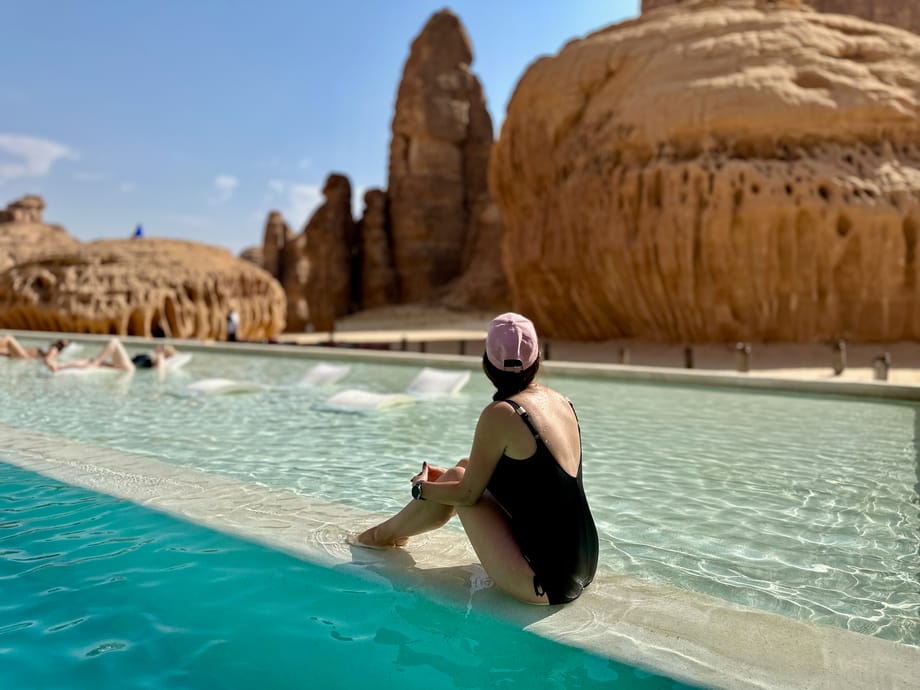
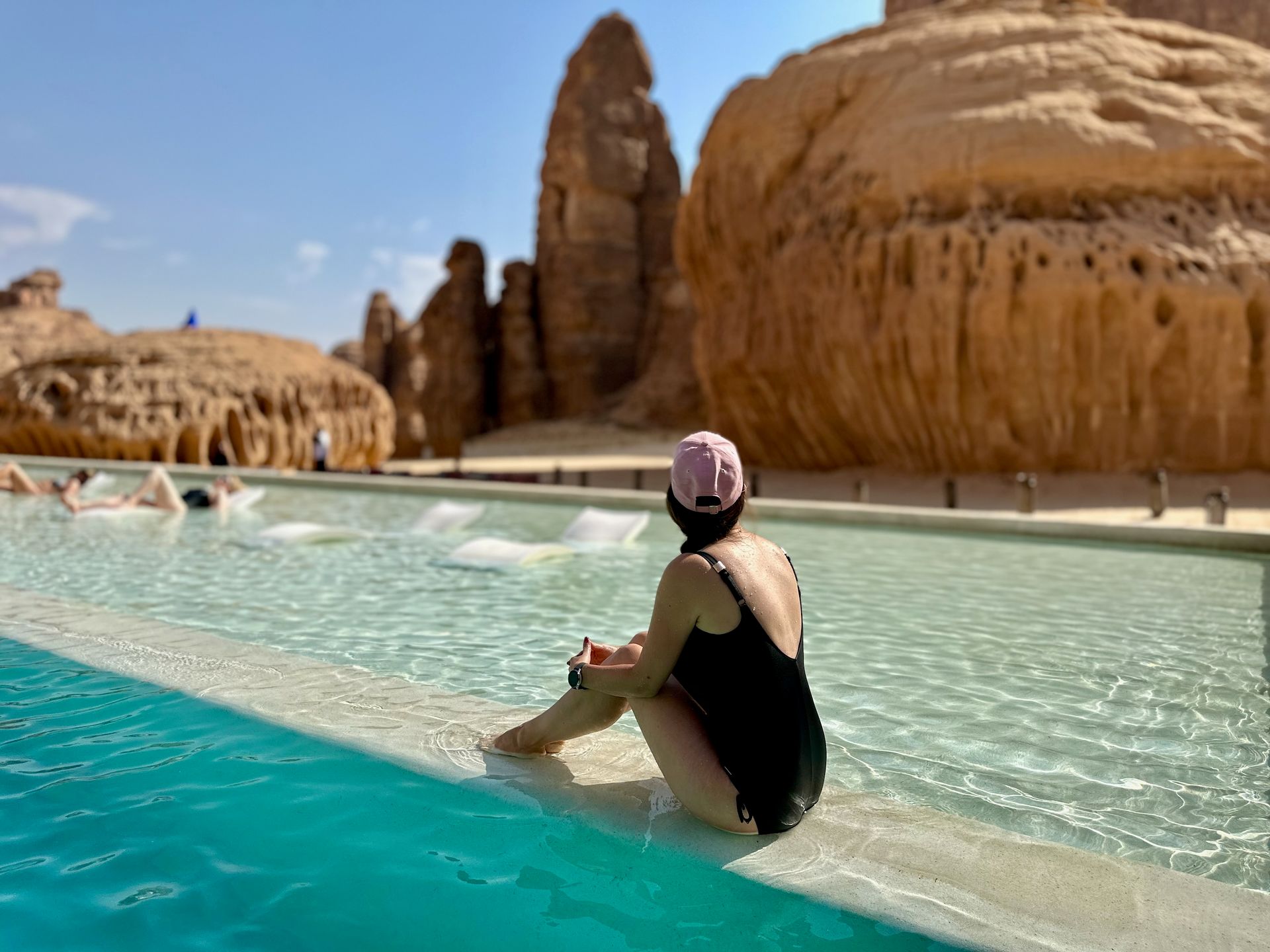
Staying at Caravan by Habitas also came with access to the pool in the main villa complex. That famous Instagram pool where girls walk along a kind of “water walkway” in long dresses. Yes, that’s the one. The pool itself is just a pool, water is water. But the view and the overall atmosphere are honestly amazing.
Getting from the camper to that pool, though, was… exhausting. A transfer, then a change, then another electric cart. At some point you start to feel like a package moving through a sorting center. On one hand, it’s nice that they even give you access to it. On the other, it’s definitely not a “quick swim and back” kind of situation.
Internet? As we mentioned earlier, it was pretty average. In the campers, we had a mobile router provided by the property, but the connection itself just didn’t really work…
Is it worth it? In our opinion, yes, it’s worth it. Not every day, not for a whole week, and definitely not at any price. But once in a lifetime, spending a night in a camper in the desert, with views of the surrounding rock formations, is absolutely worth experiencing.
Villas in the main Habitas resort for around 5,000 PLN per night are definitely on a whole different level for us. The camper at about 900 PLN outside the season felt like a splurge, but one that was worth this one-time indulgence.


Food
Food in Al Ula works a bit differently than in big cities like Riyadh or Jeddah. Restaurants aren’t on every corner, but no one goes hungry, especially if you like chicken 😅 We mostly lived on shawarma, with pizza making a one-time appearance.
In practice, most of the food spots are clustered around Old Town and the AlJadidah Arts District. That’s where you’ll find the more typical restaurants.
Near the main attractions, you’ll often find food trucks. At Elephant Rock, for example, there’s Salt serving burgers and milkshakes. It’s a very “Instagram-style” food truck set right in the desert.
On the other end of the scale, there’s fine dining. On the roof of Maraya, you’ll find Maraya Social, a restaurant by Jason Atherton. It serves modern cuisine in a sharing-plates style and sits firmly in the $$$–$$$$ price range. On top of that, there are restaurants in resorts like Our Habitas AlUla or Banyan Tree (Tama, Harrat). The views are stunning, but the prices match a five-star resort, not a roadside eatery.
Cash: Exchange or ATM?
For us, it was simple: we paid for almost everything by card. There wasn’t a single situation where we had to run around the city asking, “where can we even exchange money here?”.
Okay, correction — we did need cash once, just to pay the apartment owner for the rental. And that was it.
Saudi Arabia is heavily geared toward cashless payments. In most hotels, restaurants, shops, and attractions, you can pay without any issues using Visa or Mastercard. American Express tends to be a bit less widely accepted.
We didn’t come across any currency exchange offices in the city. There may be one at the airport, but we didn’t use it and didn’t see it ourselves.


Safety
Al Ula was one of those places where you simply feel calm and safe. No stress, no wondering whether your helmet will disappear if you leave it hanging on the motorcycle mirror. The biggest “attraction” was actually us, with people being curious and asking where we had come from.
Saudi Arabia generally has a low level of crime. In our experience, the biggest risk is still the roads and the driving style of some local drivers, which we already mentioned in the road conditions section. You need to keep your eyes open when overtaking and not assume that everyone respects speed limits the way you might expect. Well… they do slow down, just mainly when there’s a speed camera 😁
On the formal side, the Royal Commission for AlUla oversees tourism in the region to keep things organized and well managed. Guides, tour operators, and attractions operate under licenses and regulations designed to ensure safety and a reasonable standard of service.
Climate and weather conditions
The entire region lies in a typical desert climate. Summers are very hot, the air is dry, rainfall is minimal, and temperature differences between day and night can be quite noticeable. If you look at climate statistics, you’ll see that the hottest period runs from late May through the end of September. During this time, average daytime highs exceed 34–35°C, and at the peak of summer, especially in August, daytime temperatures can reach around 40–41°C. Winters are surprisingly pleasant. In January, average daytime highs sit around 20–21°C, while nighttime temperatures can drop to roughly 6–8°C.
From a regular traveler’s point of view, the most comfortable time to visit is roughly from October to March. Mornings are fresh, afternoons are warm but not yet overwhelming, and in the evenings you can sit outside without feeling like someone just pointed an industrial hair dryer at you. During this period, daytime temperatures usually stay between 20 and 30°C, depending on the month, with very little rainfall, often just a few millimeters per month.
September, when we arrived, is still full-on “frying pan” season. Average daytime highs for this month hover around 40–42°C, and the beginning of September can easily hit 39–40°C during the day. Along the way, temperatures during the ride were around 36–38°C, but the closer we got to the region itself, the faster the display jumped to a solid 40°C or more. Long walks in the middle of the day are not exactly enjoyable in those conditions. It’s more about trying not to melt than actually sightseeing.
This also changes the daily rhythm. During the day, even outside the main season, the town can feel half asleep. Few people on the streets, very little movement, everything seems to be on pause. Only after around 4 p.m. does it slowly start to wake up. It gets a bit cooler (which sounds funny when it’s still around 38°C xD), and restaurants begin to open.
Co warto zobaczyć w Al-Ula?
This is where the real fun begins, but… we’re not going to turn this into a guide covering every single rock and viewpoint. The official guides you can easily find online list more places than most people could ever fit into an average vacation anyway haha.
👉 That’s why everything we managed to see and do on site went into a separate post 👈. A calm, practical “what’s worth seeing in Al Ula” kind of guide, with specific places, our impressions, logistics, and photos. There isn’t that much of it, don’t worry 😊 Unless you’re planning to stay here for two weeks. In that case, add your own discoveries and let us know in the comments what else you found interesting.
Yes, Hegra is also on the list – without her, this entry would not make sense 😉


Our summary
The whole region has been growing for several years now. New hotels, new projects, carefully developed attractions. At the same time, there’s still a lot of raw desert and those almost alien rock formations that make you feel like you’re on some kind of test trip to Mars. No point pretending otherwise. It’s simply very beautiful, and Al Ula added another solid reason for us to want more of Saudi Arabia.
There is, however, another side of the story, and this is where I, Filip, will keep reminding you of one thing. This destination is clearly aimed at travelers with deeper pockets. RCU is officially building Al Ula as a “hyper-luxury” destination, average spending per visitor is already higher than initially planned, and investments and hotels like Habitas or Banyan Tree are targeting guests who don’t really ask how much a night with a pool between the rocks actually costs.
For a “regular” traveler from Europe, it’s still very doable. There are apartments in town, meals at reasonable prices, and normal everyday shops. At the same time, it’s very clear that Saudi Arabia is using this region to test how far premium tourism in the desert can be pushed.
As for us, it’s another point calmly checked off the map, but not in the sense of “done and forgotten.” It feels more like a place worth coming back to someday, in a better season, to see what’s new and how this whole luxury vision has developed. Saudi Arabia still has a lot left to show us, and Al Ula is just one of the more spectacular stops in a much longer journey of discovering the country.