

Ten wpis jest również dostępny w języku:
 Polski
Hi! 👋
This won’t be a post from the perspective of people who fly business class all the time and compare every seat, every glass and every little detail of the service. We’re also not going to pretend that Air China is one of the most prestigious business class products in the world, because that’s not really the point here.
In December we found out that I’d be running a company event in Tokyo. Japan had already been on our list of places we wanted to see one day, but before that we didn’t have any specific plan. Since the work trip came up, and with it a business class flight, we simply put the rest of the trip together, bought tickets for Jadzia and headed to Japan.
In this post we’ll show you what an Air China business class flight to Tokyo looked like from our perspective, what you can expect on board, and whether the difference compared with economy really is noticeable. People who fly business class regularly probably know most of this already. We approached it much more simply: since the opportunity came up, we checked what it actually looks like in practice.
And we’ll talk about Japan itself, Tokyo and Kyoto in the next posts.
How we ended up in Air China business class
As you already know from the intro, I flew to Tokyo first on my own because I had a company event to run in Akihabara. The timing was April, so technically during cherry blossom season. Technically, because when Jadzia arrived a week later, the blossom situation was already pretty underwhelming xD
My work flight was in business class because that was company policy. No complaints 😄 We still had to sort out Jadzia’s ticket and the rest of our trip together. From the start we also knew we had to line up the return tickets properly, because Jadzia was only joining me after a week of work. It was also her first solo intercontinental flight, so we didn’t want to leave it at “it’ll somehow work out”.
We chose the Warsaw – Beijing – Tokyo Haneda route, with about a 4-hour layover in Beijing. We planned the return so we could also do a few-day stopover in China, since we were flying through Beijing anyway. That was one of the reasons Air China made sense for us – besides the flight to Japan itself, we could add a short stay in China too.
In Tokyo we chose Haneda rather than Narita. Narita could be a bit cheaper for the tickets – in our case the difference was around 100 PLN – but getting from Narita into the city takes longer and costs money too. Haneda is simply more convenient, especially if you’re landing with the idea of getting into Tokyo quickly, not starting another stage of the trip across half the city.
Prices at that time weren’t especially pleasant, because Japan in April does what it does. My round-trip business class ticket cost about 12 000 PLN, and Jadzia’s economy ticket was 4142 PLN. So my work flight was paid for by the company, and Jadzia had to pay out of pocket like a normal person. You can probably guess that her enthusiasm for this part of the planning was moderate 😄
What was included?
With Air China on international routes to Japan, the baggage allowance is already pretty decent even in economy. On our flight, economy included 2 checked bags of 23 kg each, and business class included 2 bags of 32 kg each. So the difference was more about the weight of each suitcase than the number of pieces. On top of that there was carry-on: in economy 1 piece up to 5 kg, and in business class 2 pieces of 8 kg each plus a small personal item, for example a laptop bag.
That sounds like a lot, especially if you’re only flying for a dozen days and you’re not planning to move to Japan. On the other hand, once we got there we started considering buying a second suitcase, so suddenly that limit stopped looking quite so absurd xD Japan can quickly verify how much “we definitely won’t buy anything” really fits into one suitcase.
From that angle Air China looked really attractive. Two suitcases included, a reasonable ticket price and the option of a stopover in Beijing were big pluses for us. LOT with a direct flight to Tokyo-Haneda in the same period cost noticeably more, and business class on LOT was completely beyond budget already (around 24 000 PLN). Maybe those are just normal business class prices, but from a regular person’s perspective that’s already the kind of amount that makes you check a few times whether you’re seeing it right.
With business class you also of course get separate check-in, Fast Track at the airport, priority boarding, faster getting off the plane and access to business lounges at the airports. We’re looking at it from a few angles, because we flew from Warsaw, then had a layover in Beijing, and on the way back we also used Beijing airport after our stopover in China. General pro tip: if, like in our case, one of you has an economy ticket, they’ll still check both of you in at the business counter anyway; nobody tells the “lower-category” person to go stand in another line 🙃.

Check-in, baggage and boarding
On paper, everything looked good. In practice, Air China has one thing that can drive you slightly insane: its websites and booking management. If you buy the ticket through a specific version of the site, for example airchina.de, then later you have to do some things through that exact version too. Not through .com, not through .it, not through another domain, only exactly where the system decides your booking lives. On top of that, my ticket was bought through a company agent, so editing the booking sometimes felt like trying to use the internet in the 90s.
Oddly enough, some things worked. We could change the meal, pick a seat and look around the booking a bit. But the extra benefits were hit or miss. On Jadzia’s ticket we could sort out a free train ride from the airport in Beijing, and on mine we couldn’t. Her ticket could be checked in online, mine couldn’t. Why? Because yes xD.
The biggest absurdity was that after about two hours of fighting with Air China’s website, I managed to book a private driver from our hotel in Beijing to the airport. Seriously. The system didn’t want to cooperate with simpler things, but a ride from the hotel to the airport at 1 a.m. somehow got sorted in the end. Complete circus, but at least with a happy ending. My IT job finally came in handy 😄.
On top of that there’s priority baggage. Suitcases checked on a business ticket should come out on the belt faster than standard baggage. We used that in practice: we checked two suitcases under my ticket so that after landing we wouldn’t have to wait extra for Jadzia’s bag from economy. A small thing, but after a long trip every 15 minutes less at the belt is a plus.
Boarding itself in business class was hassle-free. You get on earlier, you have more room to sort out your carry-on, and there’s none of the classic queue shoving where everyone acts as if they absolutely have to be first even though the plane isn’t leaving without them anyway. After landing, you’re also among the first off.


Lounge before the flight – nice extra or real difference?
With a business class ticket you get access to airport lounges along the way. If you haven’t used them before, in practice it’s a separate space before the flight where you can sit more calmly than at the gate, grab something to eat, have coffee or alcohol, charge your phone and wait for boarding without sitting on the floor between suitcases.
The Mazurek lounge in the non-Schengen area at Warsaw Okęcie made the best impression on us. The food was good, the selection sensible, and we could sit down properly and get a bit of peace before the long flight. That was actually a nice surprise, because Warsaw airport itself quickly shows its limits when there are more long-haul flights around. All it takes is a few bigger planes departing around the same time and it already gets cramped, especially at passport control.
In the non-Schengen area at Okęcie there are two lounges: Mazurek and Etiuda. We’d been to Etiuda before on another occasion using Revolut. Back then we had a delayed flight and got in through DragonPass. Another pro tip: Officially Revolut has already removed this benefit in its old form, but a quick chat with support is enough and they’ll issue lounge passes if your flight is delayed by more than an hour (a paid plan is required).

The lounge in Beijing was much bigger, but weaker on the food side. There was plenty of space and we could rest, but when it came to the food, we didn’t feel like that was any strong point of the whole experience. More of a comfortable waiting room than a place you’d show up early for on purpose.
We didn’t go to the lounge at Tokyo Haneda, so we’re not going to pretend we can judge it. With posts like this it’s easy to drift into describing everything “from the internet”, but here we stick to what we actually checked ourselves.
Does a lounge make a real difference? Yes, but mainly when you have a longer wait, a layover or an airport that’s packed. Not the most important part of business class, but before a long flight it’s nice to start the trip more calmly, with a proper place to sit and some food.


Boarding and first impression
On the Warsaw – Beijing leg we flew an Airbus A330. A bit of a shame we didn’t get the Airbus A350, because that’s a newer aircraft in Air China’s fleet and it’s less… worn. We flew it from Milan to Chengdu on the way to Thailand in 2025, so we already had something to compare it to. In our case, both on the way to Japan and later on the way back, the long leg was operated by the A330. And in both cases you could see the cabin already had a few years behind it.
You board the plane as some of the first passengers. On our flight business class had a separate entrance, so you immediately skip that moment when half the plane is standing in the aisle, someone is trying to stuff a suitcase overhead, someone else is looking for their seat, and another person is trying to push through in the opposite direction.
First impression? Nice, but without a “wow” effect. You can see there’s more space, it’s calmer, and right away you feel this is going to be more comfortable than economy. But then the second thought shows up: something worn here, something bent there, something dirty somewhere else. So more “okay, this will be comfortable” than “what luxury”.
After we took our seats, the crew immediately brought a towel, there was a welcome and something to drink before takeoff. These are small things, but they make the start of the flight feel calmer. I had a lactose-free meal set in the booking, so I didn’t get the standard menu like the other passengers – my food was handled separately.

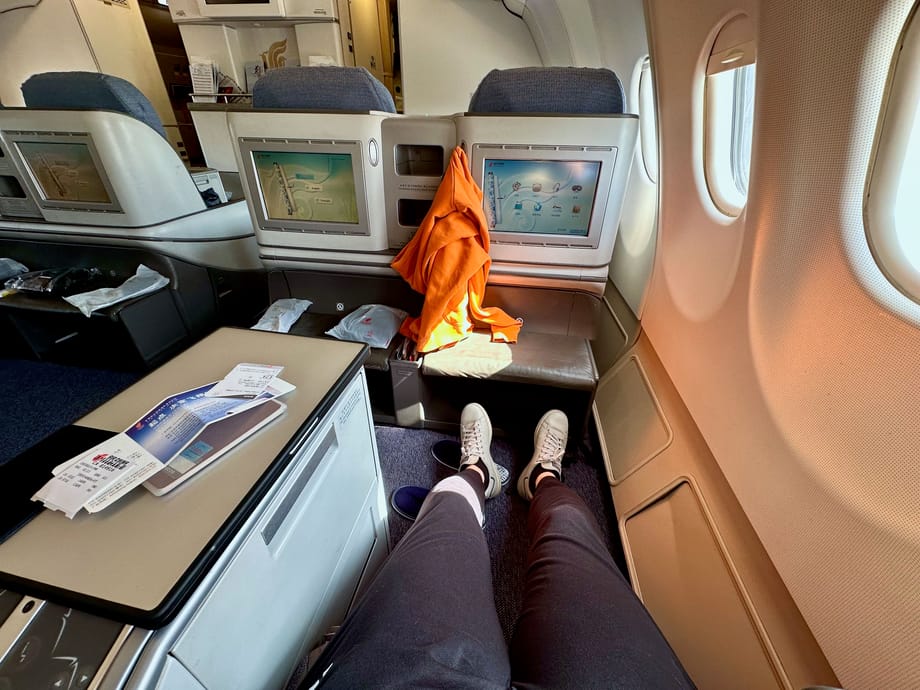
The seat in Air China Business Class
The seat is the main reason business class on a long flight makes sense. Not the food, not the towel, not the glass before takeoff, but the fact that for several or even a dozen hours you don’t have to sit with your knees under your chin wondering where to put your arm so you don’t end up in someone else’s space.
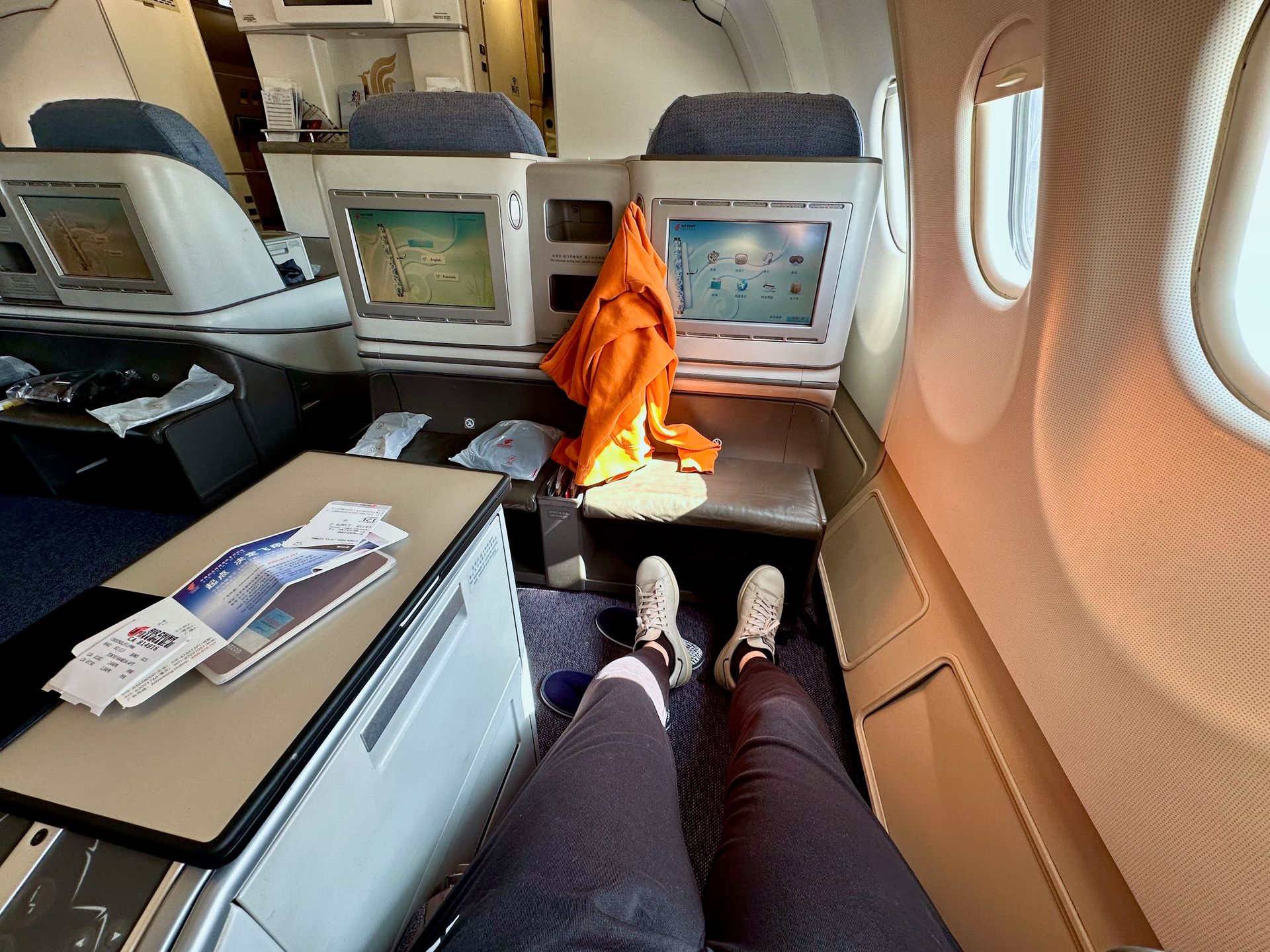
In the Airbus A330, Air China’s business class was in a 2-2-2 layout. That isn’t the most private configuration, because not every seat has direct aisle access. In newer business class cabins, a 1-2-1 layout is more and more common, where everyone gets more privacy and can get out without asking their neighbor to let them through.
The seat itself is much wider than in economy, you get more legroom and you can adjust it into different positions. You can recline properly, raise the footrest, stretch your legs and eventually turn the seat into a lie-flat position. And that’s the biggest concrete benefit of the whole flight.
The difference shows up most strongly not at takeoff, but after a few hours. In economy you start looking for any position that hurts a little less. Here you just change the seat position, stretch your legs, lie down, pull the blanket over yourself and actually have a chance to sleep for part of the route.
Was it comfortable? Yes, absolutely. Was it the nicest or most modern business class seat we’ve seen in photos? No. In the A330, Air China mainly gives you space, the ability to sleep and a much calmer flight, but not the feeling of a new, polished premium product.
Food on board
Food in business class is part of the whole experience, but we’ll say this right away: in our case there was nothing exceptional about it. It was better than in economy, it was served more calmly, on proper dishes, with a tablecloth and a few separate elements on the tray, but we never got the feeling that we’d suddenly landed in a restaurant above the clouds.
At the start, the crew comes over and asks what you’d like to eat. If you have the standard menu, you can choose a dish from the available options. In my case it was a bit different, because I had a lactose-free meal set in advance, so I wasn’t choosing from the regular menu. My meals were prepared separately and the crew mostly asked when I wanted them served.
Before the main meal there was a small snack. In my case it was a small skewer and a bowl of nuts. Then came the bigger meal: a main dish, vegetables, fruit, salad, a mandarin and rice cakes. It all looked pretty reasonable, especially for airplane food, but taste-wise it was more fine than impressive.
Later in the flight, closer to landing, another meal was served. Since I was landing in Beijing at around 4 a.m., it was hard to clearly say whether that was dinner, breakfast or something in between. And honestly, that’s kind of what it tasted like too – like an airplane meal served at a weird hour when your body doesn’t really know what’s going on anyway.
Jadzia had similar impressions on the way back. Takeoff was around 3 a.m., so the first larger meal worked more like “breakfast”, except at that hour you don’t really know whether you should eat, sleep or just stare at the wall. Then we landed in Warsaw around 12:00 and again another breakfast-style meal showed up.
The biggest difference compared with economy wasn’t that the food was outstanding. It was more about the whole setup: more peace, proper dishes, a few separate items instead of one tray with “everything at once”, crew coming over individually, and the chance to eat in less cramped conditions.


Amenity kit, blanket, pillow and little extras
In Air China business class there was also an amenity kit waiting on the seat, meaning a small toiletry pouch with things that come in handy on a long flight. Inside there were, among other things, a toothbrush, toothpaste, a comb, an eye mask, earplugs, socks and a few L’Occitane products. Nothing life-changing, but on a dozen-hour flight some of that does actually come in useful.
There was also a pillow and a blanket. The pillow did the job, the blanket was rather thin, but it was enough to cover up once the seat was reclined. There was no sheet, so this wasn’t full “bed mode” like in more polished business class products.
There were also headphones, which of course you don’t keep after the flight. And that’s fine, because there wasn’t much to regret – they worked, but they felt pretty cheap.
Screen, internet and in-flight entertainment
The in-flight entertainment system is one of those things that looks similar across a lot of airlines: either it works slowly, or it’s clunky, or it reacts with a delay, or it simply feels like its best years are long behind it. On Air China’s A330 it was no different 😄.
There was a screen, there were movies, you could watch something, but the whole system felt fairly sluggish. Responses were delayed, the interface wasn’t especially convenient, and at times everything felt slightly frozen.
The strangest part was the remote for controlling the screen. It was in a storage compartment on the left, next to the power socket. Sounds harmless until you start putting your own things there. Then it’s very easy to press a button by accident and call the crew. We have no idea who decided that was a good place for the remote, but from a design point of view it really wasn’t great xD
There was no internet on board the A330. There was onboard Wi-Fi, but not in the sense of normal internet – just a network for connecting to the entertainment system and watching movies on your own phone or tablet.
Does business class make sense on a shorter flight?
From Beijing to Tokyo-Haneda you don’t get the same wide-body plane as on the Warsaw – Beijing route. In our case it was a narrow-body aircraft with business class in a 2-2 layout and economy in a 3-3 layout. So yes, it was still more comfortable, but it wasn’t the same level of difference as on the long A330 flight.
The business seat on that segment was simply a bigger, wider seat with more legroom. It didn’t recline into a bed like on the long-haul route, so the biggest advantage of business class – proper sleep – was gone. On a flight of around 3-4 hours, we wouldn’t have had much real use for that anyway.
The cabin itself also didn’t make any special impression. The seats were already clearly tired and pretty beaten up, to put it bluntly. It was more comfortable than economy, but there was no feeling that we were sitting in something special.
On board we got one meal. It was fine, but again – nothing exciting. More the kind of food that’s meant to feed you between Beijing and Tokyo than a part of the trip you’ll remember after you get back.
Jadzia had similar feelings when we flew together from Haneda to Beijing on the way back. Yes, it’s better than economy. You get more space, fewer people around you and a calmer flight. But would we pay extra serious money just for business class on a segment like this? Probably not.


Does Air China business class actually make a difference?
Once the chance to fly business class came up, it was hard not to take it. And honestly, yes, there is a difference. Not in the sense that flying suddenly becomes some magical experience and you never want to look at economy again, but on a long flight you feel it very clearly.
The seat makes the biggest difference. Lounges, priority boarding, faster baggage, separate check-in or better food are nice, but we already knew some of that from other trips or card benefits. What we had for the first time, though, was the ability to properly lie down on an intercontinental flight. And that’s the thing that really changes the trip. After a few hours in the air, you’re not looking for a position that hurts a little less – you recline the seat, pull the blanket over yourself and try to sleep like a normal person.
Air China Business Class didn’t impress us as a premium product in itself. The A330 was already worn, the entertainment system worked so-so, the food was fine but nothing special, and a few technical solutions looked as if nobody had tested them with real passengers. Even so, the core function of business class was fulfilled: it was much more comfortable, calmer and easier to survive the long haul.
Would we pay well over ten thousand zloty out of our own pocket for a ticket like this? Probably not. With my ticket at around 12 000 PLN and Jadzia’s economy ticket at 4142 PLN, the difference is simply huge. If business class comes from company policy, an upgrade, points or a very good promo, though, it really does improve travel comfort.
Miles and Miles & More are a separate topic. For Air China flights we didn’t get status-qualifying points in the same way as on flights with Lufthansa Group airlines, but we did get the regular miles and points for flying a partner airline. In business class those values go up much faster than in economy, so if someone flies for work regularly, a status like Frequent Traveller can come fairly quickly. In my case, after a few work trips, that should already come together.
Still, we cared more about the miles than the status itself. We want to use them later for another intercontinental flight, so every segment adds something to the pool. We’ll see how much more we manage to collect and whether that really turns into a sensible ticket in 2027.
For now our conclusion is simple: Air China Business Class wasn’t glossy-catalog luxury, but it was a huge jump in comfort compared with economy. The biggest plus was the ability to sleep on the long leg. The biggest minus – the older cabin and the feeling that part of the product is stuck a few years in the past.
In September we’ll have another comparison, this time with LOT business class on the route to India. And that will be interesting, because then we’ll see whether the Polish carrier really gives a better experience, or just a much more expensive ticket.