
Ten wpis jest również dostępny w języku:
 Polski
Hello! 👋
Oman from behind the wheel is a fascinating mix: on one side brand-new multi-lane expressways, on the other, winding climbs through the Hajar Mountains and hypnotically empty coastal roads. In the south, during the khareef monsoon season, asphalt can vanish in mist and drizzle, and the road to Salalah turns into a stretch of wet, slippery bends. It’s a country where you can go from highway to hairpin in a single day.
We visited Oman as part of our Desert Horizons expedition — this time on two wheels all the way from Poland, following routes that tempt more with their views than with the map. Below, we’ve gathered the essentials for your first kilometers: how driving feels here, where to be cautious, what to know about speed cameras and navigation, how to handle fuel, and what to expect in the mountains or along the coast. And if you catch the travel bug — we’ll also share some must-drive stretches worth ticking off behind the handlebars. Ready? 🚀
Overview of road conditions
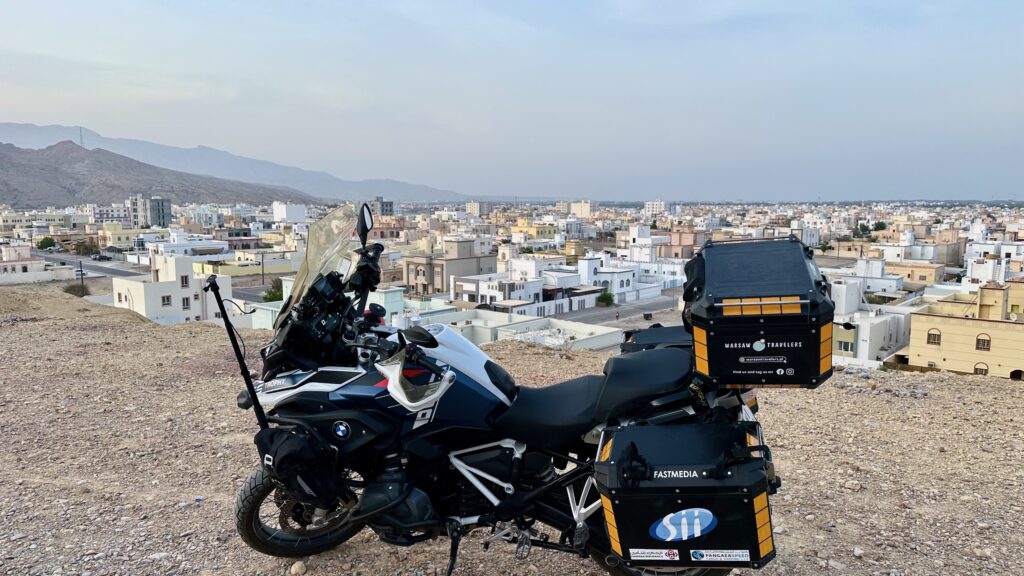
It’s no surprise that the Middle East — including Oman — is built for drivers. The main corridors are smooth and fast, with the backbone of the network being the Al Batinah Expressway — roughly 256 km of eight-lane highway stretching from the Muscat Expressway to the UAE border, featuring dozens of bridges over wadis (dry valleys). Speed limits on highways reach up to 120 km/h, with lower limits in cities and on local roads.
There are also a few “special” stretches. To reach Jabal Akhdar, you can only drive a 4×4 — there’s a 24-hour Royal Oman Police checkpoint at the base that allows entry exclusively to suitable vehicles. In practice, most visitors leave their regular cars near the checkpoint and switch to a 4×4 for the climb.
Conditions can shift quickly with the landscape and season. In the south, during the khareef (monsoon) season, fog, drizzle, and slick asphalt are common — local authorities regularly urge caution. In the Hajar Mountains, expect steep and winding climbs, while along the coast you’ll find yourself driving between cliffs and the sea — stunning, but it pays to stay alert on descents and curves.
Driving style and traffic culture
From our experience, driving in Oman feels calmer than in many other Gulf countries: drivers usually stay in their lanes, don’t cut you off aggressively, and rarely race through city streets. The rumor that “no one pays attention to motorcyclists” didn’t hold true — of course, you need to stay visible and leave yourself some space, but overall road etiquette is solid. When tensions do happen, they tend to come from the usual suspects: driving too slowly in the fast lane, tailgating, or being distracted by a phone — the very habits local police and media keep warning against.
To put it in numbers: according to data from the National Centre for Statistics and Information (NCSI) In 2024, 586 people died (the number of accidents has been dropping year over year, though fatality rates remain high). The main challenges are driver behavior and high-risk sections of roads. In response, the government has stepped up awareness campaigns and stricter law enforcement — with highway and city cameras now playing a major role in monitoring traffic and penalizing violations.
Road categories
To understand how driving in Oman feels, it helps to know the official road classification — it explains a lot about the country’s layout and what to expect behind the wheel.
- National roads: the backbone of Oman’s network — long, fast routes connecting major cities and border crossings. Examples include the Al Batinah Expressway (256 km, four lanes each way) and Muscat Expressway, with speed limits of up to 120 km/h.
- Arterial roads: link regional areas to the national highways and feed them with local traffic. They’re usually dual carriageways, still fast but with more junctions and U-turns than full expressways.
- Secondary roads: connector routes between towns and main highways. In cities, they handle heavy traffic, while outside urban areas they’re often single-lane roads.
- Distributor roads: distribute traffic within districts, service zones, and town centres — this is where you usually slow down to urban speed.
- Local roads: access routes to towns and attractions such as wadis, viewpoints, and beaches — often the ones that take you on the final stretch to your destination.
Surface in numbers: Oman has an extensive network of paved roads, including nearly 2,000 km of expressways, but still a vast share of unpaved routes — which explains why a 4×4 is still the best choice for reaching remote wadis or off-road areas.
Fines
In Oman, the fine system is detailed and clearly defined by the Royal Oman Police (ROP). Here are the most common violations and penalties that drivers and motorcyclists might actually encounter:
- Speed – the amount of the fine depends on the extent of the violation: +5–10 km/h: 10 OMR; +15–<35 km/h: 10 OMR; +35–<50 km/h: 15–30 OMR; +50–<80 km/h: 35–50 OMR; >80 km/h: 50–75 OMR. Additionally, driving too slowly in the fast lane or failing to slow down near schools or roadworks is also punishable by fines.
- Red light violations – classified as a dangerous offence: 50–75 OMR (listed by the ROP under “ignoring a red light” or “failure to comply with traffic light signals”).
- Phone use / seatbelts – holding a phone while driving or not wearing a seatbelt usually costs 15–30 OMR, and both are regularly caught by cameras. Since mid-2025, the ROP has been rolling out AI-based cameras that automatically detect phone use and missing seatbelts.
- No/expired civil liability insurance – 50–75 OMR.
You can check and pay fines online via the Royal Oman Police – Traffic Fines Payment portal, which works for both private vehicles and rentals/fleet cars. In practice, if you’re driving a rental car, any fines will be sent directly to the company and charged to your card according to the rental agreement.
Speed cameras and speed control
There are plenty of speed cameras – visible along the highway from the UAE to Muscat, on approach roads, and near major roundabouts where they effectively force drivers to slow down. That’s no coincidence: the fine schedule includes a specific offence for “failure to slow down at a roundabout” or near intersections and roadworks. Add to that the red-light cameras, and you’ll quickly get used to easing off the throttle.
There’s no guaranteed speed tolerance on Omani speed cameras. The ROP has stated that the old +15 km/h “grace” has been removed on many units, especially in high-risk areas — a “zero-tolerance” policy now applies. From our experience, a small +5 km/h margin might still exist on some cameras, but it’s not consistent. Best rule of thumb: assume grace ≠ law and stick to the posted limits.
Oman is also expanding its network of “smart” AI cameras that detect mobile phone use and seatbelt violations. Both fixed and mobile units are connected directly to the ROP’s central system, so fines are issued automatically. If you want to check whether you’ve been caught, you can do it easily on the Royal Oman Police portal using your vehicle’s registration number.
Maps and navigation in Oman
It’s easy on a daily basis: Google Maps, Waze, and Apple Maps guide you across the country.
The biggest difference shows up outside the cities. Oman’s vast distances and empty stretches mean there are occasional coverage gaps between towns — especially inland and in the south. Signal is generally strong along the Muscat–Batinah corridor and major highways, but in remote areas it’s not always enough for smooth online navigation. Having offline maps (Google or Mapy.cz) isn’t just handy — it’s peace of mind.
Security checks
We didn’t come across any permanent checkpoints within the country — aside from border crossings and the usual ROP road safety campaigns, traffic flows freely. Seasonal checkpoints do appear occasionally, especially on routes leading to Dhofar during the khareef (monsoon) season, when fog and heavier traffic prompt the police to set up informational and control points on main access roads.
The border area with Yemen is a different story. Both the U.S. and Canadian governments advise avoiding travel within at least 10 km of the frontier due to the ongoing conflict on the Yemeni side and the potential risk of incidents. In practice, this means increased security presence, occasional closures, and patrolled roads near the boundary. If you’re heading toward Sarfait/Hawf, treat it as a sensitive zone — always check the latest travel advisories, as the crossing’s status can change and the route is heavily militarized.
Fuel – availability and quality
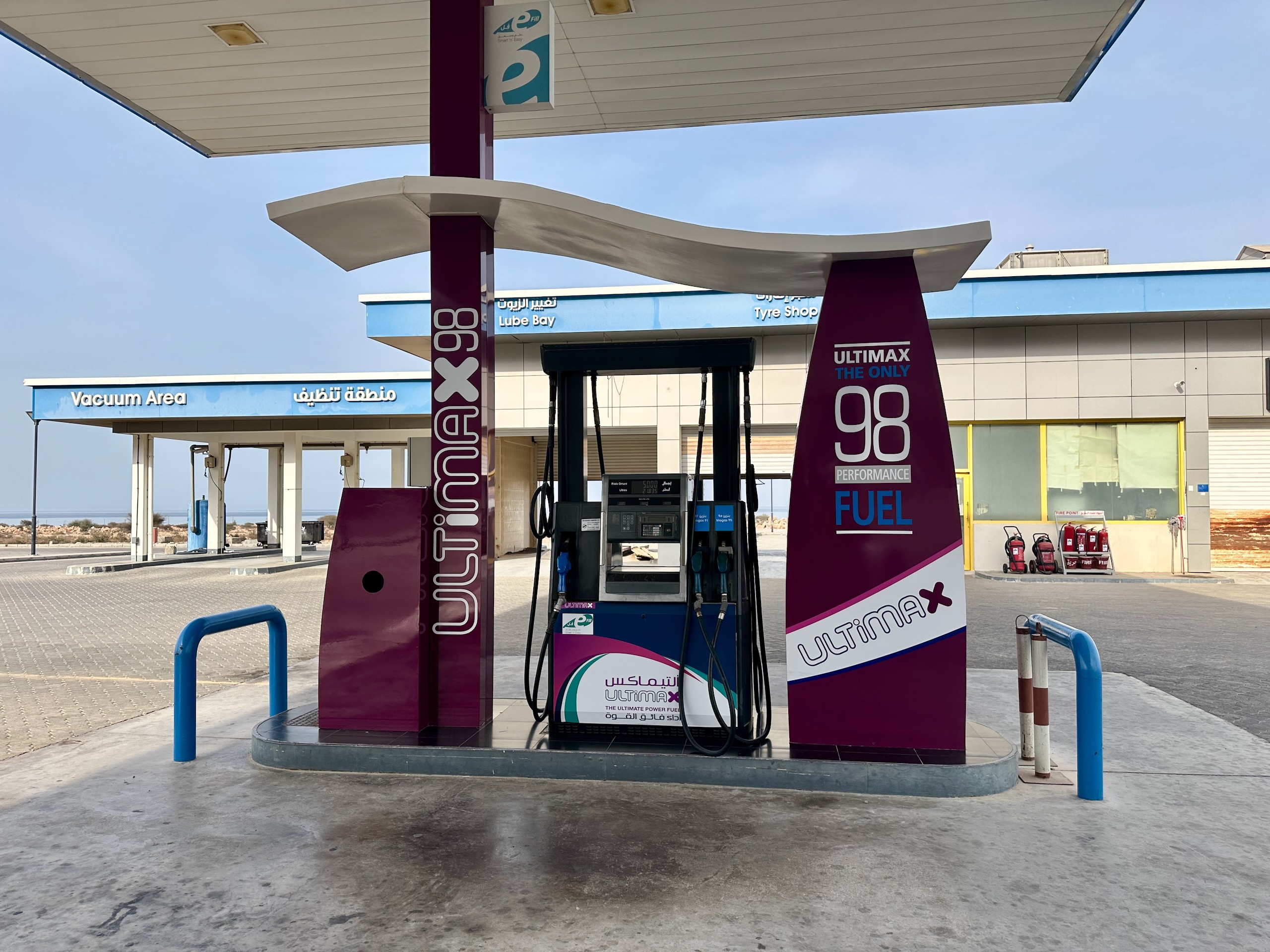
Overall, it’s straightforward and quite “European”: standard fuels are 91 and 95, while 98 is expanding as a premium option — first introduced by Oman Oil (Ultimax 98) and later joined in 2025 by Al Maha’s PowerPlus 98. That’s why you’ll spot plenty of bold “98” banners at some stations — it’s a relatively new addition and not yet available everywhere.
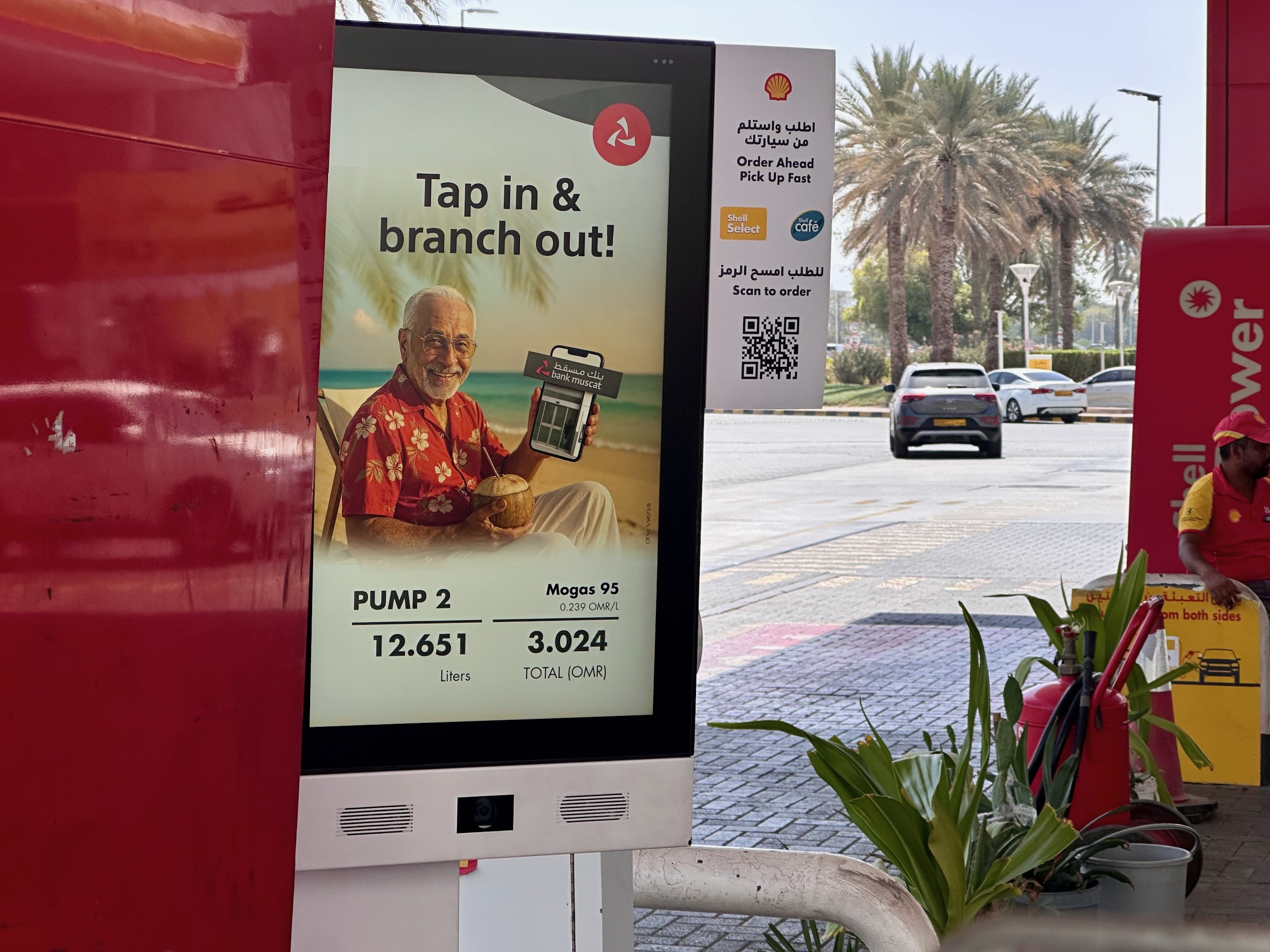
Fuel prices are announced monthly and have remained stable for quite some time. As of October 2025, the official NSS system listed: 91 – 0.229 OMR/l, 95 – 0.239 OMR/l, and diesel – 0.258 OMR/l. In other words, filling up in Oman is still relatively inexpensive by global standards.
Payment is usually straightforward: stations accept Visa/Mastercard or cash, and major networks are expanding mobile payment options — for example, OOMCO supports the Thawani app and wallet. One thing to note: most stations still run on a full-service model, meaning an attendant handles the fueling — you just pull up, say your fuel type, and pay right at the pump.
Fuel availability is excellent, especially along major corridors. On the Al Batinah Expressway, a network of integrated service areas (MOPs) with fuel, rest facilities, and shops has been gradually rolled out, while networks like Shell continue to open new stations. As a result, even on fast stretches, you’ll rarely find yourself running on fumes.
Tolls, vignettes, toll gates
Good news: Oman has no tolls or vignettes — major routes like the Muscat Expressway and Al Batinah Expressway are free for both cars and motorcycles. If you ever encounter a fee at a land border crossing with the UAE, it’s usually an exit fee charged by the Emirati side (around 35 AED), not a toll for Omani roads.
Border fees and temporary entry of vehicles (TIP/CPD)
On the Omani side, there are no extra road fees for entering with a private vehicle or motorcycle. Customs procedures are generally straightforward, and officers tend to be remarkably friendly — we were even treated to a few sweets while waiting for our papers to be processed 😉.
The Carnet de Passages (CPD) is fully recognized and stamped in Oman — it’s the standard document for the temporary import of vehicles with foreign plates. One practical detail to watch out for: make sure the stamp goes in the correct section — under “ENTRY” (counterfoil) upon arrival, not in “EXIT.”
Can you enter without a CPD? Technically yes — there’s a Temporary Import Permit (TIP) process through the customs system, but it’s a commercial-style procedure meant for freight and companies, not tourists. For travelers with private vehicles, the Carnet de Passages remains the default and easiest option. Without it, you may be required to pay a customs deposit, which can be both costly and time-consuming.
Vehicle insurance
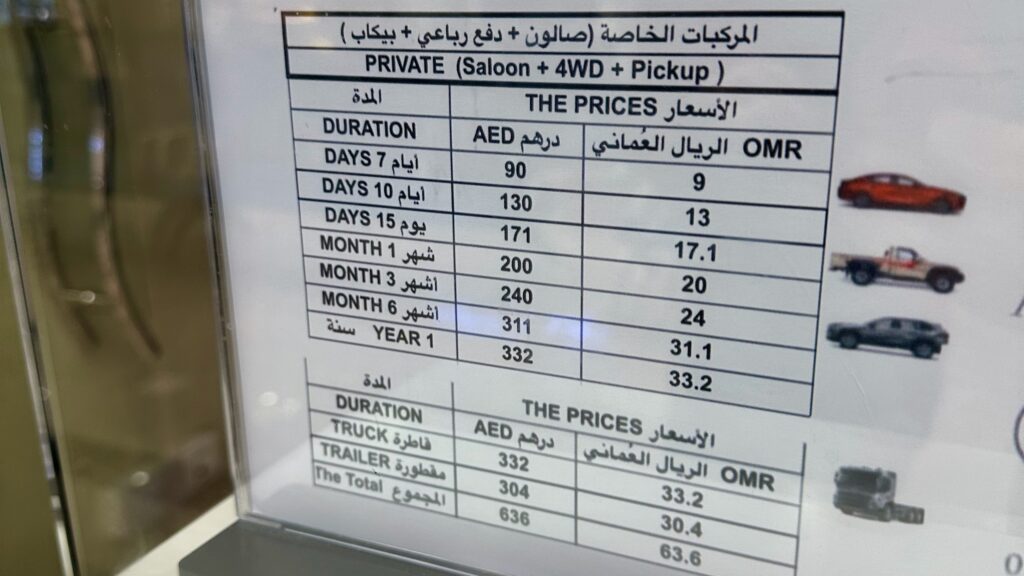
Third-party liability insurance is mandatory. If you are entering from the UAE and your policy does not cover Oman/the Orange Card, you can purchase temporary third-party liability insurance on site (kiosks/self-service) – usually for a minimum of 7 days, but in practice approx. 90 AED for 7 days (≈ 11 OMR), then the price increases with the period and scope.
For vehicles registered outside the GCC (so typically our case), you’ll need to purchase third-party liability (TPL) insurance from a local provider at the border. In practice, short-term coverage (around 5–7 days) costs roughly 10–12 OMR, while annual TPL policies for cars start at about 43 OMR per year — giving a good sense of local market rates.
Road safety
From a driver’s perspective, Oman feels predictable and relatively calm — at least compared to its regional neighbors. Of course, you’ll still come across the occasional reckless driver, but overall, traffic culture is measured and courteous rather than chaotic.
In cities and on expressways, the most common “soft” hazard is poor lane discipline. The Royal Oman Police regularly reminds drivers not to cruise in the fast lane well below the speed limit (e.g., 80 km/h where 120 km/h is allowed) — it creates dangerous closing speeds and sudden overtakes. The fast lane is for overtaking, and you’re expected to move back once you’re done. Since late 2023, Oman also enforces seatbelts for all occupants and child seats for kids under <4 years old — no exceptions.
Outside the cities, the main risks are animals on the road (especially camels) and weather conditions.
According to NCSI data, in 2021 alone, 11 people died in collisions with camels — with Dhofar recording the highest number of such incidents. During the khareef (monsoon) season in Dhofar, dense fog, wet roads, and limited visibility add extra challenges. Authorities and local media regularly urge drivers to use fog or low-beam lights and keep greater following distances during that period.
During rainfall, never attempt to drive through a wadi — the dry riverbeds that can turn into violent torrents within minutes. Even if they look calm, flash floods in Oman are fast and unpredictable. The Royal Oman Police frequently shares footage of drivers being rescued or arrested for trying to cross flooded wadis. It’s a real, life-threatening danger and one that’s actively enforced. Simply put: better to wait it out than test the depth.