
Ten wpis jest również dostępny w języku:
 Polski
Hello! 👋
Kuwait from behind the wheel means fast lanes, smooth asphalt, and heat that turns the air into a shimmering haze. Driving is efficient but not chaotic — speed cameras keep everyone in check, and desert sand can be just as tricky as haste. Here are a few key tips to help you on your first kilometers.
This isn’t an academic guide — just a set of real tips that actually help on the ground. If you’re planning to rent a car or drive your own vehicle, you’ll find the essentials here: what driving in Kuwait feels like, where to be careful, which navigation apps to use, and what to expect when it comes to fuel.
How do we know? We rolled into Kuwait as part of our Desert Horizons 2025 route. This article comes straight from the road — not from behind a desk.
Overview of road conditions
Right after crossing into Kuwait, the first impression is simple: the road network is fast and makes sense. Wide ring roads wrap around Kuwait City, while the main north–south highways connect the capital with the rest of the country. Add to that some impressive stretches like the Sheikh Jaber Al-Ahmad Bridge — roughly 48.5 km long — cutting straight across Kuwait Bay. In practice, that means less “guessing your way through” and more predictable traffic between districts.
The road surface is generally in great shape (definitely better than what we saw in Iraq), and there’s an ongoing nationwide maintenance and repair program. The government signed three-year contracts for comprehensive road works across the country, with recent projects including the Fourth Ring Road and other key routes. As a result, many areas now have fresh markings and smooth asphalt — though occasional lane closures and surprise construction zones still pop up.
Traffic order here is backed by technology. After stricter laws and an expansion of camera systems — including AI-based “smart” surveillance and mobile speed radars — in 2024/2025,
Weather conditions are a story of their own. Dust and sandstorms can slash visibility within minutes — on such days, the Ministry of Interior issues warnings, advising drivers to slow down, keep longer distances, or avoid travel altogether if visibility drops to zero. Add the summer heat on top of that, and you’ve got extra stress on tires, brakes, and engines that hold high temperatures much longer than usual.
Driving style and traffic culture
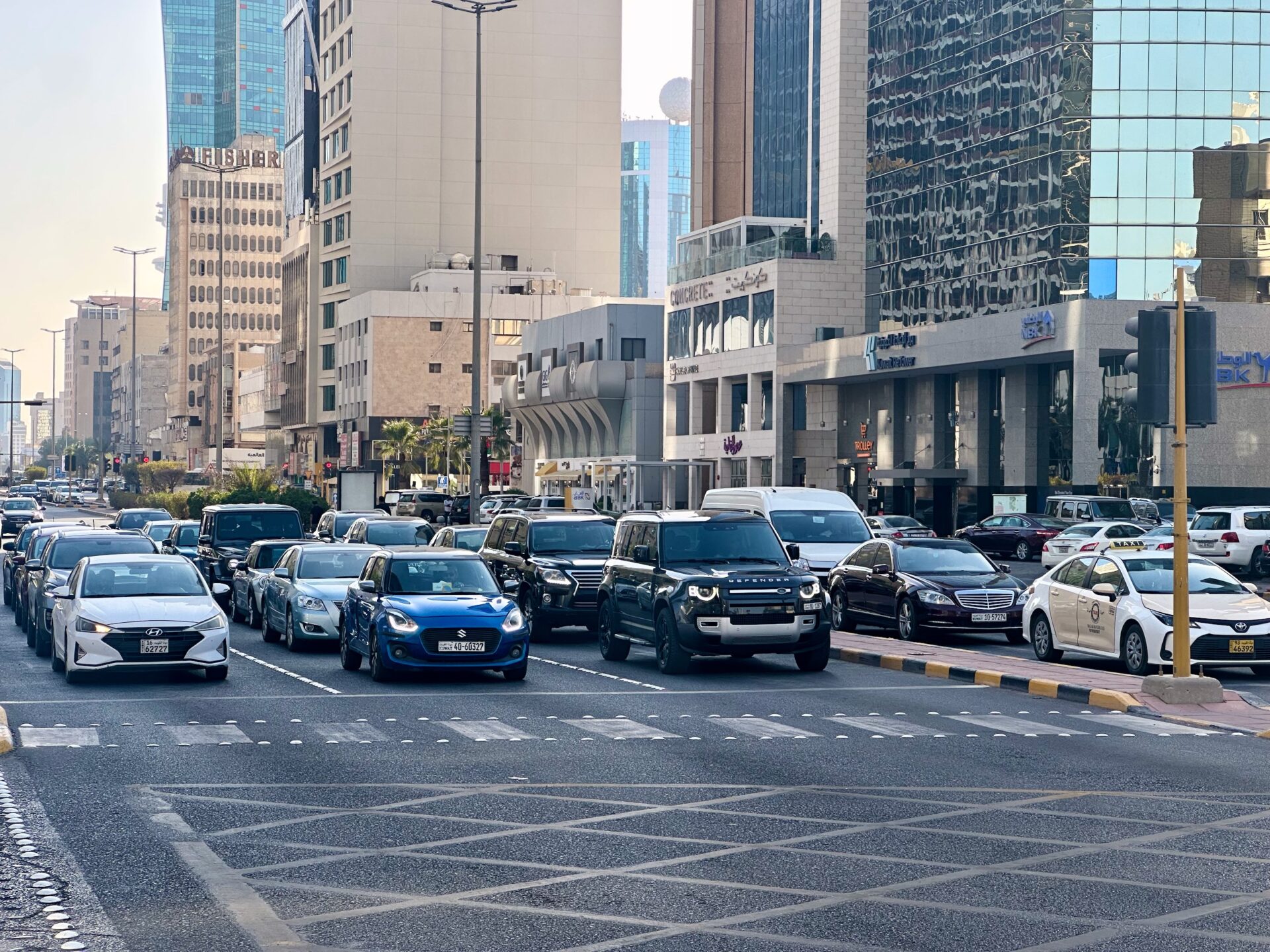
In the city, the pace is fast but predictable — most drivers stick to their lanes, and the left lane really moves. Exits and interchanges can appear suddenly, so it pays to look well ahead instead of just following the car in front. During rush hours (school and office times), traffic on the ring roads can “pulse,” but it’s rarely chaotic — more of a dense, fast flow than stop-and-go frustration.
Law enforcement is visible and effective — most “bold moves” are curbed by cameras, especially at red lights and on speed-monitored stretches. The result? That familiar Gulf-region pace, but with noticeably more discipline than in Iraq. Our impression lines up with recent data showing a drop in traffic violations and accidents after surveillance was tightened this year.
Road categories
To get the logic of Kuwait’s road network, it helps to know its “skeleton” — from that you can read how people drive here and what to expect on the tarmac.
- Expressways and ring roads: Around the capital run seven main ring roads — from the 1st to the 7th — plus the “6.5”. It’s a dense, multi-lane web of grade-separated interchanges. The farther you are from the city center, the higher the limits: up to 120 km/h on the outer rings and major expressways, and typically 80–100 km/h on the inner ones. This is where traffic flows fastest and most predictably.
- Main “vertical” routes (30/40/50/80, etc.): Highways ending in zero are the north–south corridors. Examples include Route 30 (Fahaheel), Route 40 (King Fahd), Route 50 (King Faisal), and Route 80 (Abdali – leading to the Iraqi border). Expect divided carriageways, wide lanes, and long on- and off-ramps. Near cities they feel more like urban arterials; outside, they turn into full-scale expressways.
- Special connectors / causeways: The most iconic is the Sheikh Jaber Al-Ahmad Causeway — two massive links across the bay totaling about 48.5 km. It’s a full-speed elevated route of bridges and viaducts that dramatically shortens the drive between the capital and the country’s north.
- Urban arteries and service roads: Inside the cities you’ll find wide, multi-lane streets with parallel service lanes, signalized U-turns, and direct access to shops or gas stations. Officially classed as primary or secondary roads, they usually carry 60–80 km/h limits and are designed to distribute traffic from the expressways into residential, commercial, and industrial zones.
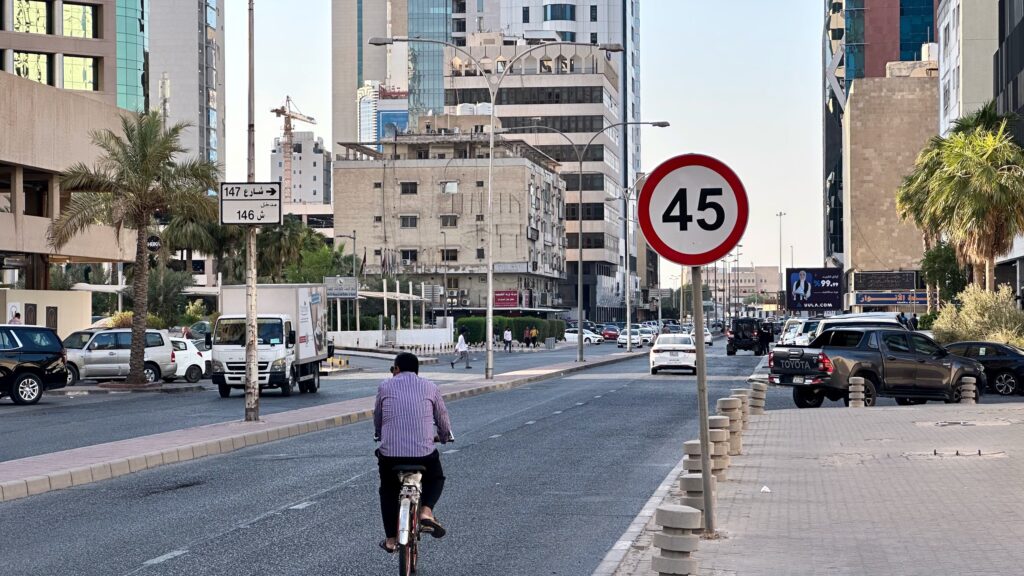
- Local and residential roads: Inside neighborhoods the pace slows down — simple street grids, speed bumps, and plenty of roundabouts. Speed limits are usually around 45–60 km/h with frequent pedestrian crossings. These are also the areas where navigation can get confusing, since service road entrances and U-turns often sit very close together.
Fines
In Kuwait, traffic fines have increased sharply — and, more importantly, they’re actually enforced. Since April 22, 2025, a new traffic law has been in effect: the lowest fines start at 15 KWD, while serious offenses (like causing injury under the influence of alcohol or drugs) can reach thousands of dinars and even jail time. Many violations are settled administratively with on-the-spot fines, but some cases go to court. Cameras are everywhere — including average-speed sections and “smart” systems that detect phones in hand or seat-belt violations.
The most important ranges that may actually affect tourists:
- Speeding: typically 70–150 KWD, depending on how far over the limit you go. Many routes now use average-speed cameras, so slowing down only at the camera won’t save you from a ticket.
- Red light and reckless driving: around 150 KWD; if the case goes to court, it can also result in jail time.
- Phone in hand: 75 KWD;
- Seat belts: 30 KWD;
- Child in the front passenger seat or without safety equipment: 50 KWD;
- On-site parking for persons with disabilities: 150 KWD;
- Driving without a license or after having your license suspended: 75 KWD;
- Driving too slowly below the minimum speed on a given section: 30 KWD;
- Driving under the influence: fines in the thousands — typically 1,000–3,000 KWD — plus possible jail time. If an accident causes injury or death, penalties can reach up to 5,000 KWD and 5 years in prison. In short: zero tolerance.
Speed cameras and speed control
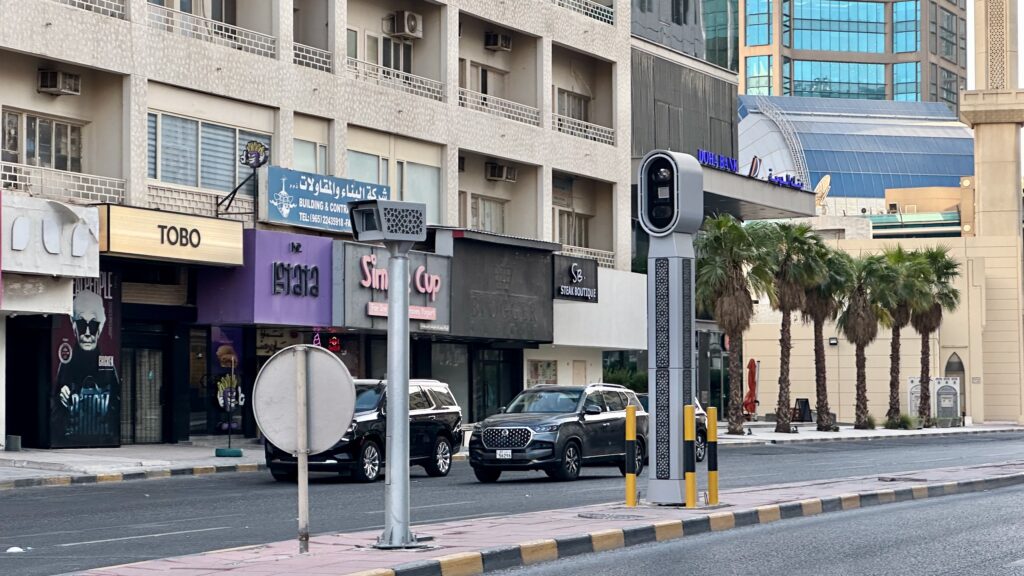
Here, speed cameras aren’t painted bright yellow like in Poland. In the city, you’ll spot poles and cameras, but they’re usually grey boxes or small units mounted on gantries — easy to miss at first glance. Add to that a dense network of intersection cameras and average-speed systems on major routes, especially where drivers tend to push the limit. In 2024–2025, the Ministry of Interior added hundreds of new devices, including “point-to-point” systems calculating average speed between checkpoints.
Just as important, there’s now a wave of mobile speed cameras in use — battery-powered “tripods” or suitcase-style units that police set up anywhere, often along highways and ring roads. There’s no big warning or signage — their effectiveness lies in showing up unannounced. Local media and Ministry of Interior statements described them as part of a broader road-safety campaign launched after the new traffic law took effect in April 2025.
Maps and navigation in Kuwait
Navigation apps work flawlessly here — no tricks needed. Google Maps, Waze, and Apple Maps all handle routing and live traffic updates without issues.
Security checks
During our stay in Kuwait, we didn’t encounter any fixed roadside checkpoints in the city — the only mandatory ones were at the border (Abdali on the Kuwaiti side / Safwan on the Iraqi side), which makes sense. Inside the country, police operations are more campaign-based: from time to time, the Ministry of Interior sets up mobile control points and runs large-scale traffic & security campaigns on major and secondary roads.
Historically, fixed checkpoints inside the city appeared only during exceptional periods — for example, during pandemic curfews — but that’s in the past. Today, Kuwait has returned to a flexible system of temporary operations and mobile patrols instead.
During the Iraqi occupation, Kuwait was dotted with military checkpoints and roadblocks operated by Iraqi forces. They controlled documents and restricted movement throughout the city — a grim but standard reality of wartime conditions at the time.
After the Imam al-Sadiq Mosque bombing in June 2015, the government significantly tightened security. Police checkpoints became more frequent, temporary road controls and field campaigns were organized, and vigilance was stepped up around sensitive sites — especially mosques and major public areas.
Fuel – availability and quality
Fuel in Kuwait is cheap and widely available. The standard lineup includes gasoline 91, 95, and 98, plus diesel. Prices for 91/95/diesel have remained stable for years thanks to government subsidies (around 0.085 / 0.105 / 0.115 KWD per liter), while 98 octane is adjusted quarterly — for example, 0.200 KWD/l in early 2025.
Fuel quality in Kuwait is consistently high. Since the launch of the Clean Fuels Project, local diesel meets Euro-5 standards (sulfur content below <10 ppm), and KNPC proudly reports regular distribution of this cleaner fuel to stations nationwide. In practice, we didn’t experience any issues after refueling — even on long-distance rides.
The fuel station network is dense in cities and along major highways. Both KNPC (state-owned) and Oula (private) are expanding their infrastructure, aiming for around 100 stations by 2027. Near border routes, stations are less frequent, but with normal route planning, you won’t have trouble finding fuel.
Payments: You can pay by card, but not every station accepts foreign Visa or Mastercard. We ran into this ourselves — some pumps only supported GCC-issued cards. Oula has started rolling out terminals for Gulf debit cards, but visitors from outside the region may still get a “declined”. If you’re out in the middle of nowhere and there’s a small truck shop nearby (selling snacks, drinks, etc.), try paying there instead — the staff will settle the fuel bill internally. They might add a tiny fee of about 2 PLN (~0.15 KWD), but hey, it works 😁.
Tolls, vignettes, toll gates
Good news: there are no tolls or vignettes in Kuwait — all ring roads and major highways are free for cars and motorcycles. That also includes the Sheikh Jaber Causeway. In the past, there were separate tolls for heavy trucks, but those don’t apply to regular vehicles.
Border fees and temporary entry of vehicles (TIP/CPD)
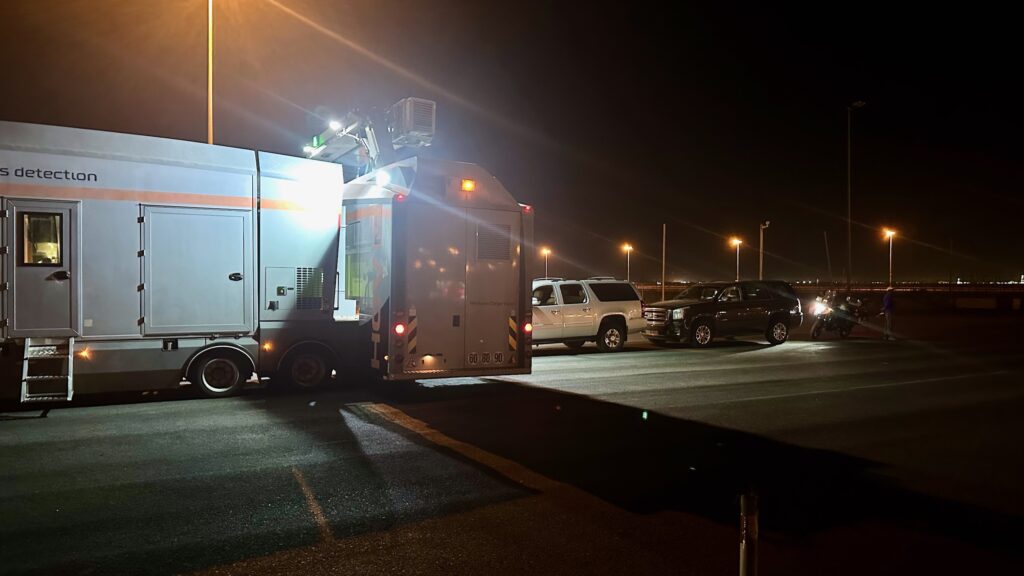
- X-ray scan at the Iraq–Kuwait border (Abdali): every vehicle passes through a scanner. In our case, the fee was 2 KWD, payable by card or cash (they even accepted leftover Iraqi dinars). It’s a small technical charge, not always listed in official fee tables, but the X-ray check is a standard part of the crossing procedure.
- CPD (Carnet de Passages): Kuwait is one of the countries that officially accepts the carnet for temporary vehicle import. Just make sure the officers stamp the correct section — in theory, the CPD is required, but in our case the officer stamped the “Counterfoil – Importation” instead of a fresh voucher (and even tore out the Importation voucher by mistake). When we were leaving the country, no one asked for the CPD at all — so technically it’s required, but in practice… it depends on who’s on duty that day.
- Note for the Iraq direction: when leaving Kuwait toward Iraq, you may be asked for a so-called Green Permit — a document that authorizes access to the border zone, issued within Kuwait. If you’re traveling from Iraq into Kuwait, this usually doesn’t apply, but it’s worth keeping in mind so the rule doesn’t surprise you if you ever plan a round trip.
Vehicle insurance
Every vehicle entering Kuwait must have valid third-party liability insurance (OC). You can buy it directly at the border (there’s usually an insurance desk/window) or online in advance as border insurance. The policy is issued through the official WARBA Insurance website — that’s the company handling vehicle insurance for foreign visitors.
How much does it cost per week (approximately):
- Motorcycle: 14 KWD Basic Premium + 1 KWD Regularity Fee
- Car: 17 KWD Basic Premium + 1 KWD Regularity Fee
Road safety
From our perspective, driving in Kuwait feels safe. The main roads are wide, the surface smooth, and while the pace is fast, it’s not reckless. We never felt threatened — more often just friendly curiosity from other drivers. Twice it even ended with invitations to lunch and quick chats in parking lots.
In the first half of 2025, compared to the same period in 2024, Kuwait recorded: 45% fewer accidents (1,383 vs. 2,511), 34% fewer fatalities (94 vs. 143), and 16% fewer traffic violations overall. The biggest drops came in May–June, right after the new, stricter traffic law took effect — clear proof that tougher enforcement and higher fines are working.