
Ten wpis jest również dostępny w języku:
 Polski
Hello! 👋
During our motorcycle journey from Poland to Oman, we rode across Iraq — both in Kurdistan and the federal part — staying on the move, talking to drivers and officers along the way. Here’s what we learned and what might help you if you plan to travel here yourself.
This is a short, practical guide for anyone planning to rent a car or enter Iraq with their own vehicle. Just keep in mind that local regulations can change — always double-check the latest info on the ground.
And if you’re curious about our personal impressions, check out our travel diary from Iraq. You’ll find more about our Desert Horizons 2025 expedition at the link below — enjoy the ride! 😊
Overview of road conditions
If you’re planning to travel by car or motorcycle across Iraq and Kurdistan — take a moment first to get a feel for what to expect. Traffic can be chaotic, road conditions uneven, and driving culture follows its own rules. In this section, we’ll share what we’ve already noticed — what worked, what surprised us, and what’s worth being prepared for.
Main differences: Kurdistan and Federal Iraq
Before setting off, we went through plenty of other travelers’ reports — and indeed, what we’d read matched what we later saw. In Kurdistan, the roads are generally in better shape, and the region is clearly investing heavily in infrastructure.
That doesn’t mean it’s perfect — between major cities you’ll still find a few “bottlenecks.” We ourselves hit a detour that led over an unpaved stretch — on a motorcycle, it was simply exhausting. Many sources also mention the rough Erbil–Sulaymaniyah section and the ongoing roadworks there (something local news and reports confirm).
In federal Iraq, the quality varies much more: you’ll come across solid highways, but also sections full of ruts, bumps, or small-scale repairs. Official travel advisories point out that traffic can be hazardous, driving standards are low, and in the past there were even cases of fake checkpoints — a useful reference point if you’re planning to head further south.
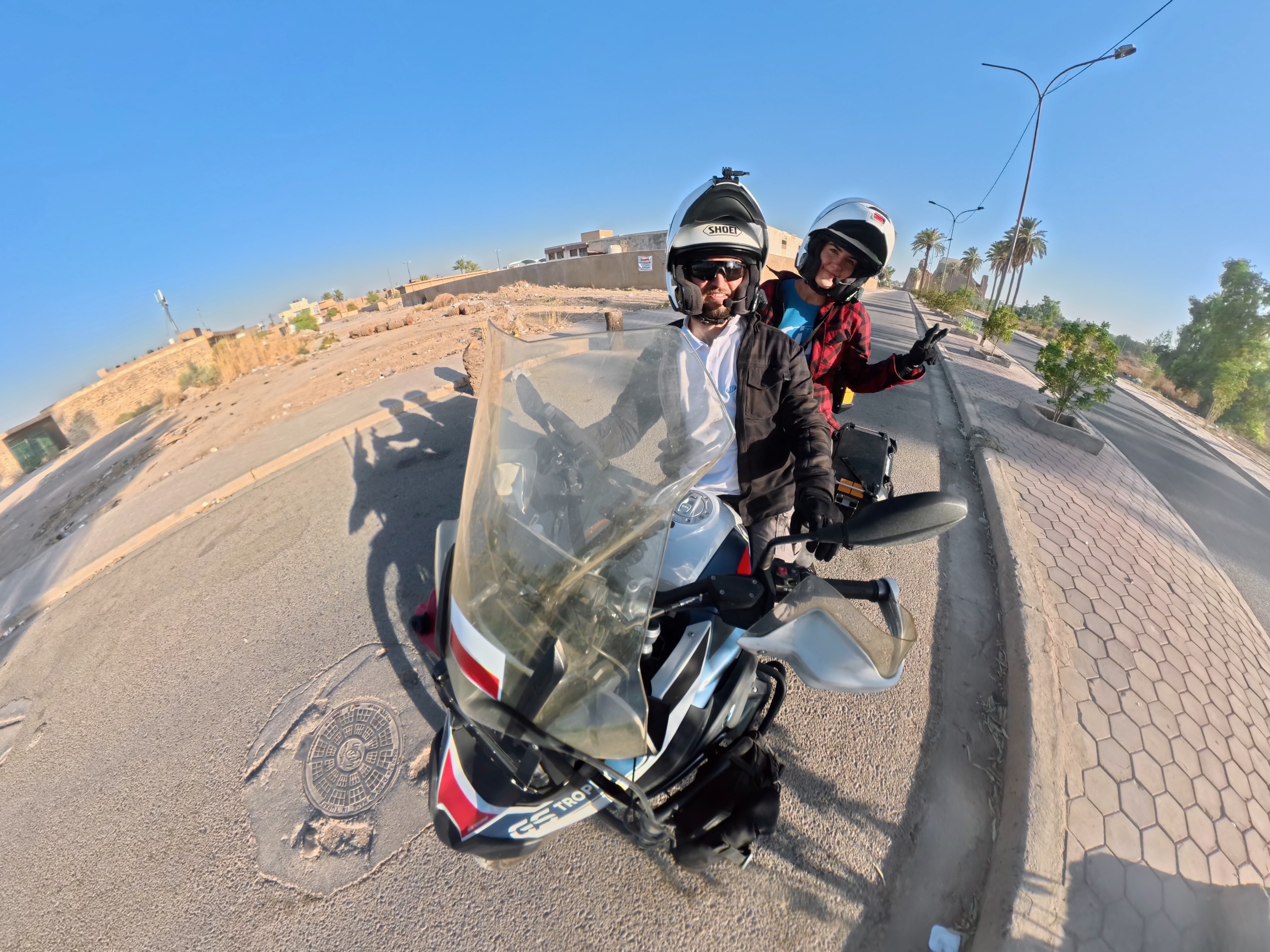
Driving style and traffic culture
In our personal “worst drivers” ranking, Egypt still holds the crown — Iraq, while sometimes intense, isn’t nearly as extreme. What surprised us: on faster stretches, many drivers actually stick to around 110–120 km/h. In the KRG that matches the official limits, and there’s also a dense network of average-speed cameras that genuinely keep things in check. In practice, the smoothest way to travel is simply to go with the flow — slightly below the posted limit.
Until recently, in federal Iraq there was a sense that traffic cameras were rare, so many drivers “took liberties” with speed. That’s changing: since July 2025, Baghdad has rolled out smart cameras and monitoring systems at intersections and along major routes — over 10 000 violations were recorded in the first 24 hours, and authorities announced plans to expand the project city-wide. Outside the capital, enforcement is still less consistent, but the overall trend clearly points toward tighter control.
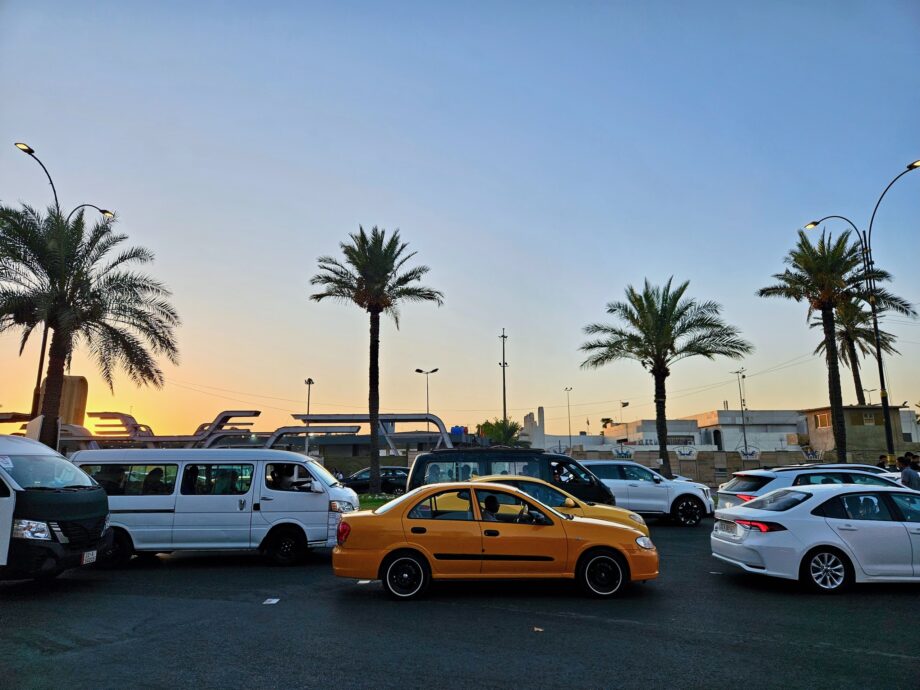
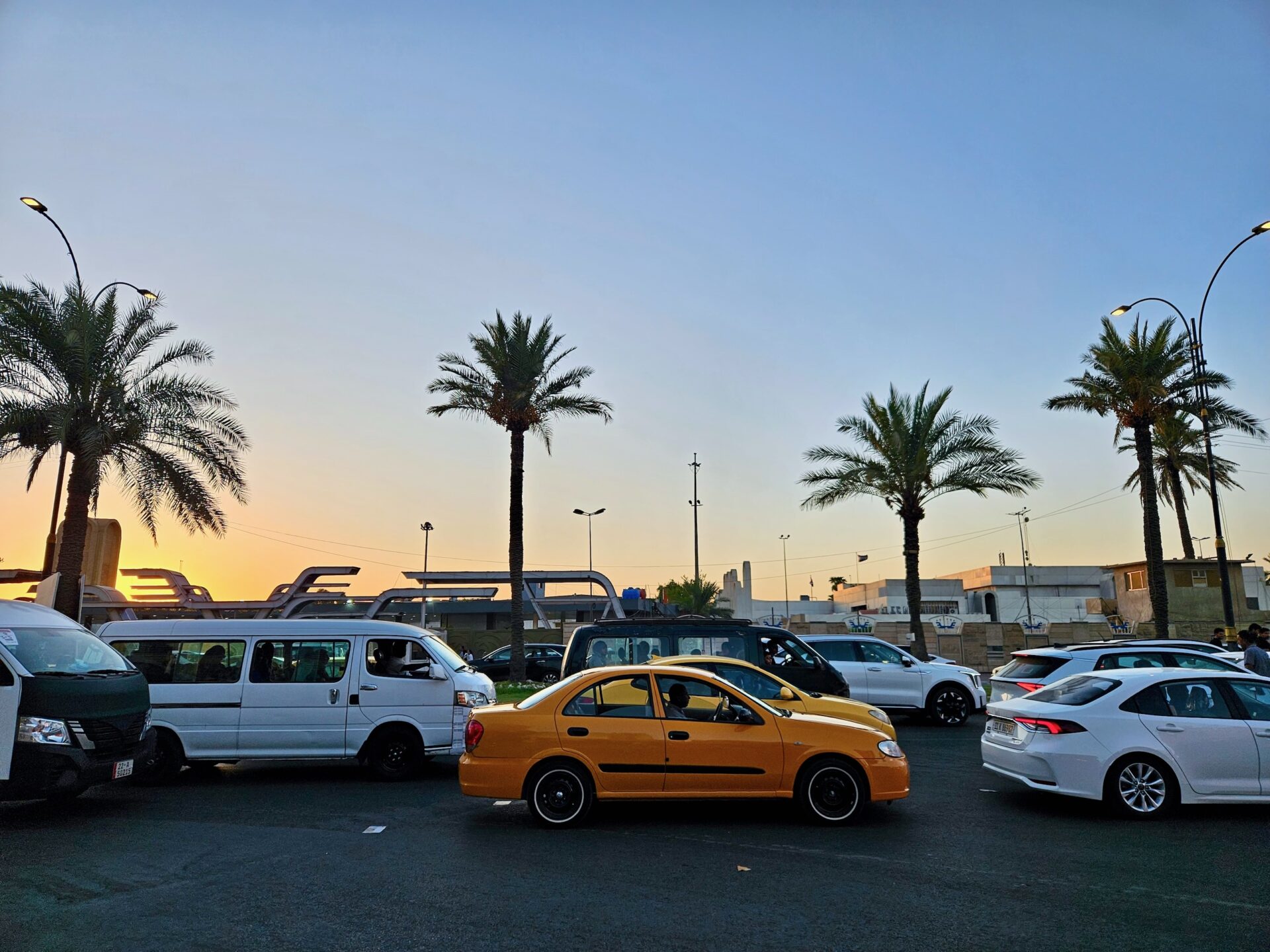
When it comes to the “soft” driving style, improvisation rules the road — traffic flows, but rules are treated flexibly. It’s common to see lane changes without indicators and drivers squeezing through any gap that appears; pedestrians often step onto the road in unexpected places, even amid fast-moving traffic, so you really need eyes in the back of your head.
On intercity roads you’ll often spot a U-Turn — a 180-degree turnaround through an opening in the median. In Iraq and the KRG, these breaks appear every few hundred meters, and drivers use them quite freely, often without signaling. In Europe this maneuver is much less common (and usually forbidden on expressways or highways, where you turn only at junctions or roundabouts), so the very term may be unfamiliar to some travelers.
Road categories and pavement condition
In Iraq, you’ll find several types of roads — from decent expressways and ring roads to solid intercity routes, as well as local stretches full of patches, speed bumps, and the occasional gravel detour. The most “highway-like” route is the national north–south axis (M1 / Freeway 1), which connects Basra, Baghdad, and continues west toward Jordan and Syria.
In Kurdistan, you can clearly see heavy investment in bypasses and access roads. Erbil is known for its famous ring roads: the 120-meter ring (opened in 2017, project cost around USD 450 million) and the expanding 150-meter ring (planned to stretch about 70 km around the city). A new connector project between the two rings (roughly 5 km, ~USD 25 million) has also started to ease congestion between main traffic corridors. For drivers, this means predictable, fast transit between districts — though it’s worth noting that motorcycles are restricted on certain ring sections.
On local roads and in cities, be ready for speed bumps — they’re frequent and not always marked. We hit a few “ski jumps” ourselves. After dark, they’re especially easy to miss, so keep a safe distance from the car ahead and watch the road surface closely.
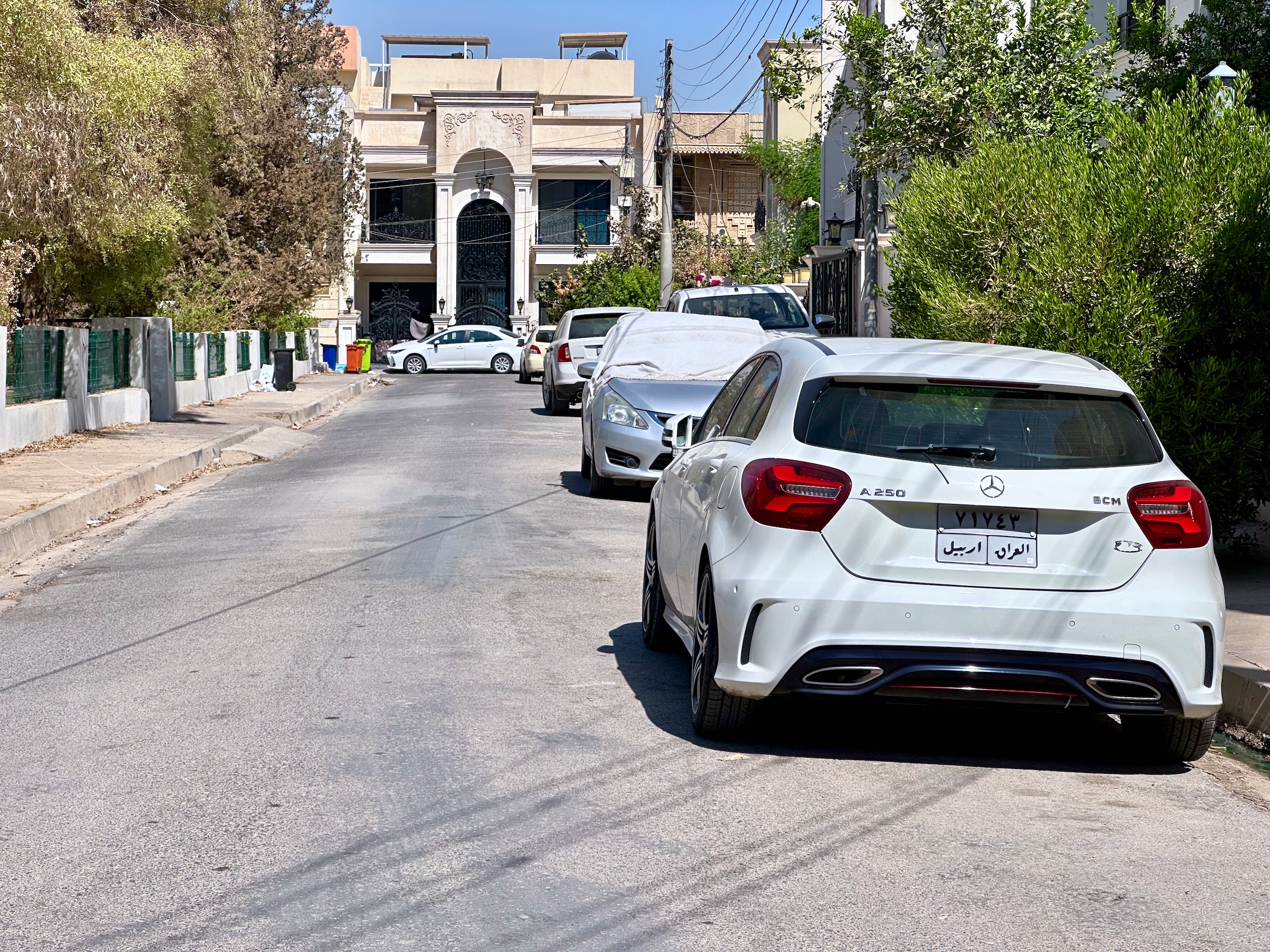
Fines
Based on the current Traffic Law No. 8 of 2019 and the latest official updates from local authorities:
- Speeding (“high speed”): 200,000 IQD;
- Running a red light/failing to stop at a traffic signal: 200,000 IQD;
- Driving the wrong way: 200,000 IQD; possible towing/impounding of the vehicle;
- Using a phone while driving: 100,000 IQD.
- Failure to wear a seatbelt: 50,000 IQD.
- Tinted windows: 200,000 IQD.
- Not having your driver’s license with you (you are licensed but do not have the document): 50,000 IQD + 5 days of vehicle impoundment.
- Driving without a license (not having a driver’s license): up to 200,000 IQD + possible vehicle impoundment/arrest.
- Throwing trash out of a car: 50,000 IQD.
Discounts/increases and where to pay:
- Baghdad (and generally the federal part): you get a 50% discount if you pay within 72 hours; after 30 days, the fine amount doubles. Fines are issued electronically.
Kurdistan (KRG): according to media reports, a permanent 20% discount applies to traffic fines.
Speed cameras and speed control
In Kurdistan, speed cameras are dense and genuinely operational. The backbone of the system is average speed enforcement (point-to-point) — first implemented on Erbil’s 120-meter ring road (speed limit: 110 km/h for cars, 80 km/h for trucks) and later expanded to major approach routes, including Erbil–Mosul, Erbil–Kirkuk, Erbil–Makhmour, and Erbil–Kazna. Fines are automatically calculated if your average speed over the segment exceeds the limit, and the cameras also detect foreign-registered vehicles.
Outside Kurdistan, speed cameras used to be much less common, but that’s changing. Since July 1, 2025, Baghdad has operated a citywide “smart camera” system covering intersections and main arteries. Outside the capital, such systems are still rare — for example, Kirkuk has announced plans to install cameras on its ring road and the highway to Tikrit — but the trend is clear: more cameras are coming.
Maps and navigation in Iraq
Google Maps worked for searching places and viewing maps, but route navigation did not work anywhere in Iraq. We resorted to mixing several tools.
What actually worked (and where it didn’t):
- Waze is popular in cities, but coverage can be patchy. If a road to your exact destination isn’t mapped, it may simply report that no route is available. In our case, near the Syrian border in Kurdistan, Waze stopped working entirely at one point.
- Maps.me: highly recommended — it proved very useful for us, though sometimes the automatic transliterations from Arabic were a bit hard to read or inconsistent.
- Garmin Montana 700i/710i: a reliable backup, though a bit clunky to operate. It was especially useful for recording the track in case we needed to retrace our route. We used OpenStreetMap data instead of Garmin’s City Navigator, which costs a small fortune.
Checkpoints and security checks
Checkpoints are part of everyday life here. You’ll find them most often at city entrances, major intersections, and within a few kilometers of military bases or facilities. They also appear in rural areas — once we waited around 20 minutes for clearance. If you’re a foreigner driving a vehicle with foreign plates, expect to be checked almost every time: passport and visa ready. It’s normal, not a reason to stress.
Who is guarding there and what do they want?
- Kurdistan (KRG): checkpoints are usually run by Asayish (internal security) and police, with Peshmerga occasionally present on major routes. Asayish officers typically verify identity and travel purpose, sometimes cross-checking details against traveler lists. For Iraqi citizens, local ID documents are key, but for foreigners, a passport with a valid visa is almost always enough.
Federal Iraq: here the range of forces is broader — you’ll encounter police, army, security services, and in some areas PMF/Hashd al-Shaabi. In disputed regions (Ninewa, Kirkuk, Diyala, Salah ad-Din), checkpoints may be run or co-run by PMF units, sometimes even issuing their own local permits. For travelers, it mostly means more questions about your route and accommodation — and occasionally, a quick phone call to a superior before you’re waved through.
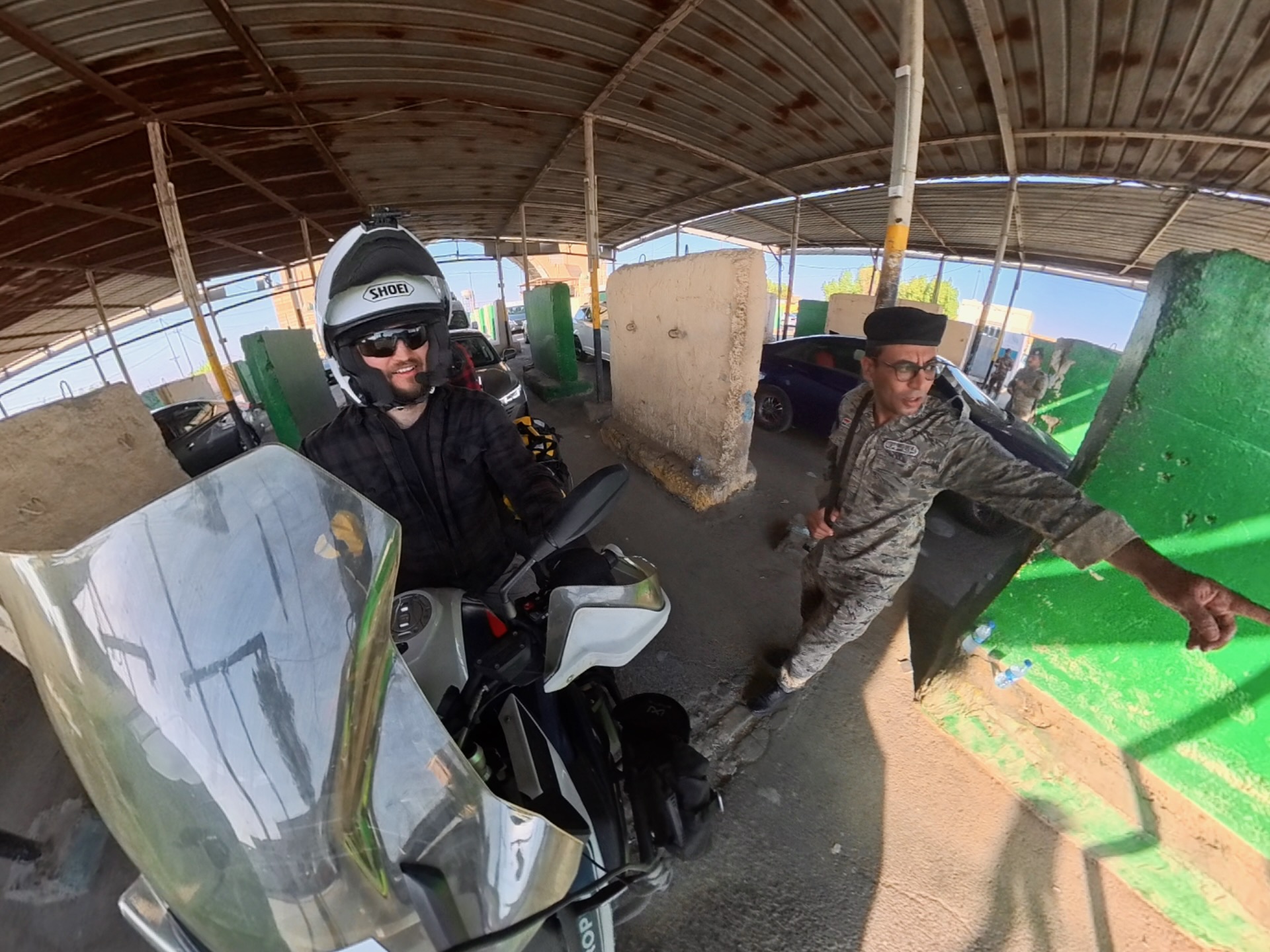
What they check and how it looks
- Documents: carry your passport and visa (especially the entry stamp). If they ask for vehicle papers, show the registration certificate — though it’s usually not in Arabic, so they won’t really understand it anyway 😆. Carnet de Passages is rarely requested. For Iraqis, a valid national ID is essential at checkpoints; for foreign travelers, the passport serves as the equivalent.
Procedure: approach slowly — window down, hands visible, sunglasses off. On a motorcycle, if they ask you to remove your helmet, do it (we weren’t asked since we had flip-up helmets). They often go for a short Q&A: where from, where to, where you’re staying, and sometimes request a contact number for your hotel or host. Occasionally, they’ll note down your vehicle’s license plate number.
And if you are interested in how to obtain a visa to Iraq, check out a separate post 😊
Fuel – availability and quality
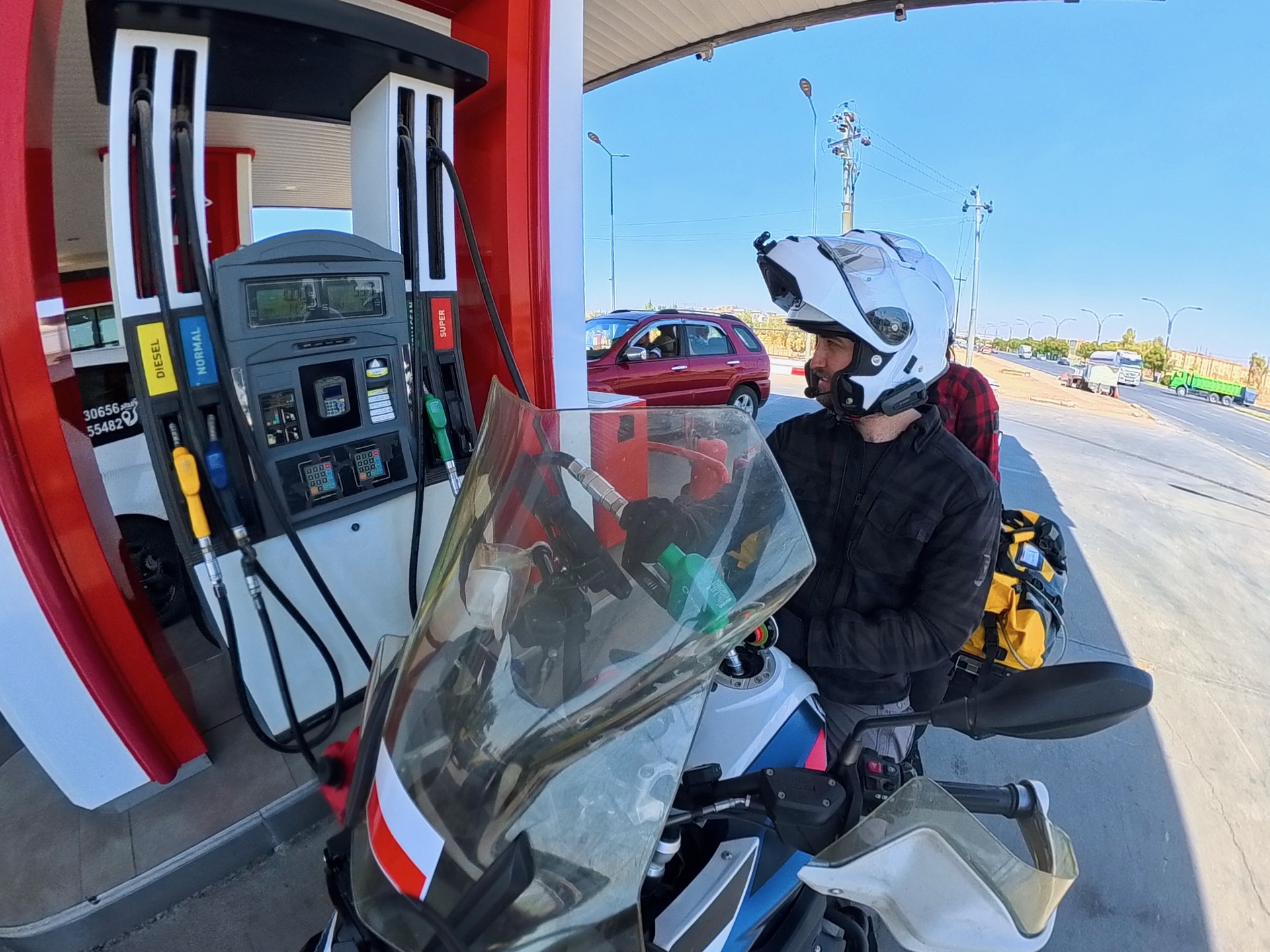
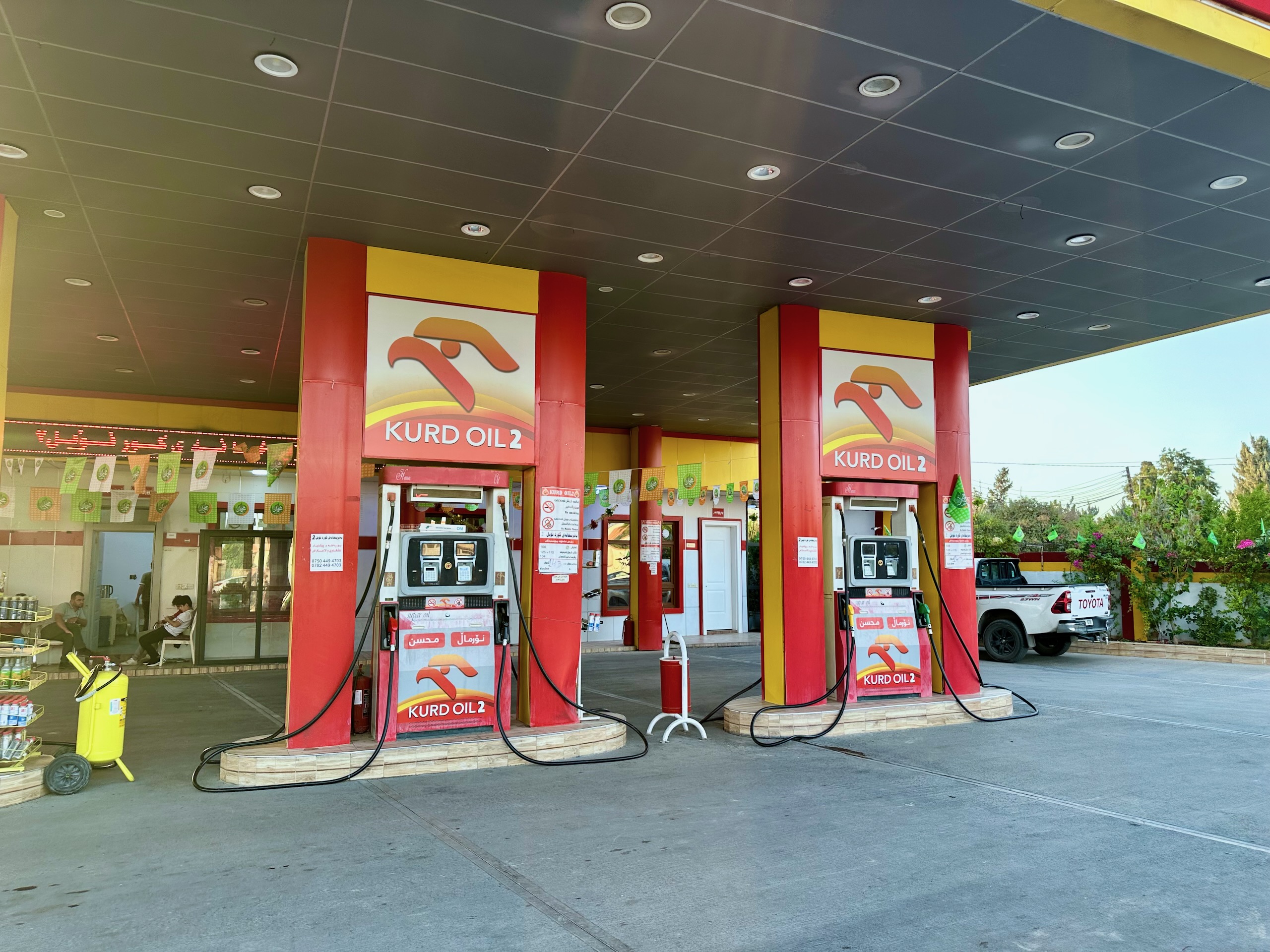
From May 1, 2025, the Federal Government raised prices in Iraq and the prices were frozen at the following rates: Regular 91 – 450 IQD/L, Premium 95 – 850 IQD/L, Super 98 – 1250 IQD/L. We usually filled up with 91, since it was more widely available, while 98 we only managed to get once in Kurdistan.
In Kurdistan, fuel prices tend to drift away from federal levels, and long queues for cheaper fuel aren’t unusual. For instance, in Erbil, mid-2024 saw regular gasoline rise from around 750 to 800–810 IQD/L, and by October 2025, reports again mentioned a “fuel crisis” with long lines at stations — drivers waited for cheaper fuel while complaining about its quality. The reason is simple: the KRG doesn’t fully meet local demand from its own production, so whenever imports or logistics slow down, shortages and price jumps appear.
What about quality? There are three types of gasoline available: regular, premium (95), and super (98). Federal standards are stricter than those in the KRG, particularly regarding sulfur content. Media reports and lab tests from Erbil have shown occasional parameter exceedances (especially in sulfur and volatility), and for diesel, the issue has been even more pronounced. In short: fuel quality is inconsistent and can vary between stations or shipments. If your engine requires 95 or 98 octane, ask directly about the grade and fill up only at large, branded stations in major cities.
Payment: officially, the government is pushing toward a cashless system (especially for gas stations and the public sector), but implementation is inconsistent. In our experience, not once did we find a station that accepted card payments — cash only, every single time.
If you’re riding a motorcycle, be ready for an extra quirk: at some stations — especially private ones — you can’t refuel directly into the tank and must use a jerrycan instead. On state-run stations, it’s increasingly common to be allowed to fill up normally, but it still depends on the staff and shift. Locals explained that the restriction originated from old security concerns — in the past, motorcycles had been used in terrorist attacks.
Tolls, vignettes, toll gates
As of today, there’s no vignette or toll system in place — all roads are free to use. The “gantries” you’ll see across highways in the KRG aren’t toll gates but rather speed enforcement cameras for point-to-point monitoring.
Border fees and temporary entry of vehicles (TIP/CPD)
Most importantly: even if you’re entering with a Carnet de Passage (CPD), you’ll still need to pay an administrative fee for the temporary vehicle import. The CPD waives customs duties and deposits, but not the processing fee for the paperwork.
- Federal Iraq (the south, e.g. when entering from Kuwait): online sources mention a fee of around 100 USD for a temporary import permit (TIP) when entering. At exit, some travellers reported paying about 38,000 IQD, but in our case (September 2025) it was roughly 30,000 IQD.
- Kurdistan (KRG – entry from Turkey or Iran): the fee is around 35 USD, payable in cash. Some travellers reported paying 20 USD for a 90-day permit for a regular car, while caravans or larger vehicles were charged more. These figures come from real driver and rider reports.
Vehicle insurance
There isn’t a single, clear answer on whether third-party liability insurance (OC) is truly mandatory in practice. Officially, it appears as a legal requirement, but enforcement is inconsistent. In case of a minor accident, drivers often just settle things on the spot without involving the police.
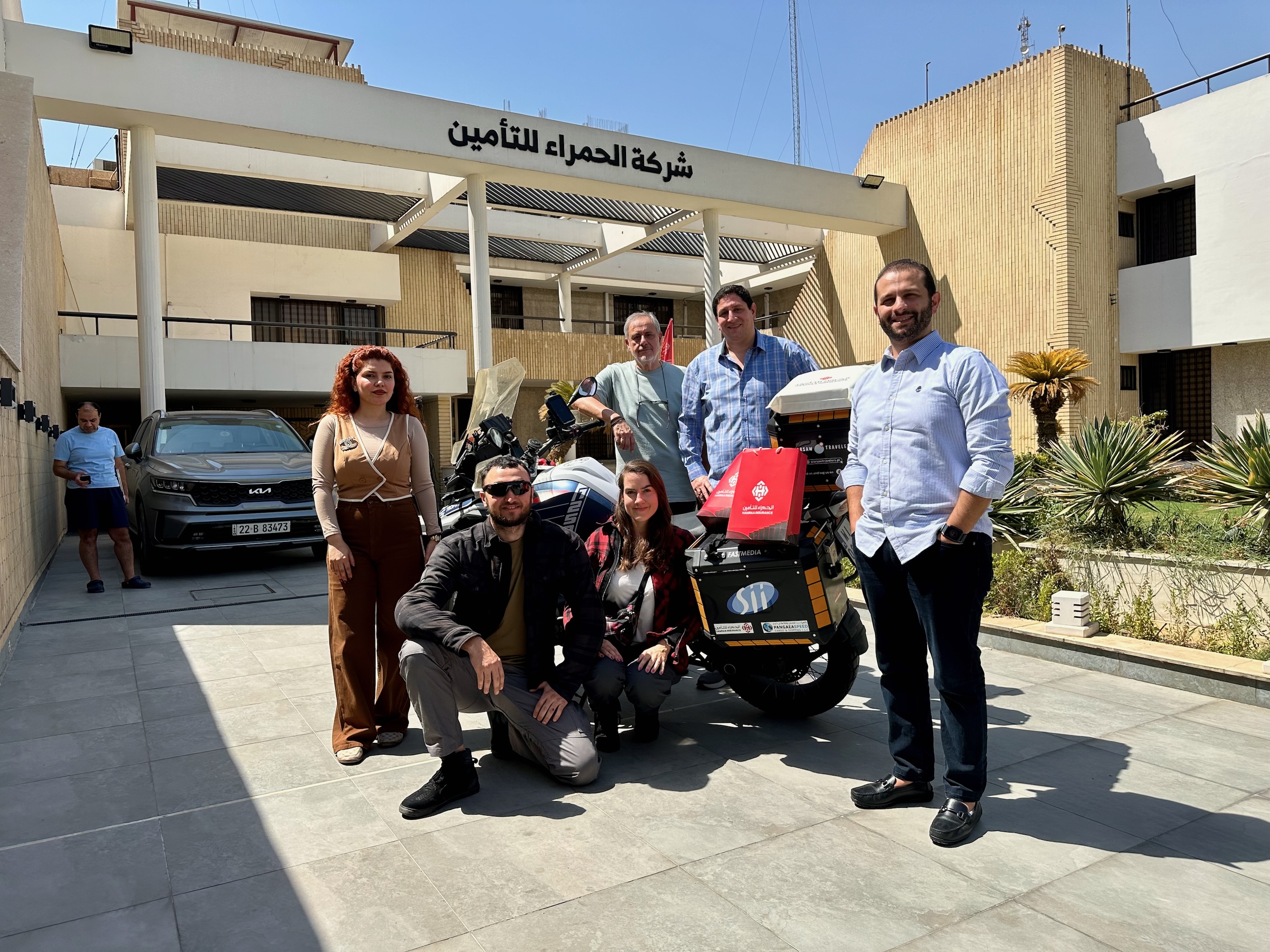
Our experience: at the border, we didn’t find any insurance sales point, so we arranged a policy ourselves through Hamraa Insurance. The coverage was similar to European third-party + comprehensive (AC) + roadside assistance, but the insured sums were much lower than the motorcycle’s actual value — roughly ¼ of its value for comprehensive insurance and ⅓ for TPL. This is partly because motorcycles are rarely insured locally and are mostly associated with delivery work rather than travel.
Our practical tip: don’t count on buying insurance at the border. Instead, contact an insurer in Erbil or Baghdad (for example, Hamraa Insurance) and ask for the policy document in English. Keep a PDF or printed copy with you at all times.
Road safety
You can drive, but you’ll need eyes all around your head — especially after dark. You’ll occasionally see cars without headlights, pedestrians crossing wide roads, and even animals near the shoulders (sometimes, unfortunately, dead ones). At night, it’s best to slow down or avoid long stretches altogether.
In one of the hotels in Kurdistan, we were told directly that smaller bikes (125–250 cc delivery types) are a more tempting target for thieves than big, well-equipped adventure bikes. Still, it’s smart to use some kind of wheel lock (we use a Litelok U-Lock) and park under a camera — hotel reception staff will usually help with that.
Regulations that have a real impact on safety:
- Helmet: mandatory in Iraq (national law), although enforcement varies.
- Phone: prohibited while driving.
- Speed limits (domestic): 50-60 km/h in built-up areas, 100 km/h outside built-up areas, 120 km/h on motorways.
Pogoda i widoczność: kurz i burze piaskowe potrafią w kilka minut „wyłączyć” widoczność. Lokalna drogówka przypomina, by zamykać okna i włączyć obieg wewnętrzny, jechać wolniej, trzymać większy odstęp, a przy spadku widoczności zjechać z trasy (awaryjne dopiero po zatrzymaniu).