
Ten wpis jest również dostępny w języku:
 Polski
Hello! 👋
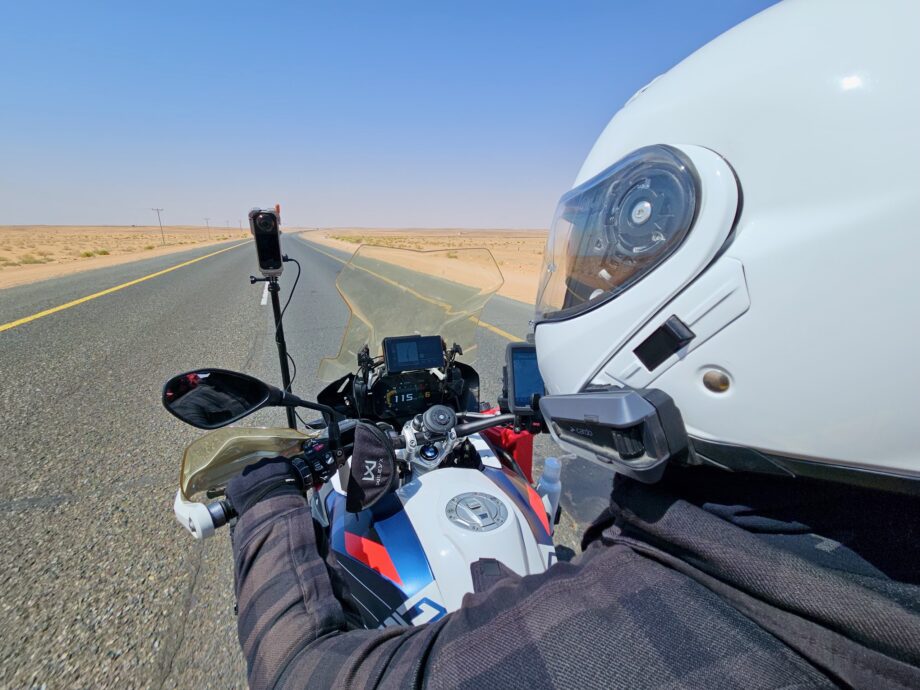
Saudi Arabia from behind the wheel means endless straight highways, shimmering heat above the asphalt, and a horizon that never seems to get closer. You drive fast, you drive far — and that’s exactly the kind of long-distance travel this story is about.
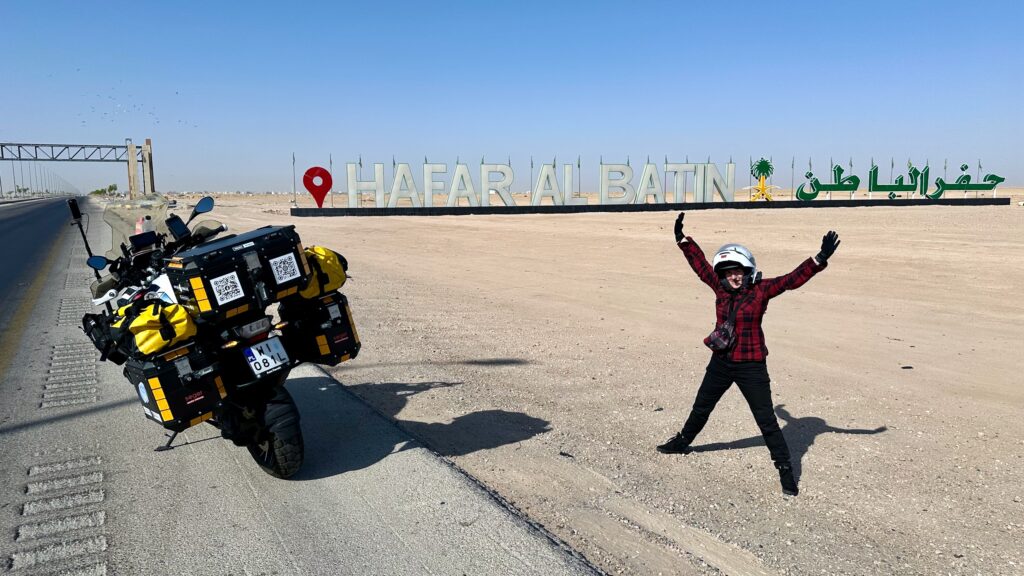
It was our second time in Saudi Arabia, but a completely different part of the country — and a different ride. This time, we entered on a motorcycle as part of our Desert Horizons expedition. The season? Let’s just say it was a bit toasty for sightseeing, but that’s when our schedule lined up — so we hit the road anyway.
Below we’ve gathered everything that’s useful from the very first kilometers: what traffic is like, what to expect on the main roads, how speed cameras work, what to know about maps, fuel, and safety. And if this topic clicks with you, check out our other posts about Saudi Arabia too 😃.
Are we going? 🚀
Overview of road conditions
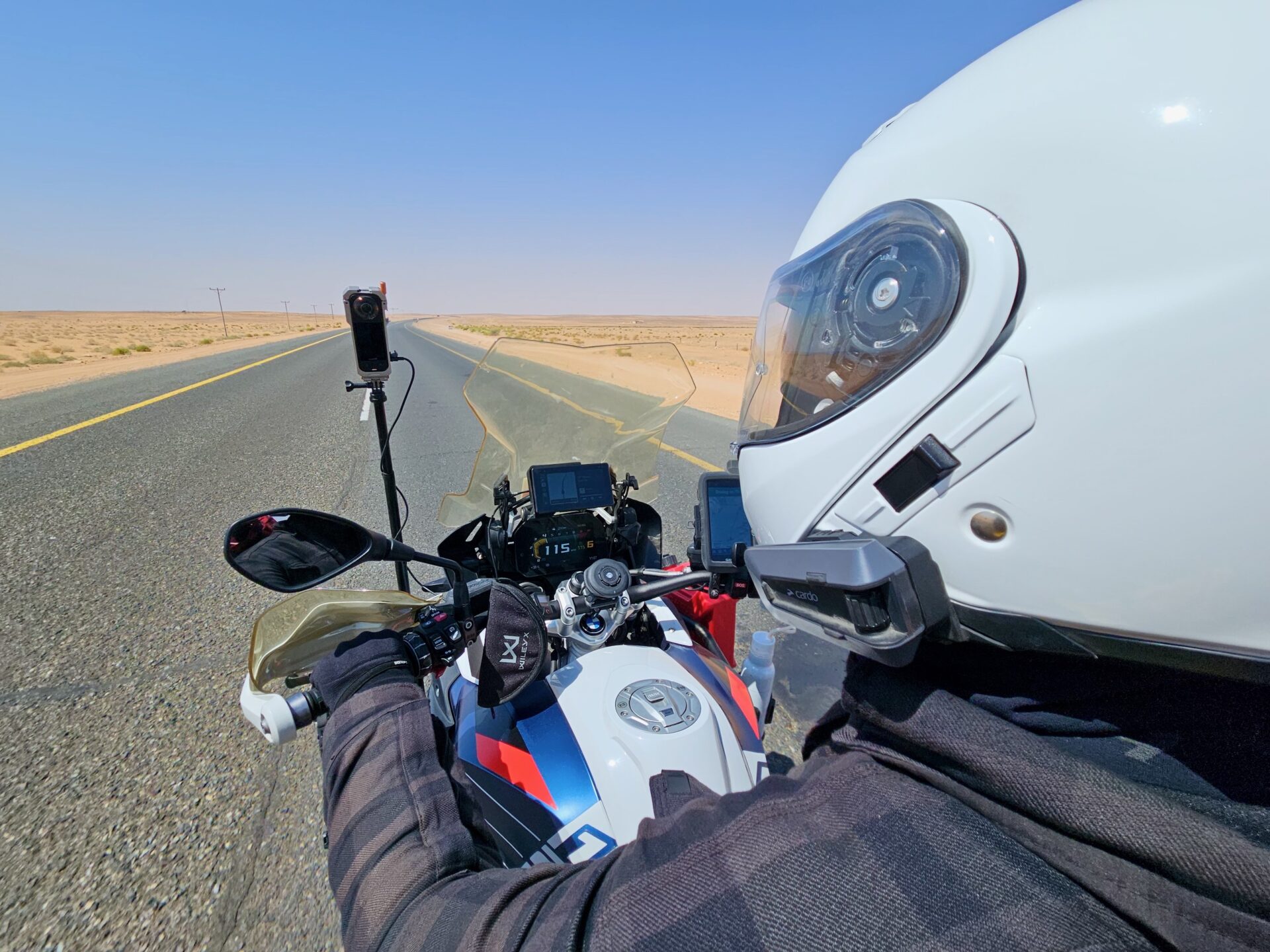
The first thing worth saying is that Saudi Arabia is built for moving — by car, bus, or motorcycle. A dense network of highways and expressways connects cities and regions, and in recent years the country has seriously upgraded both the quality and connectivity of its roads (they proudly tout top rankings and ongoing modernization projects). In practice, the main arteries are smooth, wide, and fast — and on some long-distance corridors, the speed limit now goes up to 140 km/h (though not everywhere — it applies only to selected major routes).
There’s also the flip side, which we felt firsthand: constant roadworks and upgrades. When lanes narrow or detours kick in, the temporary surfaces can get bumpy and the signage less clear. And if you miss an exit or a flyover turn, the next U-turn might be several kilometers away. Cities — especially the outskirts of Riyadh — are extremely car-oriented, with limited pedestrian infrastructure. In short, it’s not a “walkable city” kind of place.
Weather and environmental conditions deserve their own chapter: sandstorms can suddenly drop visibility to zero, and authorities regularly urge drivers to slow down or pull over when that happens. Outside cities, camels on the road are a real hazard — there are entire zones marked with warning signs — and the danger increases dramatically after dark.
Driving style and traffic culture
In the cities, the pace is fast and often assertive: quick lane changes, tailgating, and short following distances are all part of the rhythm. Studies from Riyadh have for years pointed to speeding, impatience toward slower drivers, and distraction as the most common risky behaviors — things have improved recently, but it’s still far from ideal.
At the same time, Saudi Arabia has significantly tightened traffic enforcement. The key player here is the SAHER camera network — fixed, average-speed, red-light, seat-belt, and phone-use cameras — operating 24/7 and effectively curbing reckless driving. And the data backs it up: according to WHO and partner reports, road fatalities and serious injuries have been steadily declining over the past few years. approx. 35–40% decrease in mortality on the roads between 2016 and 2021.
Road categories
To make sense of Saudi Arabia’s vast road network, it helps to understand two overlapping systems: the functional classification (what role a road serves) and the numbering scheme (how it’s labeled on maps and signs).
Functional classes (according to Saudi Highway Code / RGA):
- Highways / Freeways (urban & rural): fully grade-separated, access-controlled roads where speed limits for cars can reach up to 140 km/h on selected segments (lower for trucks and buses). They form the backbone connecting major cities and ring roads.
- Arterial Roads (principal / minor, including expressways): high-capacity routes designed for fast movement but with more exits, U-turns, and occasional intersections. Speed limits typically range from 120–100 km/h outside cities and lower within urban areas.
- Collectors – collect traffic from local streets and “feed” it onto arterial roads; moderate speeds.
- Local – commuting to properties, commercial areas, and residential areas.
The network is complemented by ring roads around major metros — Riyadh has the Eastern, Northern, Southern, and Western Rings — which handle most through traffic. Cities are currently upgrading these corridors under large-scale projects like the Riyadh Main & Ring Road Axes Development Program.
Signage and language: official guidelines call for bilingual road signs (Arabic/English) with exit numbers, but in practice many locations — even in Riyadh, the Saudi capital — still feature signage only in Arabic, which can make quick navigation tricky for foreign drivers.
Fines
Saudi Arabia doesn’t do half measures — fines are steep and enforcement runs 24/7. Here are the key penalties that can realistically affect a visiting driver:
Speed (example – sections with a speed limit of 120 km/h):
- +10–20 km/h: 150–300 SAR; +20–30: 300–500 SAR; +30–40: 800–1 000 SAR; +40–50: 1 200–1 500 SAR; above +50: 1 500–2 000 SAR.
- Red light: 3,000–6,000 SAR (intersection camera = automatic ticket).
- Phone in hand: 500–900 SAR.
- Seat belts: 150–300 SAR.
- Driving the wrong way: SAR 3,000–6,000 + penalty points; additional measures possible for repeat offenders.
How to check if any fines are “hanging” on your vehicle or your name? For foreigners, there’s an official e-service called “Query Traffic Violations for Visitors” on the Absher platform — you can verify your record using your passport number or border number.
Speed cameras and speed control
Saudi traffic enforcement relies on a dense SAHER camera network: intersections (red lights), straight sections (speed), lane discipline, and mobile phone use. The system combines fixed roadside units, grey boxes, and mobile setups — all operating in front/rear mode, meaning they capture plates from both directions (yes, motorcycles too). Everything is connected to the National Information Center and runs automatically.
Maps and navigation in Saudi Arabia
Simply put — navigation works. Google Maps, Apple Maps, and Waze guide you smoothly throughout the country.
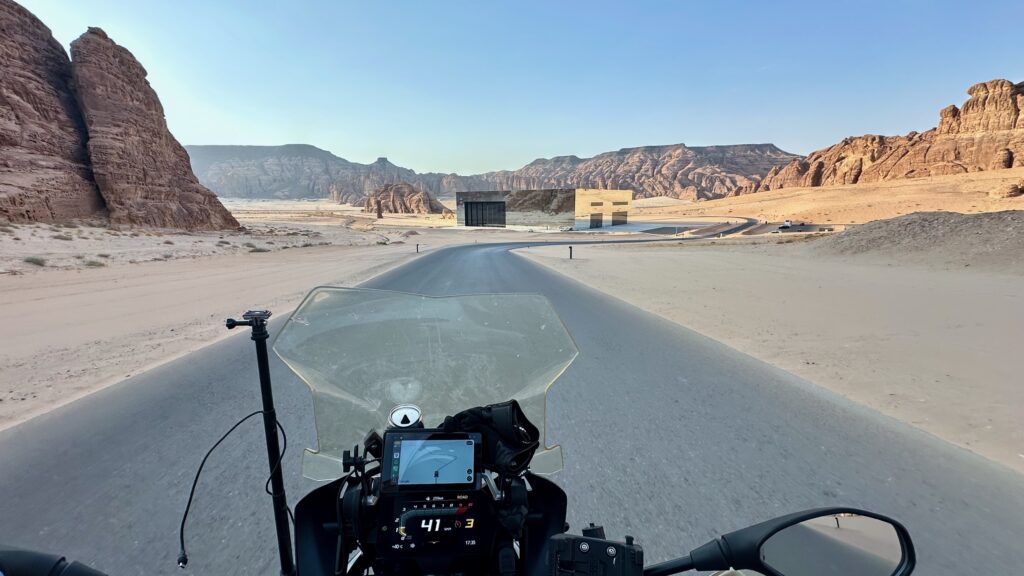
What really makes a difference is coverage outside the cities. Saudi Arabia is vast, and between towns the signal can drop to 2G/EDGE or disappear completely — we had that on the way to Al-Ula. With Zain KSA, we sometimes got only 2G; after switching to Mobily eSIM, we had more consistent 4G/5G — though that 5G wasn’t always as fast as it looked on paper.
For long, remote stretches, take a satellite device with SOS (e.g., Garmin inReach) — SOS works globally with an active subscription.
Security checks
From our experience, checkpoints in Saudi Arabia are quite rare. We mostly encountered road patrols or temporary controls — often related to pilgrimage routes — rather than fixed “gates” inside cities. On longer stretches, you’ll see the Roads Security Special Forces, a Ministry of Interior unit responsible for highway patrols and checkpoints at city entrances.
What do they usually check? In practice, the most common request is for the vehicle registration card (istimara), your driver’s license, and — if needed — an ID document. For rental cars, the rental agreement plus the car’s papers are usually enough. In our case, officers often asked for the istimara first, and never even wanted to see our passports. (“Istimara” is the official vehicle registration card managed through the Absher system.)
Fuel – availability and quality
From a driver’s or rider’s perspective, things are simple: Saudi stations offer 91 and 95 petrol, plus diesel. Outside major cities, you’ll more often find 91, while 95 is less common but still easily available along main corridors and at larger stations. If your car or bike requires 95 — stick to the manufacturer’s recommendation.
Prices (approximate, as of summer 2025, Aramco):
- 91 — 2.18 SAR/l,
- 95 — 2.33 SAR/l,
- diesel — 1.66 SAR/l.
The KSA publishes prices every month, and these values have been stable for a long time.
Quality-wise, since February 2024 all fuels in Saudi Arabia comply with Euro-5 standards — including diesel with sulfur content up to 10 ppm. In practice, that means cleaner emissions and reliable fuel with no surprises for modern engines.
Availability on the road: Stations are frequent along highways and junctions, and large service centers like SASCO include restaurants, shops, ATMs, and even small repair facilities. On some newer sites, the truck area is physically separated — diesel only — while cars have their own entrance with petrol pumps only, so it’s easy to take the wrong turn if you’re entering quickly.
Payment: Digital payments are the norm in Saudi Arabia. The local mada network is the default, but the Ministry of Commerce has explicitly stated that stations cannot require mada only or refuse Visa/Mastercard. In practice, terminals in rural areas can be hit-or-miss, so it’s still smart to keep some cash just in case.
Service: Most gas stations in Saudi Arabia are full-service, with attendants handling the refueling for you. There are a few self-service pilot stations, but they’re still rare — just pull up to the pump, and the staff will usually take care of the rest.
Tolls, vignettes, toll gates
Good news: Saudi Arabia has no tolls or vignettes for cars and motorcycles — the entire highway network is toll-free. The only exception is the King Fahd Causeway connecting Saudi Arabia and Bahrain, where you’ll pay around SAR 25 / BHD 2.5 per car. In 2022, the Ministry of Transport officially denied rumors about introducing tolls on existing roads.
Border fees and temporary entry of vehicles (TIP/CPD)
- Land border crossings: there’s no standard road fee for crossing the border with a private car or motorcycle. Customs (ZATCA) may direct vehicles through an X-ray scanner, but that’s part of the inspection process — not a paid toll or traveler’s fee.
- Carnet de Passages (CPD): not required for tourist entry. Most overlanders enter Saudi Arabia on an e-visa, presenting only the vehicle registration and valid insurance at the border.
- Vehicle authorization (if you’re not the owner): sometimes requested, though not always. The safest option is to carry a power of attorney in Arabic with an apostille — Saudi Arabia has been part of the Hague Apostille Convention since December 7, 2022. If you’re arriving overland from Iraq or Kuwait with a leased or financed vehicle, this document is effectively mandatory.
Vehicle insurance
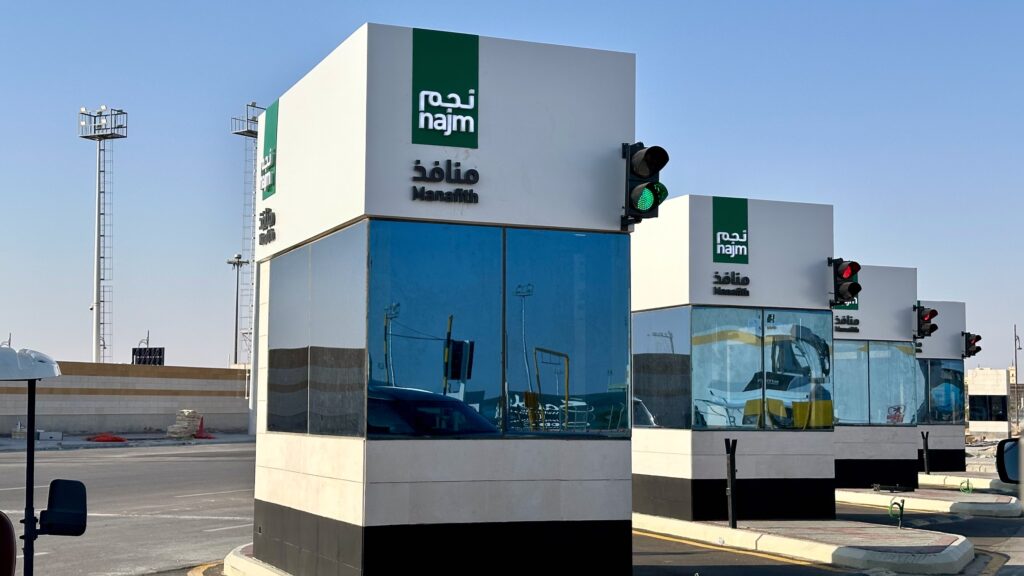
Mandatory third-party insurance for foreign-plated vehicles can be purchased online via the Manafith platform (app or web) or at the border counter. Online options include short-term coverage, for example one week for about 60 SAR. 2 weeks 90 SAR ), which is usually cheaper than a month for 130 SAR – in the case of a motorcycle.
Buying vehicle insurance in Saudi Arabia sounds simple — at least on paper. For non-GCC vehicles, there are two theoretical options: buy a one-month policy at the border counter, or use the official Manafith app to get short-term coverage (like one or two weeks). On paper it all looks smooth — but in practice… well, let’s just say it didn’t go that smoothly.
First, there was the registration battle on the iPhone — the app looked sleek, but the confirmation email never arrived. Then came round two on Android — and that’s where the real gem appeared: the system misread Poland’s country code. The field was preset to “+0048,” which the server interpreted as “++48,” so the verification SMS simply never came through.
In the end, we gave up on the digital route and just kept going without insurance. No one stopped us, no one asked — not even at the border on our way out.
Road safety
In Saudi Arabia, city driving can get pretty intense: big cars and trucks often claim the right of way, so in practice, “the bigger one wins”. On the left lane, following distances are tight, lane changes can be sudden, and turn signals don’t always mean what you think — so it’s best to drive predictably, keep extra space up front, and avoid power struggles on the road.
Road safety stats are moving in the right direction thanks to cameras and tougher penalties — but it’s still far from European standards, so driving cautiously really does pay off.
Near the borders, things can look a bit different from the country’s central regions. Close to Yemen (Jazan, Najran, Asir), you’ll encounter more frequent police checks and temporary checkpoints, and areas marked “border zone” are taken literally — movement there is limited. In the Empty Quarter (Rub’ al-Khali), distances between fuel stations are vast, cell coverage is unreliable, and entry to some protected zones requires a permit. It’s the kind of terrain that calls for a well-prepared route, extra fuel, and solid offline maps.