

Ten wpis jest również dostępny w języku:
 Polski
Hi! 👋
When planning your sightseeing in Kyoto, it’s easy to get carried away with the number of places to visit. You mark a few temples, a garden and some interesting little streets on the map, and before you know it, you’ve planned enough for one day to comfortably fill three 😄
It’s hardly surprising, though. Kyoto was Japan’s capital for over a thousand years and still has a huge number of historic sites. One interesting fact is that a single UNESCO listing covers as many as 17 separate sites, including temples, shrines and Nijō Castle. What’s more, not all of them are in Kyoto itself, as the listing also includes nearby Uji and Ōtsu. And those are just a small fraction of the places you can visit here.
During our stay, we wanted to see both the best-known sights and simply spend some time walking around the city. We didn’t make it everywhere, but we were happy with most of the places on our list. There were also a few where the number of tourists took some of the enjoyment out of the visit.
In this article, we’ll show you the places we actually visited, along with our impressions and information to help you plan your own route. We’ve grouped them by area so it’s easier to combine several places in one walk. We’ll also share where we think it’s worth allowing more time and where a shorter visit is enough.
If you’ve only just come across our posts about Japan, we’ve already written about our first stay in Tokyo and the places we visited there. We also have a separate, more practical article about Kyoto with details of how we got here, getting around the city, accommodation and our expenses.
Tenryu-ji
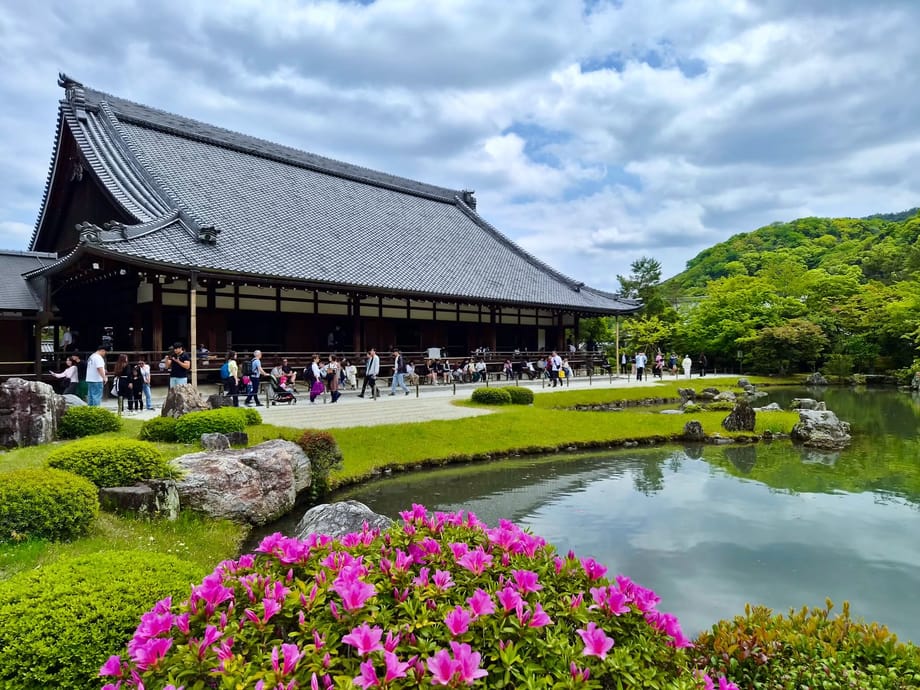
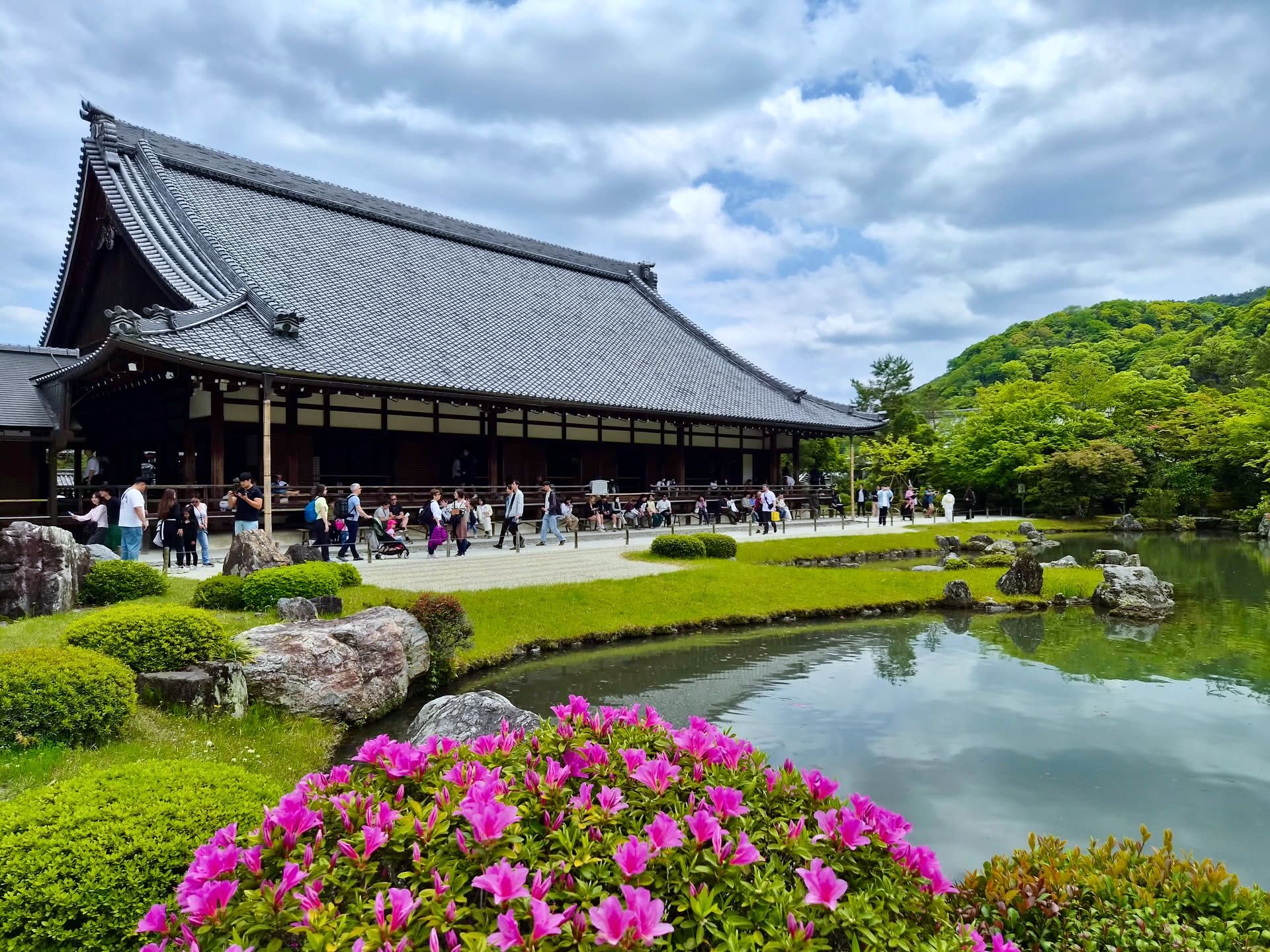
Arashiyama is best known for its bamboo forest, but right next to it is Tenryu-ji, one of Kyoto’s most important Zen Buddhist temples. What we remember most is the garden, which is well worth a look even if visiting temples isn’t really your thing.
The temple was founded in 1339 and has had a fairly turbulent history. Over the following centuries, the complex suffered eight major fires, so most of the buildings you see today date from later reconstructions. Interestingly, the Sogenchi pond garden has retained the layout designed in the 14th century by the monk Musō Soseki. Tenryu-ji has also been a UNESCO World Heritage Site since 1994.
The most interesting thing here is the approach to garden design. It uses a technique called shakkei, literally meaning “borrowed scenery.” The idea is to incorporate the natural surroundings into the composition. So the Arashiyama mountains visible behind the pond aren’t just an incidental backdrop, but part of the overall design. Once you know that, you start looking at the arrangement of the trees, rocks and paths a little differently.
Entry to the garden alone costs 500 JPY per person, so 1000 JPY for the two of us. If you also want to look inside the temple buildings, there’s an additional charge of 300 JPY per person. Visiting the hall with the huge dragon painting on its ceiling costs extra too (500 JPY). The garden is open from 8:30 to 17:00, with last entry at 16:50.
There’s one more practical detail. The garden’s north exit leads directly toward the Bamboo Forest, so you can combine both places in one walk without returning to Arashiyama’s main street.


Arashiyama Bamboo Forest
The bamboo forest in Arashiyama is probably one of the most recognizable places in all of Kyoto. We’d seen photos of the tall green bamboo lining both sides of the path many times before our trip. So we were curious to see what it was like in person.
The first thing that might surprise you is its size. The main path through the Bamboo Forest is only about 400 meters long, so walking through takes roughly 10-15 minutes. It runs between the area around the small Nonomiya Shrine and the Ōkōchi Sansō garden. So this isn’t a huge forest with kilometers of hiking trails, although the photos can give you a rather different impression.
The bamboo really is tall, though, and grows so densely that in places it’s hard to see what’s behind it. The path is surrounded by greenery, with light filtering through the stalks and leaves. It’s also worth listening to the sound of the bamboo moving in the wind. It’s a very different setting from the forests we’re used to in Poland.
Entry to the Bamboo Forest is free. The path is open to the public, and you don’t need a ticket or a reservation. You can walk through at any time, although there is no regular lighting after dark.
There is, however, one detail that most popular photos don’t show: the number of visitors. The Bamboo Forest attracts plenty of tourists, and you’re unlikely to find an empty path during the day. If you want photos without strangers in the background, it’s best to arrive early in the morning, before the larger groups turn up.


Togetsukyō Bridge
While you’re in Arashiyama, it would be a shame to skip Togetsukyō Bridge, which is just a few minutes’ walk from Tenryu-ji and the bamboo forest. You can comfortably see all three during one visit to this part of Kyoto.
The bridge is 155 meters long and crosses the Katsura River. On one side you can see the buildings of Arashiyama, and on the other the river and wooded mountains. It looks particularly good from the riverbank, where you can take in the whole bridge and its surroundings. There are also walking paths nearby and spots where you can watch boats on the river.
The bridge itself has quite an interesting history. The first crossing was built here back in the 9th century, while the current structure dates from 1934. Although it looks wooden at first glance, its main elements are made of reinforced concrete, with wood used for features including the railings.


Kinkaku-ji
Kinkaku-ji is in northwestern Kyoto, so unlike the sights in Arashiyama, you’ll need to plan a separate journey to get there. There isn’t a subway station right by the entrance. The easiest option is to take a bus to the Kinkakuji-michi stop and then walk for a few minutes.
The main attraction is, of course, the Golden Pavilion, standing beside Kyōko-chi pond. Its upper two floors are covered in real gold leaf, while the lowest floor is not gilded. Interestingly, each floor was designed in a different architectural style. The lowest draws on aristocratic residences, the second on samurai houses and the third on Chinese Zen temples. A phoenix figure sits on top.
The history of the place is actually more interesting than you might expect. In the late 14th century, the grounds belonged to the shogun Ashikaga Yoshimitsu, who built his residence here. After his death, it was converted into a Buddhist temple. Its proper name is Rokuon-ji, but the distinctive pavilion became so recognizable that the whole complex came to be known as Kinkaku-ji.
There is one detail worth knowing, though. The building we see today does not date from the 14th century. The original pavilion was set on fire by a young monk in 1950 and burned to the ground. It was rebuilt five years later, and the gilding was restored in 1987. The arson even inspired Yukio Mishima’s novel “The Temple of the Golden Pavilion.”
The visit itself is fairly straightforward. You don’t go inside the Golden Pavilion. You view it from outside, mainly from across the pond, and then follow a marked route through the gardens. Along the way, there are smaller buildings, a small waterfall and a historic teahouse. We’d allow around 45-60 minutes for the whole visit, not including travel time.
Tickets cost 500 JPY per adult, so 1000 JPY for the two of us. The temple is open daily from 9:00 to 17:00.

Nishiki Market
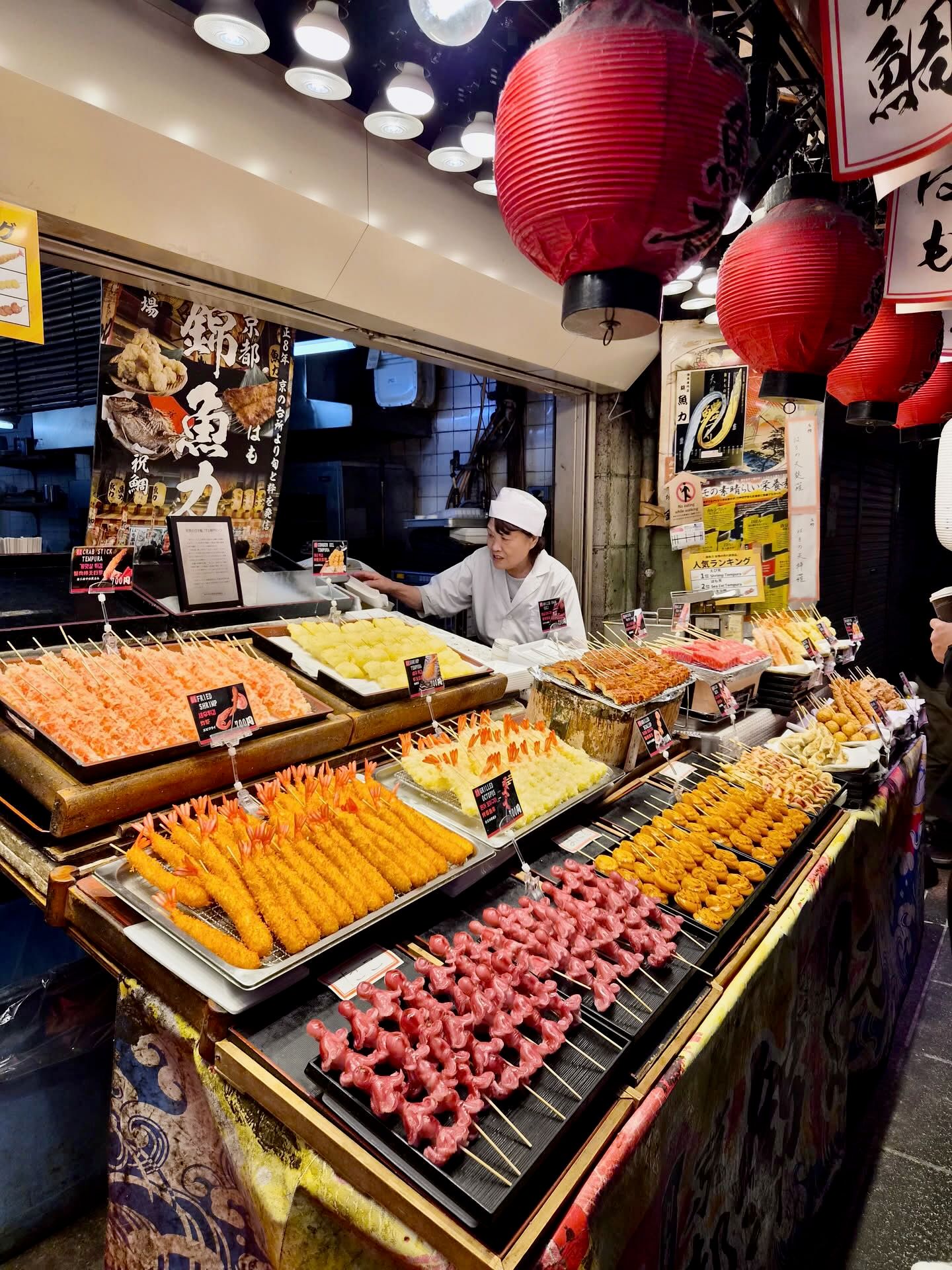
We really liked Nishiki Market. If you enjoy browsing local markets, trying food and seeing what’s sold in everyday Japanese shops, you could spend quite a while here.
The market itself is about 390 meters long, with more than 120 shops and stalls lining both sides of a narrow, covered street. You’ll find fresh fish, seafood, pickles, spices, Japanese sweets, tofu and plenty of ready-to-eat food. Nishiki’s history dates back to at least 1615, when the fish trade officially began to develop here.
Is it still a local market, or has it become an attraction aimed mainly at tourists? Probably a bit of both. There are still shops selling ingredients used in Japanese cooking, but it’s hard to miss how much the place also caters to visitors. That didn’t bother us. The choice of food and the chance to browse one stall after another were reason enough to come.
And if you’re still in the mood for shopping after eating, Nishiki connects to the nearby Teramachi and Shinkyogoku shopping arcades. There you’ll find shops selling clothes, shoes, cosmetics and all sorts of little things. You can pop in for a moment and then realize two hours have passed 😄
One practical point: you shouldn’t eat while walking around Nishiki Market. It’s best to eat what you’ve bought at the stall where you ordered it. With such a narrow street and so many visitors, that makes a lot of sense.


Gion and Yasaka Shrine
Gion is one of Kyoto’s most recognizable neighborhoods, mainly because of its preserved traditional buildings and geiko and maiko culture. If you’ve seen photos of old Japanese streets lined with wooden houses, there’s a good chance some of them were taken here.
One of the best-known streets is Hanamikoji, lined with traditional teahouses, restaurants and distinctive wooden machiya buildings. Gion developed as a neighborhood accommodating pilgrims visiting the nearby Yasaka Shrine, and over time it also became an important center for Japanese arts and entertainment. That tradition continues today, although alongside the historic buildings you’ll also find ordinary shops, cafés and modern buildings.
We’d recommend walking around Gion without a particularly packed itinerary. The neighborhood itself is relatively small, and the walk from Hanamikoji to Yasaka Shrine takes about 10 minutes. Just head east toward the distinctive red gate at the end of Shijo Street.


Yasaka Shrine is a Shinto shrine whose history, according to one account, dates back to 656. The current main building, however, dates from 1654, while the distinctive western Nishiromon gate was rebuilt in 1497. Inside the grounds, you’ll find several smaller shrines and a pavilion with numerous lanterns bearing the names of local businesses that support the shrine.
One interesting aspect is the shrine’s connection to Gion Matsuri, one of Japan’s best-known festivals. Its origins date back to 869, when residents of the capital at the time held religious rituals in the hope of ending an epidemic. The festival still takes place throughout July, and its most distinctive feature is the processions of huge, elaborately decorated floats pulled through Kyoto’s streets.
Entry to the Yasaka Shrine grounds is free, and the shrine can be visited around the clock. After dark, the gate and some of the buildings are lit up, making it an option for an evening walk too.


Yasaka Pagoda, Ninenzaka and Sannenzaka
If you recognize photos of Kyoto showing a narrow street, traditional wooden buildings and a tall pagoda at the end, this is most likely the area you’ve seen. And we have to admit, it looks really good in person. There’s just one problem: there are a hell of a lot of tourists here 😄
Walking from the Gion area toward Kiyomizu-dera, you’ll come across Yasaka Pagoda, a five-story pagoda belonging to Hōkan-ji Temple. It’s around 46 meters tall, and according to tradition, its origins date back to the 6th century. The distinctive tower rises above the rooftops of the surrounding houses and is hard to miss. Especially since so many tourists stop right here to have their photo taken.
A little further on are Ninenzaka and Sannenzaka, two historic streets leading toward Kiyomizu-dera. Stone steps, traditional machiya houses, small restaurants and shops selling ceramics, sweets and souvenirs. You can spend quite a while here browsing the shops, but with so many people, at times the walk feels more like slowly shuffling along with everyone else.
Interestingly, these buildings haven’t survived purely by chance. The Sannenzaka area was designated a protected historic district back in 1976, which helped preserve the streets’ distinctive appearance.
There’s also a rather gloomy superstition associated with Sannenzaka. According to an old story, if you fall on the stone steps here, you’ll die within three years. The story was already known in the 17th century, and gourds were once sold here as protection against that fate. With so many people squeezing past each other on the steps, you’d better watch your footing 😄
We definitely recommend this walk, especially as it naturally connects Gion with Kiyomizu-dera. Just don’t expect a peaceful stroll through empty streets like the ones you often see in photos. The crowds during the day are really huge, and people stopping every few meters to take photos make it even harder to get through.


Kiyomizu-dera
After walking through Ninenzaka and Sannenzaka, we finally reached Kiyomizu-dera, one of Kyoto’s best-known Buddhist temples. It’s hard to miss, with the distinctive red Nio-mon gate visible right at the entrance and more buildings of the complex beyond it.
The temple’s history dates back to 778, before Kyoto became Japan’s capital. Over the following centuries, the complex burned down and was rebuilt many times. Most of the buildings we see today date from 1633. Kiyomizu-dera has also been a UNESCO World Heritage Site since 1994.
The most interesting feature, though, is the wooden terrace projecting from the slope of Mount Otowa. It stands about 13 meters above the ground, supported by 18 massive wooden pillars. Interestingly, the structure was built without nails, using traditional Japanese carpentry joints. Looking at it from the side, it’s hard to believe the whole thing has been standing this way for almost 400 years.
The terrace has views over Kyoto, but we also recommend walking further toward Oku-no-in. From there, you can see the main building and its distinctive structure from a little distance. This is the angle used for many of the Kiyomizu-dera photos you’ll find online.
The complex is also home to the Otowa Waterfall, from which the temple takes its name. Kiyomizu means “pure water,” and the spring itself has been a site of religious practice for centuries. Visitors can collect water from the waterfall using the long-handled ladles provided.
Entry costs 500 JPY per person, so 1000 JPY for the two of us. The temple opens daily at 6:00 in the morning and usually closes at 18:00, although opening hours are extended during certain periods.


Fushimi Inari Taisha
Fushimi Inari Taisha is one of those places in Kyoto you’ll probably recognize from photos, even if the name itself doesn’t mean much to you. It’s the place with the distinctive red torii gates, lined up one after another to form long tunnels through the forest. It’s really interesting to see in person, especially once you realize just how large the whole complex is.
Fushimi Inari is a Shinto shrine with a history dating back to 711. It is dedicated to the deity Inari, originally associated with rice cultivation and good harvests, and later also with prosperity in business. This is the head shrine of Inari in Japan, where there are around 30,000 similar places of worship.
The most distinctive features are, of course, the torii gates. There are around 10,000 of them across the mountain, many donated by businesses and individuals. They are a way of giving thanks for prosperity or asking for good fortune in the future. On the backs of the gates, you can see Japanese inscriptions with the donors’ names and the dates of their donations. This custom became widespread during the Edo period, between the 17th and 19th centuries.
Look out for the fox statues in different parts of the complex too. They aren’t just decorative. In Shinto tradition, foxes, known as kitsune, are messengers of the deity Inari. Some hold keys in their mouths, while others carry objects symbolizing things such as good harvests and prosperity.
The visit itself can take much longer than you initially expect. The best-known section, Senbon Torii, is relatively close to the shrine’s main buildings. Beyond that, the path heads up Mount Inari, which is 233 meters high. Along the route are steps, smaller shrines and more gates. Walking the full loop usually takes around 2-3 hours, but of course you can turn back earlier.
The biggest crowds gather around the lower torii tunnels. If you feel like a longer walk, it’s worth continuing, as the number of visitors usually drops the higher you go. You don’t need to reach the summit to see the most distinctive part of Fushimi Inari, though.
Entry is completely free, and the shrine grounds are open around the clock. So you can arrive very early in the morning, before the larger groups of tourists turn up.

