

Ten wpis jest również dostępny w języku:
 Polski
Hi! 👋
After Tokyo, it was time for the next stop on our first trip to Japan. Since we were already there, we wanted to see more than just the huge capital and find out whether Kyoto really was the calmer contrast to Tokyo that people often describe.
On paper, it all adds up. Kyoto is much smaller, with around 1.43 million residents, while Tokyo is on a completely different scale. So we were also expecting a slightly slower pace, fewer people and a bit more breathing room after several days in Tokyo.
Well, a small spoiler here: fewer residents does not mean fewer people on the streets.
Kyoto is one of Japan’s most popular tourist destinations, and you really feel it in many parts of the city. Around the temples, in Gion and along the routes to the best-known places in particular, the crowds can be bigger than we expected. The city itself keeps detailed tourism statistics and has been dealing with visitor pressure on some neighbourhoods for years.
Even so, Kyoto felt completely different from Tokyo right from the start. Different buildings, more walking, a different pace of getting around and a much bigger role for buses. Then, of course, there is all the history, which you do not feel in quite the same way in Tokyo.
This post is a natural continuation of our earlier articles from Japan. If you have only just found us, we have already written about our first stay in Tokyo, the places we actually visited there and getting around the city.
Now it is time for Kyoto. How we got there, where we stayed, how we got around, whether the buses really are as much of a pain as people sometimes say, how much our stay cost and, above all, whether we really found a bit of peace and quiet after Tokyo.

How did we get from Tokyo to Kyoto?
We did not spend long deciding how to travel between Tokyo and Kyoto. We wanted to ride the Shinkansen, and for this distance it is also simply the most convenient option. We boarded at Tokyo Station and arrived at Kyoto Station just over two hours later.
We chose a standard-class carriage with reserved seats, so there was no need to look for somewhere to sit once we boarded. Three main types of train run on the Tokaido Shinkansen: Nozomi, Hikari and Kodama. They all go to Kyoto, but differ in the number of stops. Nozomi makes the fewest stops and covers the Tokyo-Kyoto route in around 2 hours and 10 minutes. Hikari takes around 2 hours and 40 minutes, while Kodama stops practically everywhere and takes considerably longer.
We bought our tickets online in advance, with seat reservations. Of course, you can use a ticket machine or ticket office at the station, but if you know the day and approximate time you want to leave, we do not really see a reason to leave it until the last minute 😄 The official SmartEX website lets you choose a specific train and seats from a carriage map, and you can change your reservation before departure. If your trip is completely spontaneous, buying a ticket at the station obviously makes more sense.
And yes, the Shinkansen is punctual. Not in the sense of “around that time”. The train arrives, people get off, the staff prepare the train and a moment later it carries on according to the timetable. After our experiences in Poland, we tend to instinctively allow a bit of extra time for “what if something happens”, but we did not need it here.
On the way back, we took the Shinkansen with reserved seats again, but this time we did not go all the way to Tokyo Station. We got off at Shinagawa, because we were spending our last night near Haneda. The next morning, we had our flight home from Haneda Airport via Beijing to Warsaw, so rather than return to the centre and cross half of Tokyo again in the morning, we went straight towards the airport. Our hotel was close enough to the terminal that all we had to do in the morning was get ready and walk through a tunnel to the airport.

First impressions after Tokyo
When we came out of Kyoto Station, we did not really feel much of a difference yet. Lots of people, a huge station and a route to the subway full of passengers. If someone had asked us then where this supposedly “calmer Kyoto” was, the answer would have been short: not here yet 😄
It was only when we started walking around the city that the differences became much more noticeable.
The first was the scale of the buildings. In Tokyo, you often walk between tall buildings, multi-level stations, elevated roads and wide main streets. In Kyoto, we were much more often surrounded by buildings just a few storeys high, small ground-floor shops, houses standing right by the street and side streets barely wide enough for a car.
This is not just a coincidence or a matter of “historic atmosphere”. Kyoto has long kept a close eye on the city’s appearance. It has protected selected landscapes since 1930, and in 2007 it tightened building height restrictions. The city also regulates the appearance of advertising and new buildings so that they do not dominate the historic buildings and views.
That is why even an ordinary walk can feel different from one in Tokyo. You do not have to be at a temple or on an old street in Gion. In many parts of the centre, you can still see kyo-machiya, the traditional narrow townhouses. Their distinctive feature is that they look modest and narrow from the street, but extend far back into the plot. This layout is sometimes called an “eel’s bed”.
The second thing we began to notice as we walked was the street layout. Central Kyoto has a very regular grid. This is not a modern development. When Heian-kyo, the predecessor of today’s Kyoto, was founded in 794, the city was planned on the model of China’s Chang’an. The streets ran parallel from east to west and north to south, and that layout is still very clear in today’s city centre.
It creates a slightly funny effect. On the one hand, the streets can be very narrow and quiet, but on the other, it is easier than in Tokyo to work out where you actually are, because much of the centre is built on a regular grid.
Then there are the city’s surroundings. Kyoto lies in a basin, with mountains to the north, east and west. In Tokyo, it is easy to forget where one city ends and another begins, because the built-up area is almost continuous. In Kyoto, mountains appear much more often at the end of a street or in the background. Visually, this gives the city clearer boundaries.
How many days did we spend in Kyoto, and was it enough?
We were in Kyoto from 25 to 28 April, so we had three nights and, in practice, around three days there. That worked out quite well for a first stay, as we managed to see everything on our list and still set aside a whole day for a trip to Nara.
It also shows that you do not have to plan a whole week in Kyoto to get something out of it. If you group places sensibly and do not try to travel from one end of the city to the other every day, three days can be enough to see quite a lot.
How do you get around Kyoto?
After Tokyo, we expected transport in Kyoto to be simpler because the city itself is much smaller. And in some ways it is, but it works differently. In Tokyo, we almost always had a train or subway station nearby. In Kyoto, you are much more likely to need a combination of train, subway, bus and some walking.
The biggest trap at the beginning is that, looking at a map, it is easy to assume the bus is the best option because it takes you almost to the door of a particular temple. But it shares the road with all the traffic, stops constantly and can get really full around popular places. If there is a train or subway nearby, it is often faster to cover most of the route by rail and only walk or take a bus for the final stretch.
Buses in Kyoto
In the centre, most regular Kyoto City Bus routes have a flat fare of JPY 230 per ride. During our stay, we usually boarded through the rear door and paid when getting off at the front. With an IC card, you simply tap your Suica or another accepted card on the reader as you get off. On routes that go beyond the flat-fare zone, the process may be different: you also tap your card when boarding so the system knows where you started your journey.
It helps to know this beforehand, because on Tokyo buses we had got used to paying when boarding. In Kyoto, you might spend a moment wondering whether you have missed something.
The stops are shown on a display inside the bus, so you do not need to know Japanese. Press the STOP button before your stop, then pay as you get off.
It is better not to board a bus with a large suitcase, though. It is not formally prohibited, but Kyoto’s buses are often full, and one large suitcase can take up the space of several people. The problem has become significant enough for the city to run a “Hands Free Kyoto” campaign, encouraging visitors to leave luggage in storage or have it sent directly from Kyoto Station to their hotel.
If you arrive by Shinkansen with large bags, the subway, a train or having your suitcases delivered to your hotel may make more sense than squeezing onto a crowded City Bus with them. Kyoto Station has plenty of lockers and luggage storage facilities, as well as same-day luggage delivery services to your accommodation.


The subway, JR, Keihan, Hankyu and other railways
This is where things might initially look like a repeat of Tokyo: several operators again 😄
Kyoto’s subway has just two lines. The Karasuma Line runs mainly north to south, passing through Kyoto Station, Shijo and Karasuma Oike. The Tozai Line crosses the city more from east to west, passing through Higashiyama, Sanjo Keihan and Nijo, among other places. The two lines meet at Karasuma Oike.
So the subway is straightforward, but it will not get you everywhere on its own. That is why other rail operators become useful when sightseeing.
JR is particularly convenient if you are starting at Kyoto Station. The JR Nara Line goes directly to Inari, next to Fushimi Inari Taisha, while the Sagano Line is one of the simplest ways to reach the Arashiyama area. JR is also useful for a trip to Nara, of course.
Keihan runs along the eastern side of the city. It is a very useful line if you are staying in or exploring the areas around Gion, Sanjo or Fushimi. From Gion-Shijo, you can travel directly towards Fushimi Inari, and Keihan stations are also conveniently placed for some of Higashiyama’s sights.
Hankyu is mainly useful in the centre, around Kyoto-Kawaramachi and Karasuma, and lets you continue towards Arashiyama or Osaka. Kyoto-Kawaramachi is right in the middle of one of the city’s busiest areas, so it can be a much more convenient starting point than Kyoto Station.
There is also Kintetsu, which serves Nara among other destinations, and the small Randen railway, which you can use when exploring the western part of the city and Arashiyama.


Suica and IC cards
This part was easier for us, because we arrived from Tokyo with our Suica cards and simply kept using them.
You do not need to buy a separate “Kyoto card”. Suica works on the city’s subway and buses, as well as with many rail operators in the Kansai region. The same applies to other cards in the nationwide interoperability system, including ICOCA and PASMO.
On the subway, it works exactly as you would expect: tap your card at the gate when entering and again when leaving. On buses, how you use it depends on the type of route, but on regular city services we paid with Suica when getting off.
This is particularly convenient because you might use the subway, JR, Keihan and a bus in a single day without having to work out which paper ticket to buy each time.
The one familiar issue remained the same as in Tokyo: with a physical IC card, it is best to keep an eye on the balance. Subway top-up machines still take yen, not a regular payment card. With Suica in Apple Wallet, we did not have to worry about that, because we could top it up on our phones.
Can you explore Kyoto on foot?
Yes, and for us, walking was the main way we explored Kyoto. Our hotel was near Omiya, so the location worked quite well for our plans. For many places in the centre, we could simply head out in the morning and walk, without checking bus or subway options every time.
Kyoto lends itself well to this, especially if you stick to one part of the city on a given day. The centre is fairly compact, and you can comfortably walk between Shijo, Nishiki Market, Kawaramachi, Gion and further into Higashiyama. We often chose to walk rather than take public transport for one or two stops, because there was always something along the way that we would not have noticed from a bus. The city itself also suggests walking as a sensible alternative for many popular places, especially when buses are stuck in traffic.
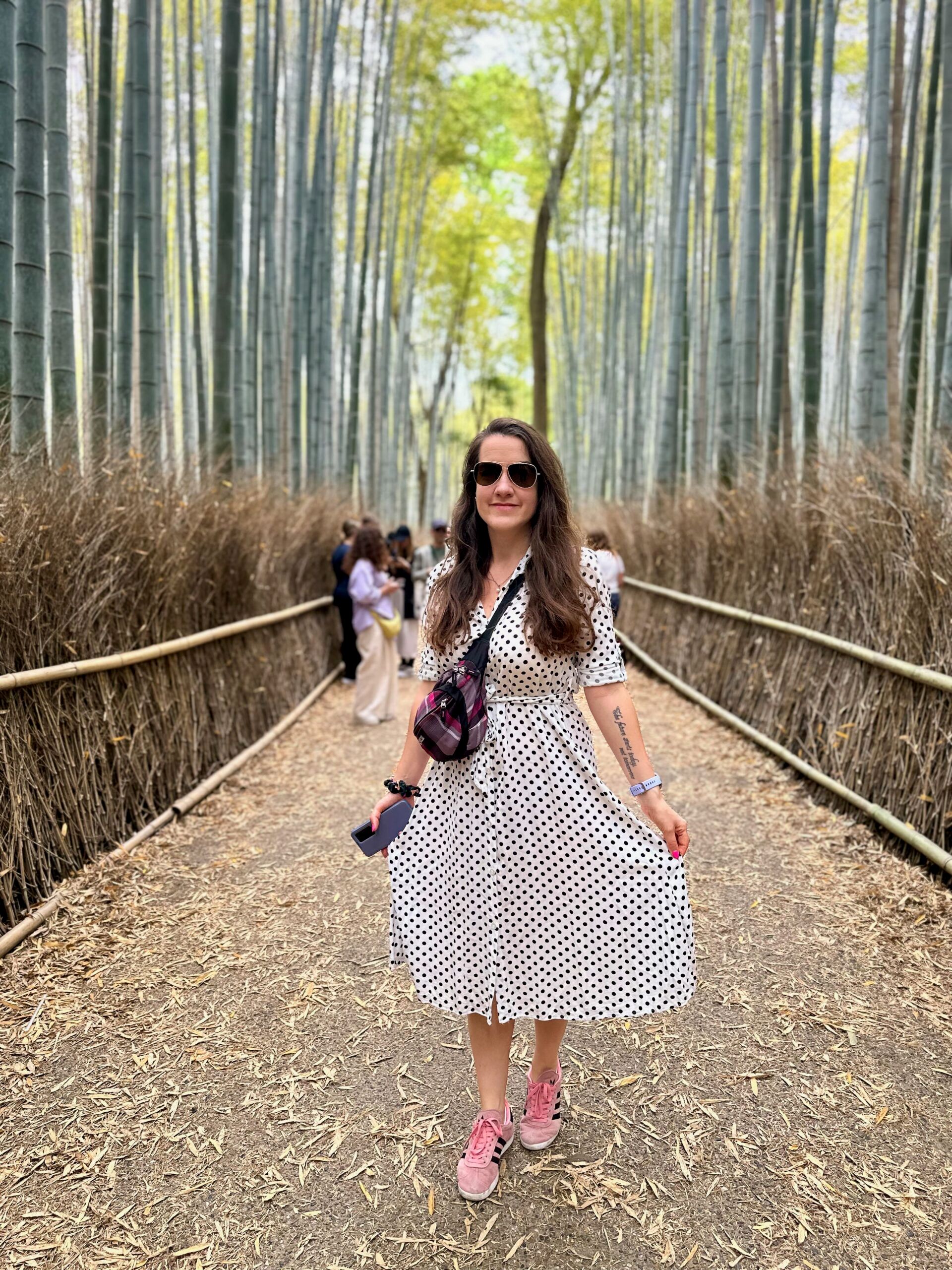
Just make sure you look at the map beyond the city centre. Kyoto is spread out, and some places are definitely too far away for a reasonable walk. Arashiyama and the Bamboo Forest are on the western side of the city. We used transport to get there, because walking well over ten kilometres just to start the actual sightseeing would not have made much sense. From the centre, you can take Hankyu, Randen or JR, then explore the whole area on foot from the station.
It was a similar story with Byodo-in, which we had planned to visit but ultimately did not reach. The temple is in Uji, outside Kyoto itself. A rapid service on the JR Nara Line takes around 17 minutes from Kyoto Station to Uji, followed by roughly a 10-minute walk.

Crowds in Kyoto: when are they worst?
A lot depended on where we were. All it took was stepping away from the most popular routes, and at times we could walk along almost empty side streets.
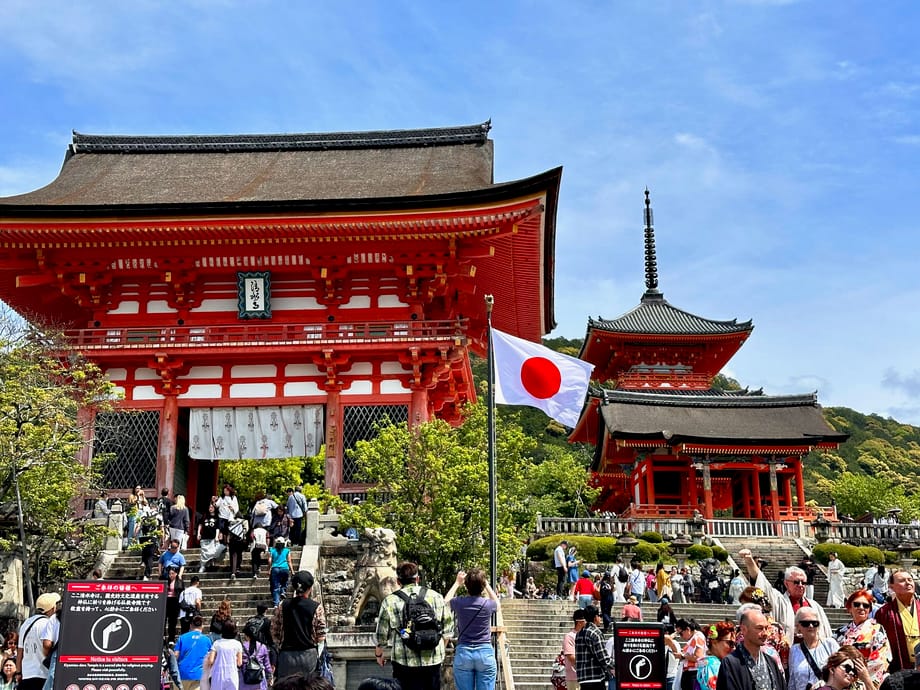
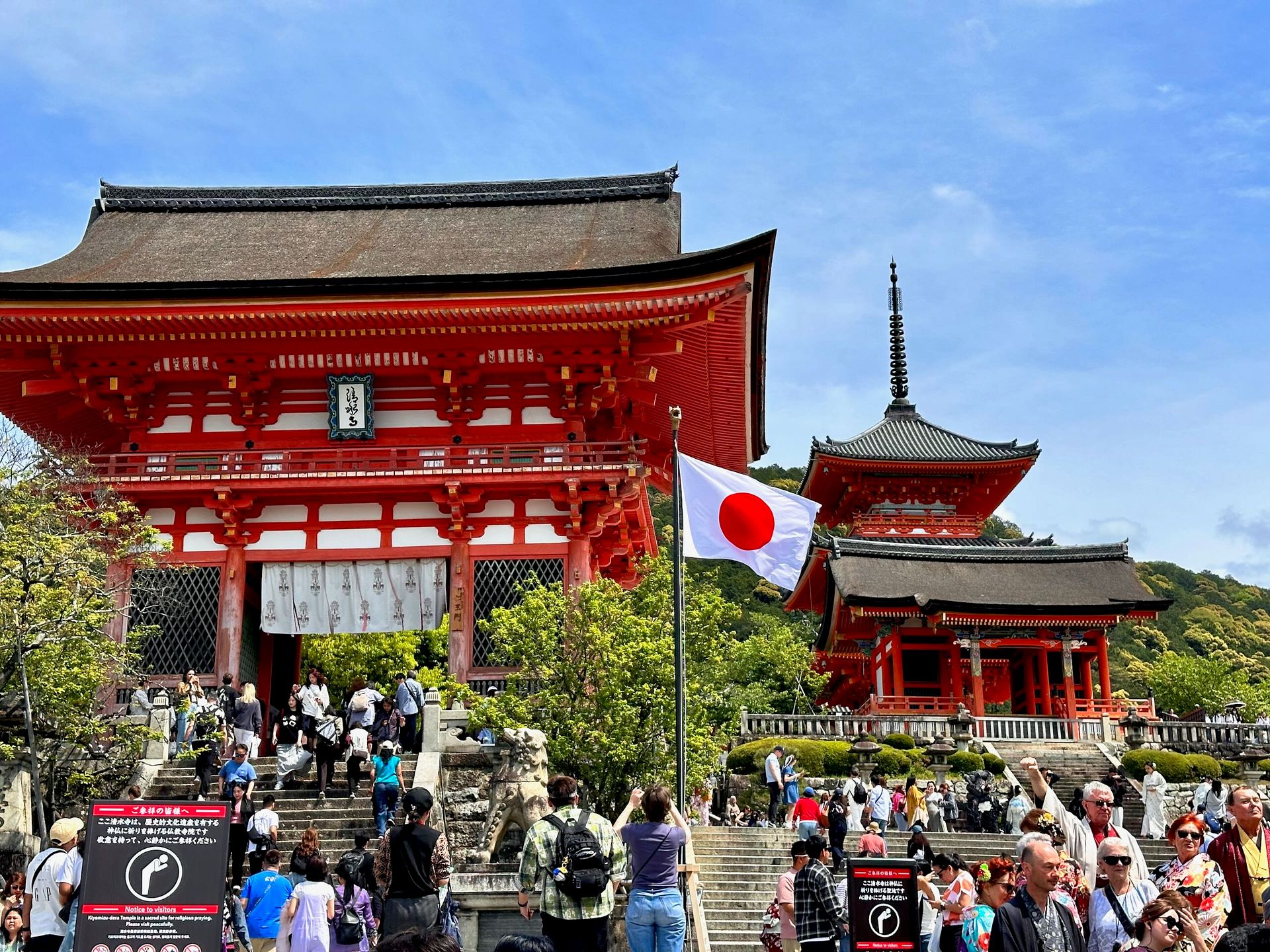
Our biggest encounter with the sheer number of tourists was on the way to Kiyomizu-dera. It was really packed there 😄 The closer we got to the temple, the more the street became one continuous stream of people moving in both directions. Add shops, restaurants, people stopping for photos and tour groups, and even a relatively short stretch can take a long time.
The layout of the place partly explains it. There are essentially two main approaches to the Kiyomizu-dera grounds: via Kiyomizu-zaka or Chawan-zaka. A large share of visitors therefore end up on the same narrow streets leading to the temple.
If the temple itself is your main priority, the solution is fairly simple: Kiyomizu-dera opens as early as 6:00 am. We are not going to pretend we got up before dawn every day just to get a photo without people in it (we would not even have felt like doing that xD). The temple normally stays open until 6:00 pm, with longer hours for selected events and seasonal evening openings.
There is a trade-off, though. At six in the morning, you can see the temple in much quieter conditions, but some shops and places to eat along the approach streets will still be closed. If you also want to explore the area, eat something and see the streets going about their normal day, you have to accept that there will be more people.
There are also periods when you should be particularly prepared for crowds. Visitor numbers are highest during cherry blossom season from late March to early April and in autumn, roughly from mid-November to early December. Golden Week, at the end of April and beginning of May, is also particularly busy. During our stay in late April, the city introduced additional crowd information and cameras specifically because of the expected visitor numbers over this period.
Gion is not a theme park
Gion is probably one of the places where the downside of Kyoto’s huge popularity is most visible. For a tourist, it means old streets, traditional buildings, teahouses and the chance of spotting a geiko or maiko along the way. But for residents, it is still an ordinary neighbourhood, not an attraction arranged for photos.
So let us start with who geiko and maiko actually are, because outside Japan you are more likely to hear the word “geisha”. In Kyoto, the term geiko is used. They are professional artists trained in traditional dance, music, singing and hosting gatherings at teahouses, among other skills. A maiko is an apprentice training to become a geiko. It is usually maiko who stand out with more colourful kimono, hair ornaments and distinctive makeup. In Kyoto, this culture is still an active part of five traditional kagai districts, including Gion Kobu, Gion Higashi and Pontocho.
And their popularity with tourists has been a problem for years.
People have stopped geiko and maiko in the street, followed them, taken photos from very close up and even tried to touch them. Yet if you see a geiko or maiko walking through Gion, she is usually simply on her way to work or an appointment, not taking part in a performance for passers-by. In southern Gion, the rules are therefore very clear: do not stop them, follow them or photograph them without permission.
The second issue is the streets themselves. Some look as though everything around you is public space, but that is not the case. Gion has private roads and properties that you cannot enter just because they look good in a photo. Photography is also prohibited in some of these places.
Then there is simply blocking the streets. Hanamikoji and the side streets are not huge pedestrian avenues. Cars use them, people come out of their homes and businesses, and a group standing in the middle for several minutes to take one photo can make it difficult for everyone else to get through. That is why visitors to Gion are also reminded not to step into the road for photos or obstruct traffic.
For us, this was a useful reminder of how easy it can be, when travelling, to slip into thinking “everything here is for tourists”. That is definitely not the case in Gion. You can walk around the neighbourhood and take photos where it is allowed. But if you come across a geiko or maiko, the best thing to do is simply let her pass.
And if you actually want to see their dancing and learn more about this culture, there are places specifically set up for that. One is Gion Corner, which hosts performances of Kyoto’s traditional arts. There are also organised meetings and performances with geiko and maiko for which you can buy a ticket or make a reservation.
Where did we stay in Kyoto?
We chose Hotel M’s Plus Shijo Omiya for three nights and paid PLN 1,240 for two people for the whole stay from 25 to 28 April.
The hotel is practically next to Omiya station, around a two-minute walk from Hankyu Omiya and the Randen tram stop. The location worked very well for us: we were close enough to the centre to explore much of the city on foot, and when we wanted to go further, public transport was right on our doorstep.
The room itself was not large. After Tokyo, that was no longer much of a surprise, as we had already become familiar with compact rooms in Japanese hotels. The smallest rooms at M’s Plus are just 12 m², with other options measuring 15-16 m², so this is not a hotel you choose for vast amounts of space. It was perfectly enough for three nights, though, especially as we spent most of each day out of the hotel anyway.
Our booking was without breakfast, and we chose that deliberately. On a short stay, we did not want to start every day at a hotel buffet when shops and places to eat were just a few minutes away, and trying food around the city was one of the things we wanted to do while sightseeing.
Food in Kyoto
It is hard to complain about the choice of food in Kyoto. Ramen, sushi and yakitori are easy to find, but we also soon started coming across things that we either had not noticed in Tokyo or had not previously associated specifically with Kyoto.
For us, the best place to see that variety in one spot was Nishiki Market. Calling it simply street food would not really do it justice. It is a narrow, covered market street around 390 metres long, with more than a hundred shops and places to eat. Trade here goes back several hundred years, and an official fish market was already operating in the early 17th century. There is a reason Nishiki earned the nickname “Kyoto’s kitchen”.
You can buy fresh fish and seafood, vegetables from the Kyoto region, dried foods, seasonings, pickles, tofu, sweets and ready-to-eat food. There are grilled skewers, oysters, sushi, dashimaki, a Japanese omelette made with dashi, tempura and hamo, a fish closely associated with Kyoto cuisine. Other displays hold less familiar things, such as yuba, the delicate layer that forms on the surface of heated soy milk, or nama-fu, a wheat gluten product used in traditional cooking.
This is where you can get a slightly better sense of what makes the food associated with Kyoto different. Tofu, yuba, vegetables, pickles and dashi all play a big role. There is also obanzai, home-style dishes originating in the kitchens of Kyoto residents, usually based on seasonal vegetables and simple ingredients. At the other end is kaiseki, a much more formal, multi-course style of dining. One city, but quite a difference between those two ways of eating.
Nishiki does have one catch, though. With so much food practically right under your nose, the instinct is to buy something and keep going, but eating while walking through the market is discouraged. You eat what you buy at the stall or in a designated area. In places, the street is little more than three metres wide, so when it is busy, someone walking with food in one hand and a phone in the other soon starts getting in everyone’s way.


Payments, cash and ATMs
After Tokyo, we were not expecting anything radically different here, and that was how it turned out. In Kyoto, we also paid for most things by card, and we think we only withdrew cash once. What is more, we did not get through that cash particularly quickly afterwards.
It shows just how much Japan has changed in this respect. You can still come across places where cash is the only option, particularly at some temples, smaller places to eat or for small purchases, but cards are very often accepted at hotels, larger restaurants, shops and konbini. Kyoto’s official tourist information still recommends carrying some yen, precisely because some temple admission fees are cash-only.
We did not carry large amounts of cash “just in case”, though. A few thousand yen in our wallets was enough as a reserve, and we paid for everything else by card or Suica.
ATMs are not a problem either. They are not on every corner, but it would be hard to call them difficult to find in the city. Once again, Seven Bank ATMs were the easiest option for us. You can find them in 7-Eleven stores, among other places. They accept foreign cards and have menus in several languages.
Just pay attention to one thing when withdrawing cash. If the ATM asks whether you want the transaction processed in Polish zloty or Japanese yen, we chose JPY. The PLN option usually means that the ATM operator handles the conversion through DCC, rather than leaving it to your bank or card provider. Seven Bank itself explains both options for withdrawals with foreign cards.
What did we see in Kyoto?
We did not want to make another list of sights here, because this post is more about what staying in Kyoto is actually like. Knowing how transport works, where to stay and how much cash to carry is one thing; deciding which places you actually want to see is another.
Over those few days, we visited Kiyomizu-dera, Gion, Nishiki Market and the Bamboo Forest, among other places, and came across plenty more along the way that we did not treat as separate stops to “tick off”. We did not get through everything we had written down before the trip.
And that was probably a good thing, because in Kyoto it is very easy to put together a plan that has you rushing from one temple to the next from morning to night. After a few places like that, the names start to blur together, and you end up paying more attention to the next bus than to where you actually are 😄
That is why we have put together a separate post about the places we visited ourselves in Kyoto. We share our route, what actually impressed us, where the crowds became tiring and which places we would happily visit again. Without adding sights just because they appear on every “must-see” list.
If you are at the stage of marking places on a map, you can find our separate Kyoto sightseeing guide here.


How much did our stay in Kyoto cost?
Adding up our expenses, our stay in Kyoto cost around PLN 3,263 for two people. That includes three nights of accommodation, the Shinkansen journey from Tokyo and the return trip, plus our day-to-day spending there. We also spent one of the three days on a trip to Nara.
The biggest part of the budget went on things paid for before we even started sightseeing. Accommodation cost PLN 1,240.02, and the return Shinkansen journeys cost PLN 1,264.62 for both of us. Together, that is already around PLN 2,505, or more than three quarters of the total.
For day-to-day spending from 25 to 27 April, we recorded around PLN 758 in our tracker. That includes restaurants, groceries, konbini, coffee, Suica top-ups and other smaller expenses. It works out at roughly PLN 253 a day for the two of us, excluding the hotel and travel between Tokyo and Kyoto.
We do not count ATM withdrawals as separate costs, because that would mean counting the same money twice. For the same reason, we treat the PLN 758 as more of a guide than an exact account down to the last grosz, since we later spent some of the yen in cash.
In the end, that comes to around PLN 1,630 per person for three days in Kyoto, including accommodation and the return Shinkansen journey. This makes it clear where the money really went. Food, public transport and getting around the city were not particularly expensive. It was mainly the high-speed train journey and accommodation that pushed up the overall cost of the trip.