

Ten wpis jest również dostępny w języku:
 Polski
Hi! 👋
In our previous post, we told you what our first stay in Tokyo was like: how we got around, where we stayed, roughly how much we spent and what our first impressions were after landing.
Here, we’re focusing only on the places we actually made it to.
This won’t be a classic “20 Tokyo attractions you must see” list, though. Tokyo is too big to sensibly run from one point to another, especially when some places are on opposite sides of the city. We usually chose one part of Tokyo and spent a few hours there, combining places that were close to one another.
That’s why we organized this post in a similar way. Akihabara, Ueno, Asakusa, Shibuya, Harajuku, Shinjuku and a few less obvious places will appear here in the same groups in which we visited them.
We didn’t see everything, and we didn’t even try to. This is simply our route around Tokyo from our first trip – with places we liked, some that were a little less interesting and a few we ended up at simply because they caught our attention.
Akihabara
Akihabara was the first part of Tokyo I got to spend more time in, because this was where the company event took place. And I think it was a good place to start, because you immediately get a substantial dose of the city that you may have previously known mainly from photos: lots of people, colorful facades, neon signs, huge advertisements and shops squeezed in practically everywhere.
The history of this neighborhood explains well where its current character came from. After World War II, Akihabara developed as a place where radio parts and electronics were traded. Later, increasingly large stores selling equipment, computers and components began to appear, and over time games, manga, anime, figurines and the entire otaku culture joined the electronics. Today, these two worlds are mixed together practically at every turn.
What stands out most, though, is the number of people. Akihabara can get really crowded, especially around Akihabara Station. And there’s one more thing worth remembering – on Sundays, the main street is closed to cars and turns into a pedestrian promenade, precisely because so many people pass through there.
Despite all the crowds, the neighborhood is surprisingly compact. Away from the main thoroughfare, you quickly find much smaller streets where shops are literally right next to one another, sometimes spread over several floors, sometimes hidden above another business. That’s where Akihabara becomes more interesting than it looks on postcards, because next to a figurine shop you might find a small computer-parts store, a retro-game shop or electronics whose purpose we wouldn’t even try to guess.


Ueno Park and Ameyoko Market
If you start your day in Akihabara, you can easily walk to Ameyoko. It’s roughly 15–20 minutes from Akihabara Station, and about 20–25 minutes to Ueno Park itself. This is one of those parts of Tokyo where there isn’t much point in going underground and catching a train for just one stop every time.
Ueno Park
Ueno Park is one of those places that lets you disconnect from Tokyo’s dense urban landscape for a while. It was established in 1873 and is one of the oldest public parks in Japan. The land previously belonged to Kan’ei-ji Temple, which was associated with the Tokugawa clan, so there is quite a lot of history beneath the ordinary label of “city park” here.
The park itself is large and consists of more than just paths and trees. It is home to museums, temples, Shinobazu Pond and the oldest zoo in Japan.
And then, of course, there are the cherry blossoms in April. Ueno is one of Tokyo’s better-known hanami spots and can attract really large crowds when the trees are in full bloom. We managed to catch the tail end of the season, so as you can probably guess – we didn’t quite manage to hit the cherry blossoms at their perfect moment 😆.


Ameyoko Market
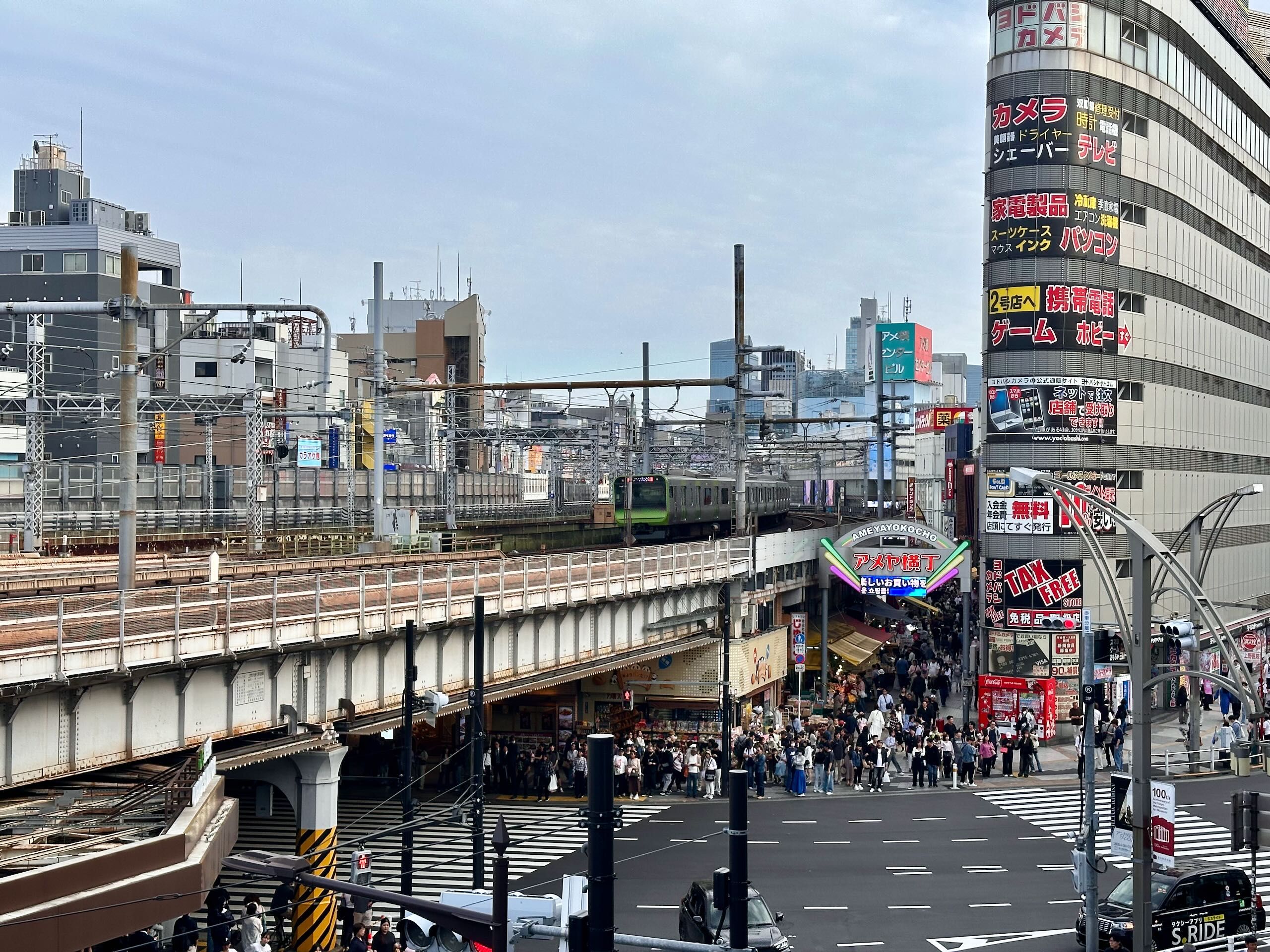
On the other side of Ueno, you get practically the opposite of the park. Ameyoko is about half a kilometer of very dense rows of shops, stalls and businesses stretching between Ueno and Okachimachi stations, partly under the railway tracks. There are plenty of places selling practically everything: food, fish, clothes, cosmetics, spices and all kinds of small items.
The place itself has an interesting history. After World War II, there was a black market here selling, among other things, goods from the United States. Trade eventually became legal, of course, but the layout of the streets and the character of the market remained.
You can feel that while walking around. It’s cramped, noisier than the park, vendors try to shout over one another, trains pass overhead, and there are shops and food on both sides. It feels more like a classic Asian bazaar than an orderly shopping center.

Asakusa – Kaminarimon, Nakamise-dori and Sensō-ji
If, after Akihabara and Ueno, you’re hoping Asakusa will be a little quieter, this probably isn’t the right address 😄 This is one of the busiest parts of Tokyo, and around Kaminarimon it can get seriously packed.
It all starts at Kaminarimon, or the “Thunder Gate.” This is the main entrance leading toward Sensō-ji and one of Asakusa’s most recognizable landmarks. The current gate dates from 1960, as the previous one burned down in the 19th century. Statues of Fujin and Raijin, the gods of wind and thunder, stand on either side, and a huge red lantern weighing around 700 kg hangs in the middle.
After passing under the gate, you immediately enter Nakamise-dori. This is about 250 meters of shopping street leading straight to another temple gate. On both sides, there are around 90 small shops and stalls selling souvenirs, sweets, fans, ceramics and small snacks. The tradition of trading in this location dates back to the 17th century, so this isn’t a modern street built specifically for tourists, even though there are obviously plenty of tourists here today.
And Nakamise is exactly where you can best feel how popular Asakusa is. The street isn’t wide, people stop at stalls, take photos, try food and all move in roughly the same direction. When it’s busy, you move through it rather than taking a relaxed stroll. That doesn’t take away from the place’s charm, but if you’re expecting an empty little street leading to an old temple, reality looks a bit different.


At the end, you reach Sensō-ji, the oldest Buddhist temple in Tokyo. Its origins are connected to a legend from 628, when two fishermen supposedly pulled a statue of Kannon from the Sumida River. The first temple was built here later, in 645, and the complex was repeatedly destroyed and rebuilt over the following centuries. Today, Sensō-ji remains one of Tokyo’s most important places of worship and attracts around 30 million visitors a year.
There is a little more space on site than on Nakamise, so you can walk around the main hall, pagoda and the rest of the complex at a more relaxed pace. Still, don’t expect the kind of silence you might find at a small temple somewhere outside the city. Sensō-ji is both a place of worship and one of Tokyo’s biggest attractions, so these two worlds coexist here.


Tokyo Skytree
After walking along the Sumida, the natural next stop is Tokyo Skytree, which you can see somewhere in the background practically the entire time. Up close, it makes a bigger impression than it does in photos, mainly because of its scale. The tower is 634 meters tall and is the tallest broadcasting tower in the world.
There are two observation levels at the top. Tembo Deck is at a height of 350 meters, and above it there is Tembo Galleria, reaching around 450 meters. We treated Skytree primarily as an opportunity to finally see Tokyo from above and get a better sense of how enormous this city is.
And from this perspective, the scale starts to feel slightly absurd. The urban landscape stretches practically to the horizon, and entire neighborhoods that had previously seemed huge suddenly look like small sections of one continuous mass of buildings. On the one hand, it can be a little overwhelming, because it is only from here that you can really see how densely built-up Tokyo is. On the other, it is simply interesting, because it makes it easier to understand the enormous area we had been moving around during the previous days.
Tickets aren’t excessively expensive for this type of attraction. Currently, entry to Tembo Deck alone starts at 1800 JPY per adult, while a package that also includes Tembo Galleria starts at 3000 JPY when purchased online. There is an additional fee at the on-site ticket office, so buying your ticket online in advance makes more sense.
Do you need to go all the way to the highest available level? Not necessarily. The panorama from 350 meters is already wide enough to give you a full picture of the city. The higher level is an interesting extra, but the biggest impact comes when you first walk up to the window and see Tokyo stretching out below you practically without end.


Tokyo Station and the Imperial Palace area
Tokyo Station makes an impression before you even go inside. On the Marunouchi side, there is a brick building from 1914 that regained a look close to its original appearance after renovation. It contrasts somewhat with the surrounding office buildings and modern architecture in this part of the city.
Once you go inside, it’s a completely different story. Tokyo Station handles urban, regional and long-distance traffic, including Shinkansen trains, while underground there are more passages, shops and restaurants. It’s easy to spend more time there than you planned, especially on your first visit. Simply getting between the right platforms can take a while, so when changing trains, it’s better not to leave yourself just two minutes of spare time.


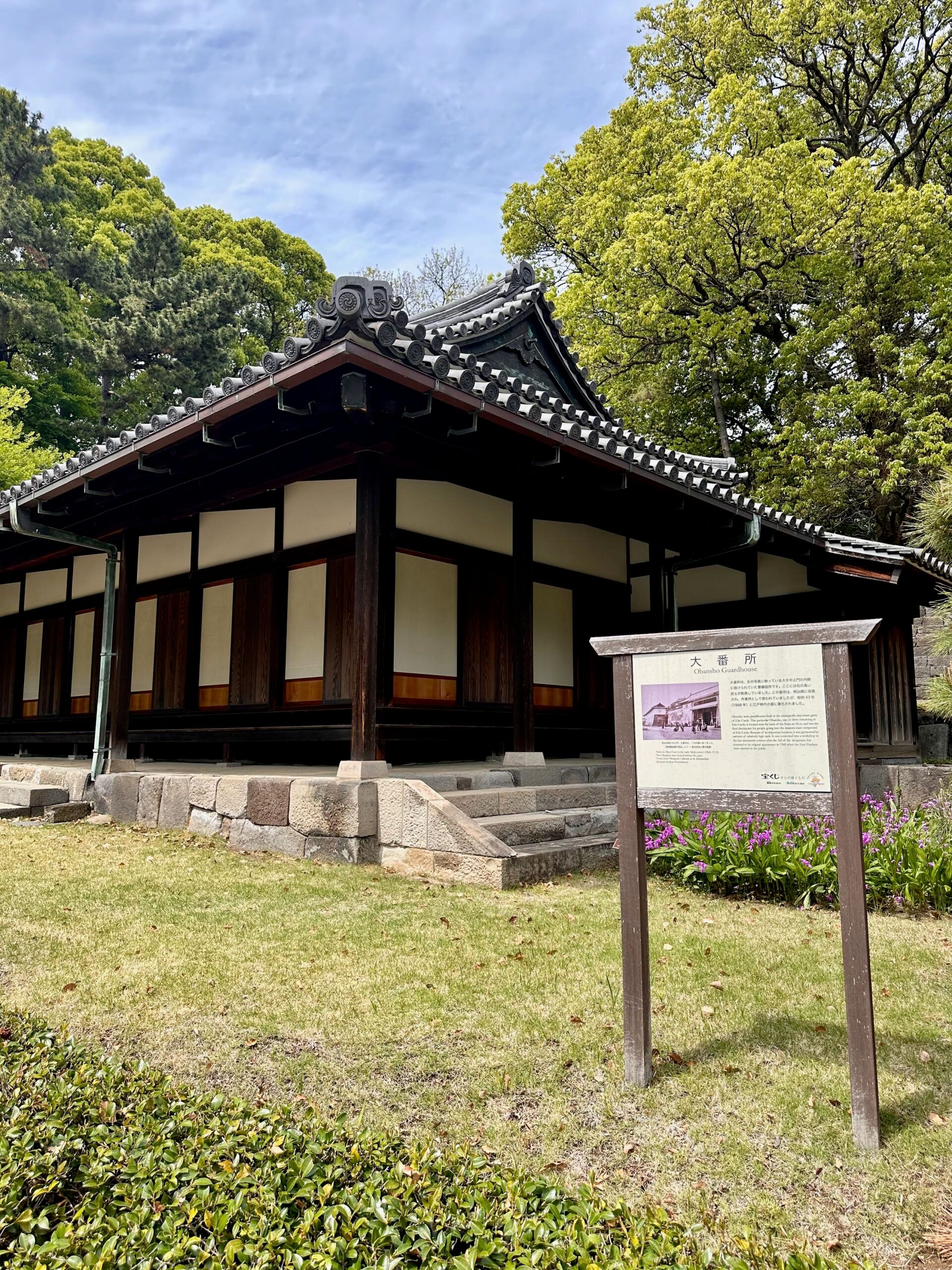
From the Marunouchi side, you can later walk toward the Imperial Palace area. You can’t enter the palace itself freely like a museum. It is still the official residence of the imperial family, so most of the complex remains inaccessible. Visitors can mainly access the moat area and the East Gardens, or the Imperial Palace East Gardens.
In the gardens, you can see fragments of the former walls of Edo Castle, broad green spaces and remnants of old buildings, among other things. Admission is free, but you should remember that the gardens are closed on certain days. As a rule, the East Gardens are closed on Mondays and Fridays, with exceptions related to holidays and imperial events.


Ginza
From the Tokyo Station area, you can easily walk to Ginza. It’s about a 15-minute walk, so with this kind of itinerary, there isn’t much point in going back down to the subway. Along the way, the buildings become increasingly commercial, until you reach one of Tokyo’s best-known shopping districts.
The name Ginza has a very literal origin, by the way. In 1612, a mint producing silver coins was moved to this area, and it was from this that people began informally calling this part of Edo “Ginza.” The mint disappeared long ago, but the name remained, and over time the neighborhood grew into one of the city’s important commercial centers. By the end of the 19th century, large shops were already operating here, and the area had begun to be associated with Tokyo’s more elegant side.
Today, this is best seen on Chuo-dori, Ginza’s main street. Department stores stand next to boutiques of global brands, shops often occupy entire buildings several stories high, and the architecture is noticeably more orderly than, for example, in Akihabara. Chuo-dori itself is about 1.2 km long.
If you come here on a weekend or public holiday, it’s even more pleasant. In the afternoon, part of Chuo-dori is closed to cars and turns into a wide pedestrian promenade. This tradition has been in place since 1970. Around 230,000 people reportedly walked along the closed street on the very first day, so the idea clearly caught on.


Shibuya – Hachikō, Shibuya Crossing and Center-gai
Shibuya is another part of Tokyo where the crowd stops being background scenery and becomes part of the place itself. As soon as you leave the station, you come across the Hachikō statue, one of the best-known meeting points in the city. The dog’s story is fairly well known: for years, he waited outside the station for his owner, even after the owner’s death. The statue itself is small, but practically all the time someone is taking a photo there or waiting for someone.
A few steps away is Shibuya Crossing, the intersection that appears in films, advertisements and practically everywhere someone wants to show Tokyo in a single image. When the lights change, more than a thousand people can cross it at the same time. The most interesting thing is that, despite the number of people, the movement still looks surprisingly efficient.
We also wanted to see the crossing from above. Instead of buying entry to an observation deck, we went into the Starbucks in the QFront building opposite the intersection. It was a good idea, but we weren’t the first to think of it 😄 The second floor has a direct view of the crossing and is one of the more popular places for watching all the movement from above, so finding a spot by the window can take a while.


On the other side of the intersection, Shibuya Center-gai begins: a network of narrower streets full of shops, restaurants, bars and karaoke venues. This is one of the main areas associated with Shibuya’s youth culture, fashion and nightlife. It’s crowded during the day, while in the evening the neon signs and even more people appear, so the character of the place changes with the time of day.
Harajuku – Meiji Jingu, Takeshita Street and Omotesando
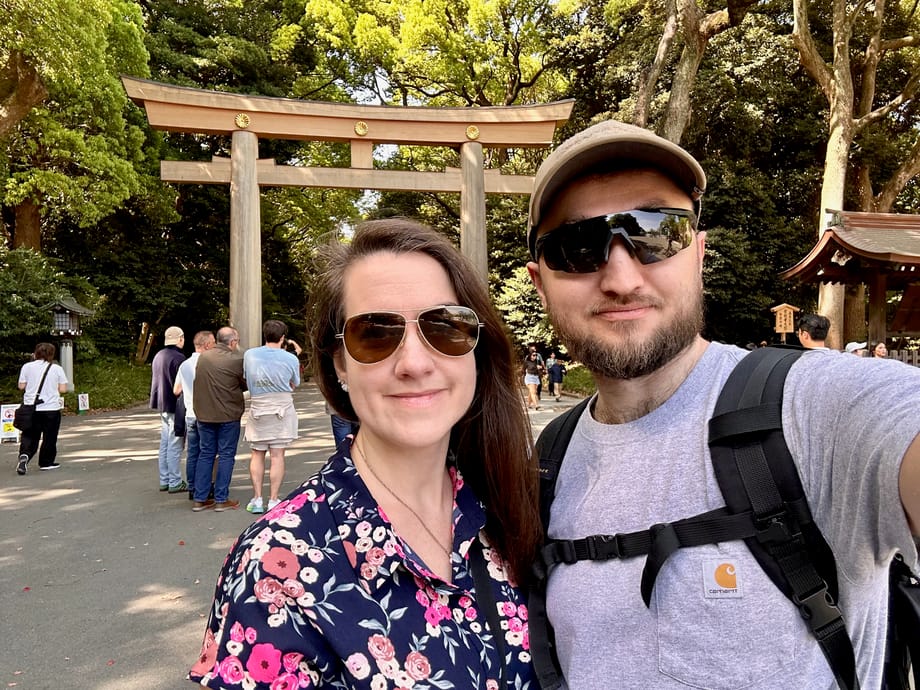
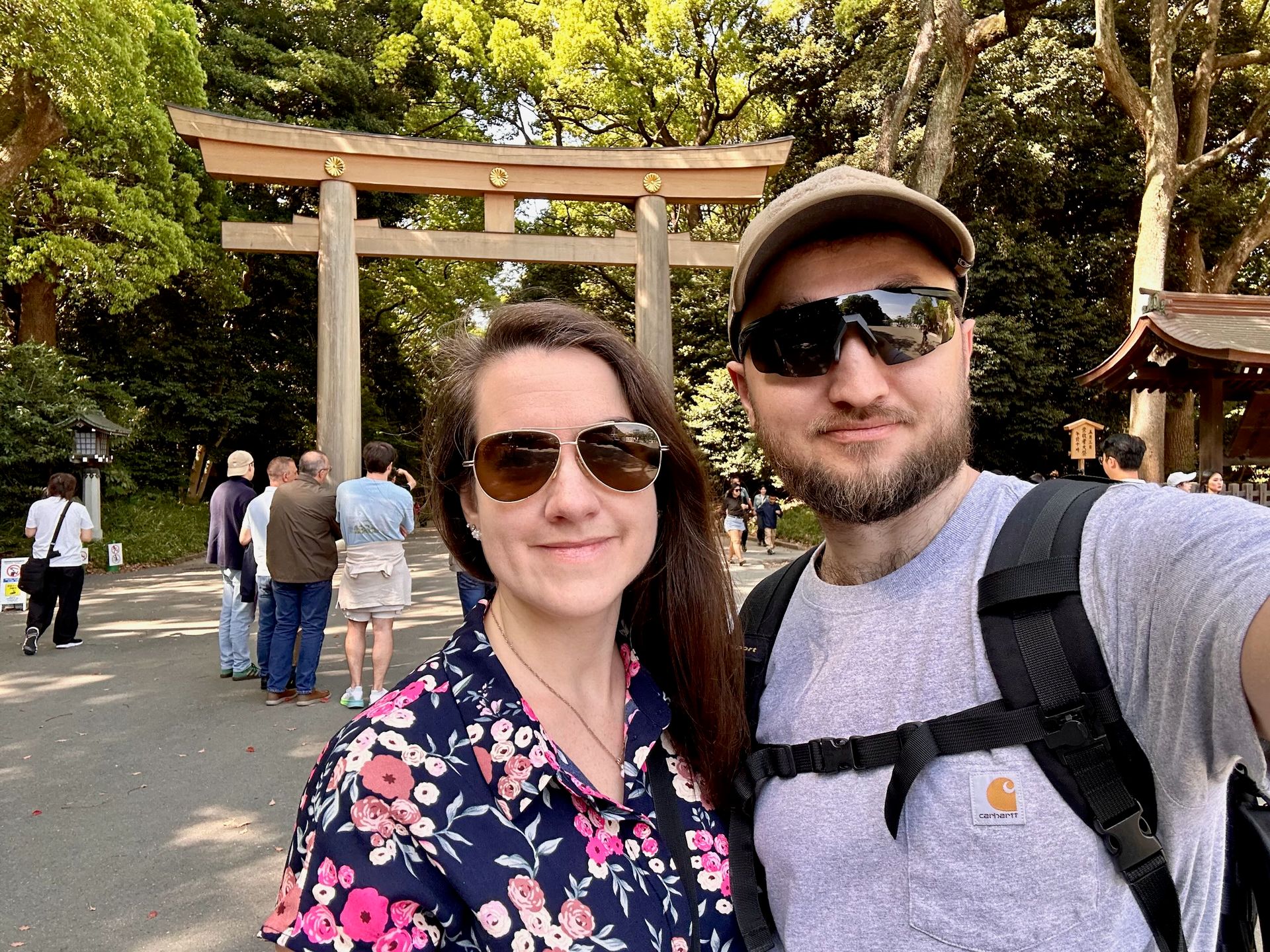
Harajuku is mainly associated with fashion, youth culture and Takeshita Street, but a few minutes from the station you can enter Meiji Jingu, where the atmosphere changes completely. The shrine itself was completed in 1920 and dedicated to Emperor Meiji and Empress Shōken. The forest surrounding it is not a natural remnant of old Tokyo. It was planned and planted with around 100,000 trees donated from all over Japan, with the intention that it would eventually develop into a self-sustaining ecosystem.
Entry to the Meiji Jingu grounds is free, and opening hours change with sunrise and sunset.

After leaving this greenery, you can walk toward Takeshita Street, and suddenly everything goes back to typical Harajuku. The street is about 350 meters long and starts practically opposite JR Harajuku Station. It’s narrow, very crowded and full of shops selling clothes, accessories, sweets, purikura and things aimed mainly at younger customers.
Walking along this short street can take much longer than the map would suggest, because people stop at shop windows, take photos or stand in line. Harajuku has a long history connected with youth fashion and kawaii culture, so Takeshita Street is still one of the most characteristic places in this part of Tokyo.
A few minutes farther on, things become more elegant. Omotesando is a wide, tree-lined avenue with boutiques of major brands, galleries and buildings designed by renowned architects. The name is also connected with Meiji Jingu, as the street was the main road leading to the shrine.


Shinjuku – the garden, Kabukichō and Golden Gai
It’s best to split Shinjuku into two parts of the day. Start with Shinjuku Gyoen, and only later head toward Kabukichō and Golden Gai, when it starts getting dark and this whole part of the city takes on more character.
Shinjuku Gyoen is a large garden that once belonged to the imperial family and is now a public national park. Its grounds include gardens in several styles, large lawns, ponds, a greenhouse and plenty of space for an ordinary walk. In a Tokyo full of people and buildings, this kind of green space makes a very good break between neighborhoods.

After dark, you can head toward Kabukichō. This is one of the best-known parts of nighttime Shinjuku, full of bars, restaurants, hotels, neon signs and all kinds of entertainment. During the day it still looks fairly ordinary, but in the evening it much more closely resembles the Tokyo you know from nighttime city photos.


A few minutes farther on is Golden Gai. This is a very small area with six narrow alleys and around 280 tiny bars. Some venues can accommodate literally just five or six people, so the scale is completely different from Kabukichō a few streets away. Most bars only start operating in the evening, often around 20:00, so arriving earlier doesn’t make much sense.
Golden Gai has also survived in a form that strongly resembles postwar Shinjuku. While most of the surrounding area was rebuilt several times, the narrow streets and very small venues here remain practically right next to one another. Just remember that some bars mainly cater to regular customers, and you shouldn’t take photos without permission.

Toyosu and Ariake – teamLab, the Gas Science Museum and the disaster prevention center
Toyosu and Ariake are already on Tokyo Bay, and the buildings here look completely different from those in the older parts of the city. There is more space, the architecture is more modern and things are a little less chaotic. We came here mainly for teamLab Planets, but since we were already in this part of Tokyo, we added two places that you probably won’t find high on standard attraction lists.
teamLab Planets
This was definitely the best of the three and one of the attractions we remember most fondly from all of Tokyo.
It is an interactive exhibition that you move through with your whole body. In some rooms, you walk barefoot through water; in others, you are surrounded by lights, mirrors, flowers and images that react to people’s presence. So you don’t view the works while standing in front of a wall. You step directly inside the installations and move between the different spaces.
It sounds a little abstract until you actually go inside. Once there, you quickly realize that you don’t need to know anything about contemporary art or analyze “what the artist meant.” You simply keep moving and see what has been prepared in the next room.
We really liked it. It’s unusual, occasionally strange, but above all, very well done. If we had to recommend just one paid place in this whole part of Tokyo, we’d choose teamLab Planets.
Getting there is easy too. The venue is a one-minute walk from Shin-Toyosu Station or about 10 minutes from Toyosu Station.


Gas Science Museum
A few minutes farther on is the Gas Science Museum, run by Tokyo Gas. Admission is free, and the exhibitions cover topics including energy, gas, safety, the environment and how infrastructure works in everyday life. A large part of the exhibition is interactive.
That said, we have considerably more reservations about this one.
First of all, the museum is strongly geared toward children. This is clear both from the exhibits themselves and from the activities on offer. Tokyo’s official guide also classifies it primarily as a family and educational venue.
The second problem is the language. A lot of the content was in Japanese, and without knowing the language, some of the exhibition lost its meaning. You can walk around, try the interactive stations and see a few things, but we probably wouldn’t recommend that an adult visitor from abroad make a special trip just for this museum.
If you’re already in Toyosu and are interested in infrastructure or are traveling with children, you can stop by. Otherwise, you can easily skip it.
Tokyo Rinkai Disaster Prevention Park
We found Sona Area Tokyo in Tokyo Rinkai Disaster Prevention Park a much more interesting idea. The park itself was not created solely as an educational attraction. In the event of a major earthquake, it is intended to serve as one of the main bases for coordinating rescue operations across the entire Tokyo metropolitan area. It includes space for emergency services, medical facilities, a heliport and the infrastructure needed to conduct operations after a major disaster.
The Tokyo Earthquake 72h Tour has been prepared for visitors. And those 72 hours are not an arbitrary number. The idea is that organized rescue operations may need around three days after a major earthquake, so during the first 72 hours you largely have to rely on yourself.
The visit begins with a simulated major earthquake. You then pass through a darkened corridor and a reconstruction of a damaged section of the city, answering questions along the way about what to do after a disaster. At the end, you reach a section devoted to what to prepare at home and how to function when normal infrastructure is not working for several days.
And here, we had somewhat mixed feelings. The subject itself is excellent, especially in Japan, where earthquakes are a real part of life. We expected the experience to be a little more extensive, though. After going through the whole thing, we were left more with the feeling of “okay, interesting and useful” than with the impression that we had just seen one of the best museums in Tokyo.
Admission is free, so if you’re in Ariake and the subject interests you, you can easily stop by. We wouldn’t travel across all of Tokyo just for this place, though.

Rainbow Bridge
Since we were already in Odaiba, it seemed a shame not to walk a little farther and see Rainbow Bridge up close.
The bridge connects Odaiba with the rest of Tokyo and is one of the most distinctive landmarks in this part of the city. It opened in 1993, and in addition to road traffic, it also carries the Yurikamome line and pedestrian walkways. The entire pedestrian route is about 1.7 km long, so if you have more time, you can cross the bridge normally from one side to the other.
For us, the view from Odaiba Marine Park and the surrounding promenade was enough. From there, you can see the bridge together with the Tokyo skyline on the other side of the bay, and in the evening the lighting adds to it. This is one of the more popular spots for viewing Rainbow Bridge without actually climbing onto the bridge.

Railway Museum in Saitama
We saved a real highlight for last: The Railway Museum in Saitama. And here, we won’t even try to give a measured opinion. This was one of the best museums we’ve ever visited, and in the railway category it completely outclasses anything we know from Warsaw.
It takes roughly 40–60 minutes to get there from Tokyo, depending on where you start and how the connections work out. The museum is right by Tetsudo-Hakubutsukan Station, so once you arrive, you don’t have to embark on another walking expedition across half of Saitama.
The scale of the place makes an impression as soon as you enter. The main hall contains several dozen real vehicles from different periods in the history of Japanese railways. There are steam locomotives, electric locomotives, passenger cars, older commuter trains, Shinkansens and even former imperial carriages. There are 36 real vehicles on the first floor alone, while the entire exhibition includes 42 pieces of rolling stock.
And importantly, it’s not just about looking at trains from behind a barrier. The museum is strongly focused on interactive experiences. There are commuter-train simulators and an E5 Shinkansen simulator. Some attractions require an additional fee and a place lottery through the museum’s app, but the amounts aren’t particularly high.
There is also a huge railway model, zones devoted to history, technology, railway workers’ jobs and the future of transportation. The museum shows not only the trains themselves, but also why the railway works the way it does, what a driver’s or conductor’s job looks like and how Japanese safety systems developed.
For people who like maps, systems, timetables, signaling, technology and all that railway precision, this is a really strong place. Let’s put it this way: the satisfaction level for someone who likes to understand why something works exactly the way it does is exceptionally high here 😄
If you’re even slightly interested in railways, we would definitely go to Saitama specifically for this museum. An adult ticket currently costs 1600 JPY, so considering the museum’s scale and the amount of things inside, the price is very reasonable.


