

Ten wpis jest również dostępny w języku:
 Polski
Hi! 😄
It had been quite a while since our last trip farther away than a quick run to 7-Eleven for a hot dog. Work kept me very busy in the meantime, because this year we are once again co-organizing an event abroad at the company. There are already more trips in the pipeline, which sooner or later we will describe here too.
For now, though, we are going back to our trip in April. Japan had been on our minds for a long time, but somehow we had never quite managed to make it happen. We had no specific date, we were not buying tickets, and the whole idea was simply sitting somewhere at the back of our minds. Until suddenly it turned out that I had a business trip to Tokyo.
There is a line from a Polish comedy series that basically translates to “free is a fair price”, and that summed up the situation pretty well 😄 Since the company was organizing part of the trip anyway, we added our own plan, and Jadzia flew out to join me after the business part of the trip was over.
So in this post, we are taking you along for our first encounter with Japan. We will cover what my first days in Tokyo looked like during the business trip, as well as how Jadzia and I started exploring normally and checking what the country looked like beyond the conference room and hotel.

How did we end up in Japan in the first place?
We have already described the flight to Japan in a separate article, because a good opportunity came up to try Air China’s business class. I left for Tokyo a week earlier because of work, while Jadzia flew out later to join me for the part of the trip we would spend together.
Tokyo is served by two major airports: Haneda (HND) and Narita (NRT). Haneda is definitely closer to the city, and you can get from there to the center in roughly half an hour. Narita is much farther away, around 60 km from central Tokyo, so the journey usually takes about an hour or more.
That is why we did not look only at the ticket price. If Narita is a little cheaper but you then add a longer and more expensive transfer, the difference can quickly stop mattering. We flew to Haneda, and from the perspective of a first stay in Tokyo, it was a very convenient choice.
If you are curious about what Air China business class was like on the Warsaw–Beijing–Tokyo route, we described the whole experience separately. You can read it here.
Jadzia and I also had a little arrangement. On the way there, I used my company business-class ticket, and on the way back we asked the crew whether we could swap seats. They agreed without any problem, so Jadzia could see what a long flight was like with a bit more comfort, while I went back to economy for a few hours. A fair deal 😄
How many days did we spend in Tokyo, and how did we plan our stay?
Our trip took place in April, which was the period Jadzia had particularly wanted because of the cherry blossoms. The plan sounded good, but nature had its own ideas, and by the time Jadzia arrived in Tokyo, the peak sakura season was basically over 😄
We arranged the whole trip so that we would first spend some time in Tokyo, then travel to Kyoto, and finally return to the capital for a little while. From there, we flew on to Beijing, where we had a few-day stopover before returning to Warsaw. So we did not want to treat Tokyo as one short stop, but see it during two parts of the trip.
We started booking accommodation and some of the attractions as early as January. With an April travel date, that made sense, because the closer the trip got, the less pleasant hotel prices could become. Of course, it still was not Switzerland-level expensive, where sometimes you look at the price of a room and start wondering whether you are accidentally buying it 🤣.
On your first trip to Japan, it is also worth accepting one thing right away: you will not see everything. Tokyo is enormous, Kyoto can easily fill several days too, and adding more cities just because “we are already in Japan” quickly turns the trip into a journey from one station to another. We preferred to leave ourselves a little more time in two places rather than tour half the country and spend just a few hours everywhere.
It also helped us to divide Tokyo into specific areas instead of creating one enormous list of attractions. If we were on one side of the city on a given day, we tried not to travel three times to the other end just because one location looked good on the map. With Tokyo’s distances, journeys like that can eat up a surprisingly large part of the day.
We did not book the entire trip down to the hour, though. Hotels, travel between cities and the things we genuinely cared about—yes. We left the rest a little more open. On our first stay, it quickly turned out that simply walking around Tokyo and coming across places we had not planned to visit could be just as interesting as the next pin saved in Google Maps.


Our first impressions of Tokyo
Our first impression? Tokyo is absolutely enormous. Not just in the sense that you look at a map and see a big city. It is only when you start moving around, changing subway lines, emerging at yet another huge intersection and seeing crowds of people at practically every hour that you begin to understand the scale you are dealing with.
In everyday life, we are much more drawn to nature, the outdoors and greenery than to huge metropolises. Our motorcycle trip also changed our approach to travel itself a little. After several weeks of riding through different countries, the classic “plane > hotel > city sightseeing” pattern stopped being our only point of reference. But Tokyo was still interesting enough for us that we did not feel tired from exploring the metropolis.
You can also feel from the start that the culture is different. It is not even about one specific thing. Everything simply works a little differently: the way people move around, behavior on the subway, orderliness, queues, shops, vending machines, announcements and rules that nobody specifically explains to you, but that everyone around you seems to know. At first, you need some time to get used to this rhythm.
The crowds can be overwhelming. Especially on the first day, when you are tired after a long flight and still trying to work out which direction you are actually supposed to go in. I also had one extra problem: I was an idiot and left my travel router and an old iPhone at the airport in Beijing. So my first few hours in Tokyo were spent a little less admiring the city and a little more wondering whether I had just left my electronics in China forever 😆.
Fortunately, colleagues from the company’s Chinese branch helped contact the airport in Beijing, and everything was found. So if you ever lose something there, at least our experience suggests that you do not have to write it off immediately. We picked everything up intact and in good condition on the way back.
I spent the first week mainly in Akihabara, because that was where the company event took place. It is one of Tokyo’s most distinctive areas, mainly associated with electronics, anime, manga, arcades and neon signs. Simply going outside in the evening gives you the feeling that you have ended up somewhere you had spent years seeing in photos or online. We will write about the individual districts separately, because if we started describing each one in detail here, this post would quickly turn into a short book.
Jadzia flew in a week later, and her first impression was a little different, mainly because she got off the plane tired. Even so, she immediately noticed the scale of the city, its cleanliness and the fact that, despite all the buildings, Tokyo has a surprisingly large amount of greenery. Parks, street trees, small squares and temples can suddenly appear between large buildings and give you a moment to catch your breath.


Public transport in Tokyo
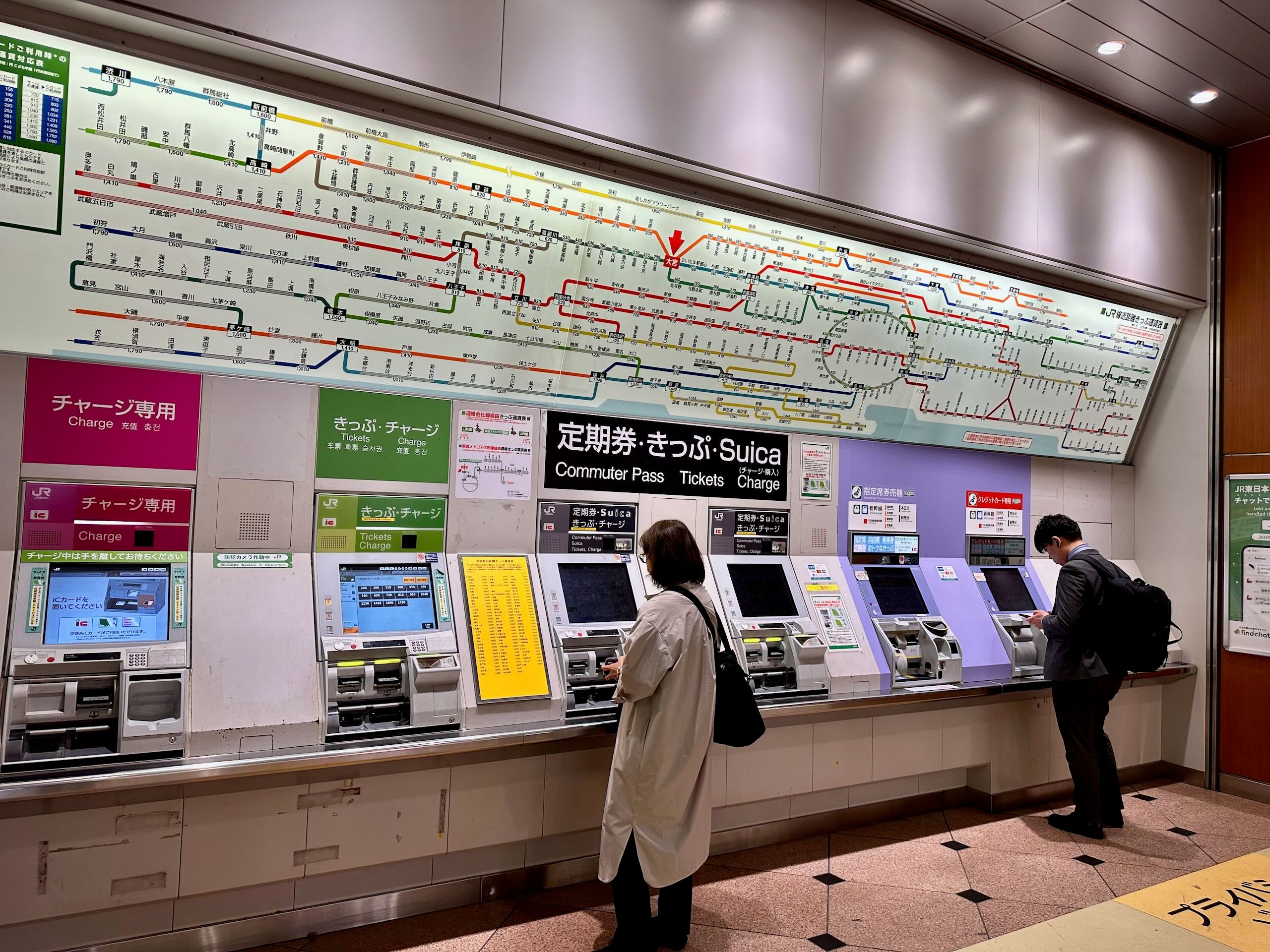
Suica is a word that will accompany you through a large part of your journey around Japan, especially if you start in Tokyo. It is a prepaid IC card that you tap on the gate when entering a station and again when leaving. The system calculates the fare for the journey and deducts it from the card. You can also use the same Suica to pay in many shops and vending machines, so after a few days you start using it a bit like an additional payment card.
It is not the only card of this kind in Japan, either. In Tokyo, you will also come across PASMO, which works on a similar principle, and IC cards from other regions of Japan are largely compatible with one another. PASMO can be used on subways, trains and buses, as well as for some shop payments.
We also collect different transport cards from our travels, so at the beginning of the trip I bought a physical, red Welcome Suica for tourists. Later, I gave it to Jadzia and added my new Suica to the Wallet app on my iPhone. This is probably the most convenient way to use public transport: you tap your phone on the gate exactly as you would a physical card and carry on.
There is one downside worth knowing about before your first journey. You will usually top up a physical Suica with cash. In most cases, the ticket machines at stations do not work the way we might expect in a country associated with technology in so many other respects.
If you run out of funds on your card when leaving the station, you first have to top up the balance. We had a minor adventure with this twice. There was not enough money left on the Suica, and there was no ATM before the exit from the ticketed area. If you also do not have any cash on you, things get a little awkward. In our case, I ended up going to get some yen, coming back, and only then could we settle the fare.
With a Suica on an iPhone, the problem practically disappears because you can top up through Apple Pay. The physical card is a nice souvenir, but the mobile version is simply more convenient.
Are they planning to change this? JR East is generally already working on further developing the system as part of the Suica Renaissance project. It is supposed to be introduced gradually over the coming years and connect Suica more closely with digital payments and other services. So this is not a change that will happen tomorrow, but the direction makes sense.
Subways, trains and the rest of the transport system
At first, Tokyo’s public transport looks like educational material for someone who really likes maps, numbers and systems. So basically, paradise for me haha.
The problem is that there is no single “Tokyo subway”. You have Tokyo Metro, Toei Subway, JR lines and several private railway operators as well. On the map, everything can look like one huge colorful bowl of noodles, but after two or three journeys, you start to see the logic.
The important thing is that when traveling around every day, you do not have to analyze each operator’s fare system every time. Tap your Suica when entering, travel, tap it when leaving, and the system settles the fare.
And it works not only in central Tokyo. When we traveled to the Railway Museum in Saitama, we used the card in exactly the same way for the entire route: card at the beginning, card at the end, and the fare was calculated automatically. No buying separate paper tickets or counting zones.
There are also buses, but during our stay we covered the vast majority of routes by train and subway. What probably surprised us most was that a system which seems absurdly complicated at first glance works very efficiently once you are there. And yes, trains really can arrive at the time shown in the timetable. For someone brought up on Polish railways, this is at times an almost exotic experience 😄
We are not going to explain here how Tokyo Metro differs from Toei, how to choose lines, which apps work best or whether time-based tickets are worthwhile, because then this one section would turn into a second article. We describe public transport in Tokyo separately, including Suica, transfers, operators and things that may look much more intimidating on your first journey than they really are.


Shinkansen from Tokyo – if you want to continue exploring Japan
If Tokyo is just the first stop on your trip, sooner or later the subject of the Shinkansen will probably come up. We used it to travel to Kyoto and back, but we are not going to write a complete railway guide here—just a few things that are useful to know at the beginning.
To get to Kyoto and Osaka from Tokyo, you use the Tokaido Shinkansen line. The most convenient starting points in the city are Tokyo Station and Shinagawa Station, so you do not always have to make your way specifically to Tokyo’s main station. If you are staying closer to the southern part of the city, Shinagawa may simply be more convenient.
There are three main types of trains on this route: Nozomi, Hikari and Kodama. They do not represent three different travel standards, but mainly a different number of stops. Nozomi stops the least and is the fastest, Hikari has a few additional stops, while Kodama stops at practically every station.
You also have to choose your seat. You can buy a ticket with a reserved seat or use the non-reserved carriages, where you simply board and take any available seat. On Nozomi, usually only some of the carriages are available to passengers without reservations, and things can get crowded on popular dates. If you are traveling on a specific day and do not want to wonder whether you will be able to sit together, reserving seats is simply the more relaxed option.
There is also the Green Car, which is the equivalent of a higher class: more space and a quieter carriage. On the regular Tokyo–Kyoto journey, we did not feel the need to pay extra, because the standard Shinkansen seats are comfortable anyway (compared with PKP Intercity carriages—seriously, they are comfortable).
Buying a ticket is not particularly complicated. You can do it at a machine with an English-language menu or online in advance. We will cover the Shinkansen in more detail when we write about the Tokyo–Kyoto journey, including prices, seat reservations and what it was like in practice.
Payments in Tokyo
For many years, Japan was a country strongly attached to cash. As recently as 2010, cashless payments accounted for only around 13% of consumer spending, and it was not until 2024 that their share exceeded 40%. This still shows how quickly the market is changing, because for a long time paying by card was not as obvious here as it is, for example, in Poland.
Cash also simply had a strong position in everyday life. Japan stood out for a long time because of the very large amount of banknotes in circulation relative to the size of its economy, and a significant share of household savings was held in cash and deposits.
So much for the history. What is it like from a tourist’s perspective in Tokyo? Much more normal than you might expect after all those stories about the “cash country”.
We paid by card for the vast majority of the trip. If we had to guess, around 90–95% of our everyday transactions were easily handled without taking out banknotes. Restaurants, shops, hotels and larger attractions had no problem accepting our cards. We mainly used cash at smaller businesses, some vending machines and, above all, when topping up the physical Suica, as mentioned above.
We used Revolut, but it does not really matter whether you use Revolut, Wise or your bank card. The most important thing is to check two things before you leave: how your bank converts transactions in yen and whether it adds its own foreign-currency payment fee.
A good exchange rate does not mean that your card needs to have a big “travel” label on it. The point is for the rate to be as close as possible to the Visa or Mastercard rate, or the market rate, and for the bank not to add several percentage points of its own margin. If a terminal or ATM asks whether you want to pay in yen or immediately in złoty, choose JPY. The second option is DCC, meaning the conversion is made by the terminal or ATM operator, often with an additional markup.
We did withdraw some cash anyway. We most often used Seven Bank ATMs, including those located in 7-Eleven stores. Foreign Visa and Mastercard cards are accepted there normally, and a single withdrawal with a foreign card can be as much as 100,000 yen.
What did we eat during our stay?
Almost everything that came our way. Yes, we went to McDonald’s too. And no, Japanese McDonald’s did not change our lives. It was McDonald’s, just in Japan 😄
Of course, things were much more interesting outside the chain restaurants. We ate sushi, ramen, various noodle dishes, grilled meat and vegetables, skewers, rice, fish and plenty of things whose names we can no longer remember exactly after several months. And that is probably how we approached food in Tokyo best: instead of ticking off a “must eat” list, we simply went into places that looked interesting and tried them.
During my business-trip week, I also went to a company dinner where small portions of food arrived at the table one after another. There were yakitori, among other things, yakitori, tsukune served with a raw egg yolk, grilled shiitake mushrooms, vegetables and several other skewers made from different parts of the chicken. There were also small portions of noodles and more side dishes. That worked really well, because instead of one large dish, you could try a little of several different things.
We are not going to pretend that one dinner taught us everything about Japanese cuisine, but this was exactly the kind of food we liked most: no grand ceremony, but plenty of variety and the chance to try a little more of one thing after another.
Ramen and the famous 1,000-yen threshold
There is an interesting local topic when it comes to ramen. For years, Japan had what was known as the “1,000-yen barrier”. There is no rule saying that ramen has to cost less than 1,000 JPY. It is more about the social expectation that it should be quick, good and, above all, relatively cheap food.
The thing is, prices are rising in Japan too. Ingredients, energy and labor are more expensive, so more and more restaurants have started crossing that threshold. In Tokyo, you can easily find ramen for 1,000–1,500 JPY or more, especially if you add toppings. Even so, you can still eat very well without leaving a fortune in the restaurant.


Sushi does not always mean an elegant restaurant
The same applies to sushi. You can of course find places where dinner costs a huge amount of money, but you can also walk into an ordinary conveyor-belt restaurant, sit at a table, order successive plates from a screen and leave full without a financial disaster.
Those were exactly the places we liked best. No ceremony, no advance reservation and no feeling that we had to know everything about every piece of fish. We sat down, chose and tried things.

7-Eleven, FamilyMark and Lawson
If you have already traveled somewhere in Asia, there is a good chance you recognize at least one of these brands. Especially 7-Eleven, which is hard to miss in places such as Thailand. If Japan is your first trip to this part of the world, however, you will very quickly learn a new word: konbini.
This is what the Japanese call their convenience stores, usually small shops that stay open for very long hours and often around the clock. Comparing them with a neighborhood shop back home does not really convey the scale of the phenomenon. Japan has more than 50,000 konbini, and the three biggest chains are 7-Eleven, FamilyMart and Lawson. In Tokyo, it is genuinely difficult to walk any significant distance without coming across one of them.
7-Eleven itself was not originally a Japanese idea—the brand comes from the United States. Its Japanese history began in 1974, when the first store opened in Toyosu, Tokyo, after a licensing agreement was signed with the American Southland Corporation. A year later, some of the stores began operating around the clock. Over the following decades, the Japanese developed this format to such an extent that 7-Eleven is now one of the most characteristic features of the country’s everyday landscape.
And it is precisely this scale that makes an impression. You walk down the street—7-Eleven. You turn the corner—FamilyMart. A little farther on, Lawson. After a few days, you stop noticing how often you pass them because they simply become part of the city.
We used them practically every day. Of course, we went to restaurants for ramen, sushi and the other things described above, but breakfast very often ended up being at 7-Eleven. It was quick, convenient and meant we did not have to look for somewhere that happened to be open first thing in the morning.
We most often picked up onigiri—the characteristic rice triangles, usually with a filling inside and nori on the outside. We also had sandwiches, coffee, something sweet or other small snacks. The choice is huge and does not stop at products meant to be eaten cold. There are also bento, noodles, curry, rice dishes and plenty of ready-made food that can be reheated. The biggest chains regularly change their selections and compete with one another through their own products.
In the evenings, we sometimes bought a ready-made dinner at 7-Eleven and reheated it in our rented room. We did not treat this as emergency food for when everything else had failed. After a full day of walking around Tokyo, being able to enter a shop, choose something decent and return to the room was sometimes exactly what we needed.
Konbini also serve many more functions than an ordinary shop. You can withdraw cash, print documents, send or collect parcels and buy tickets there, while local residents also use them to pay bills. That is why they are more a part of everyday infrastructure than simply somewhere you drop in for a cola and some chips.
Accommodation
When looking for accommodation in Tokyo, you will quickly notice one thing: a large room is not a given here. In a city where every meter of space matters, many hotels focus on a compact room with a bed, bathroom and space for luggage rather than a huge living area. This did not bother us at all, because we were outside the room for most of the day anyway.
I spent the first week at Nogha Hotel Akihabara Tokyo, practically in the middle of Akihabara. It was a regular hotel with a reception and restaurant on the ground floor. The room was not particularly large, but the bed was very comfortable, everything was well arranged, and for a business trip the location mattered more to me than a few extra square meters of floor space.
When Jadzia arrived in Tokyo, we moved to the area around Nishi-ojima Station. This time, instead of a traditional hotel, we chose Home Story in Tokyo Aerial, a property offered on Booking.com as a homestay. In practice, it was more like a small, self-contained apartment than a “homestay” understood as sharing a home with the host.
In Japan, you will see the term minpaku used for this type of accommodation. It refers to private apartments or houses made available to travelers for short stays. It does not necessarily mean living with the owner—you often get the entire place to yourself. Since 2018, these properties have been subject to separate regulations in Japan, and a legally operating minpaku has to be properly registered.


Hotel or apartment in Tokyo?
We noticed the difference immediately. The apartment was larger than the hotel room and had a small kitchen, table, washing machine and a regular bathroom. After a few days of traveling, things like that start to matter. Especially the kitchen, which was perfect for heating up all those ready-made dishes we brought back from the shop in the evening 😄
Of course, this does not mean a large apartment in the European sense. The hallway was very narrow, the space was used practically down to the last centimeter, and a few people with large suitcases would quickly have created a traffic jam. But for us, it was still much more spacious than a typical hotel room.
On a first trip to Tokyo, we would therefore look primarily at the location in relation to the station, and only then at the number of square meters. If you plan to explore different parts of the city every day, being able to walk to the subway or railway in a few minutes is much more useful than having a larger room that you only return to in the evening.

What did we manage to see?
Tokyo is so large that on our first stay we quickly abandoned the idea of doing one attraction in the east of the city in the morning, then something on the other side, and returning somewhere in the middle in the evening. On a map, everything may look relatively close, but once you add walks to stations, transfers and simply getting around huge railway stations, part of the day can disappear into travel.
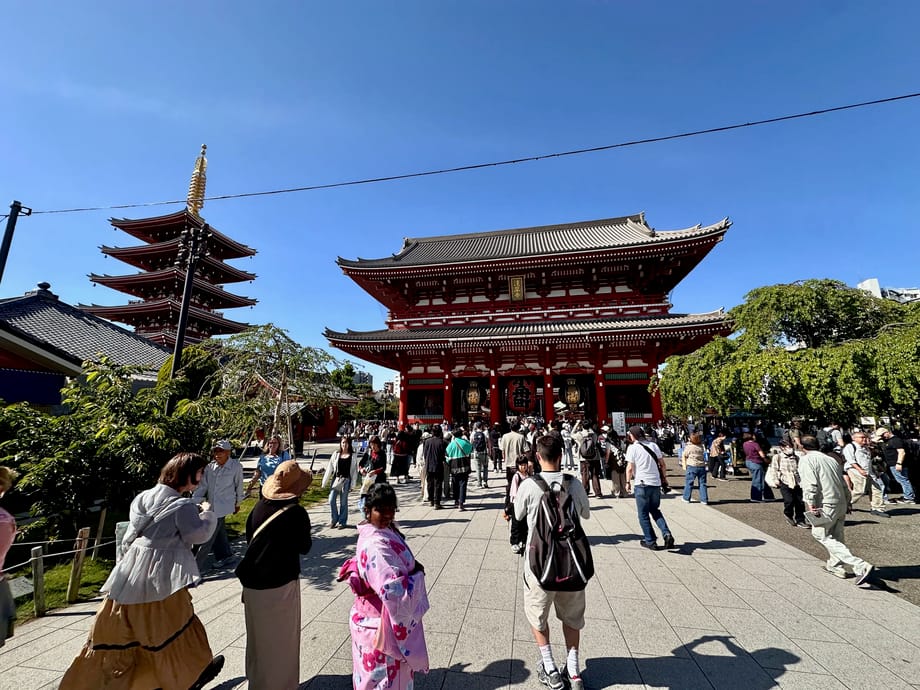
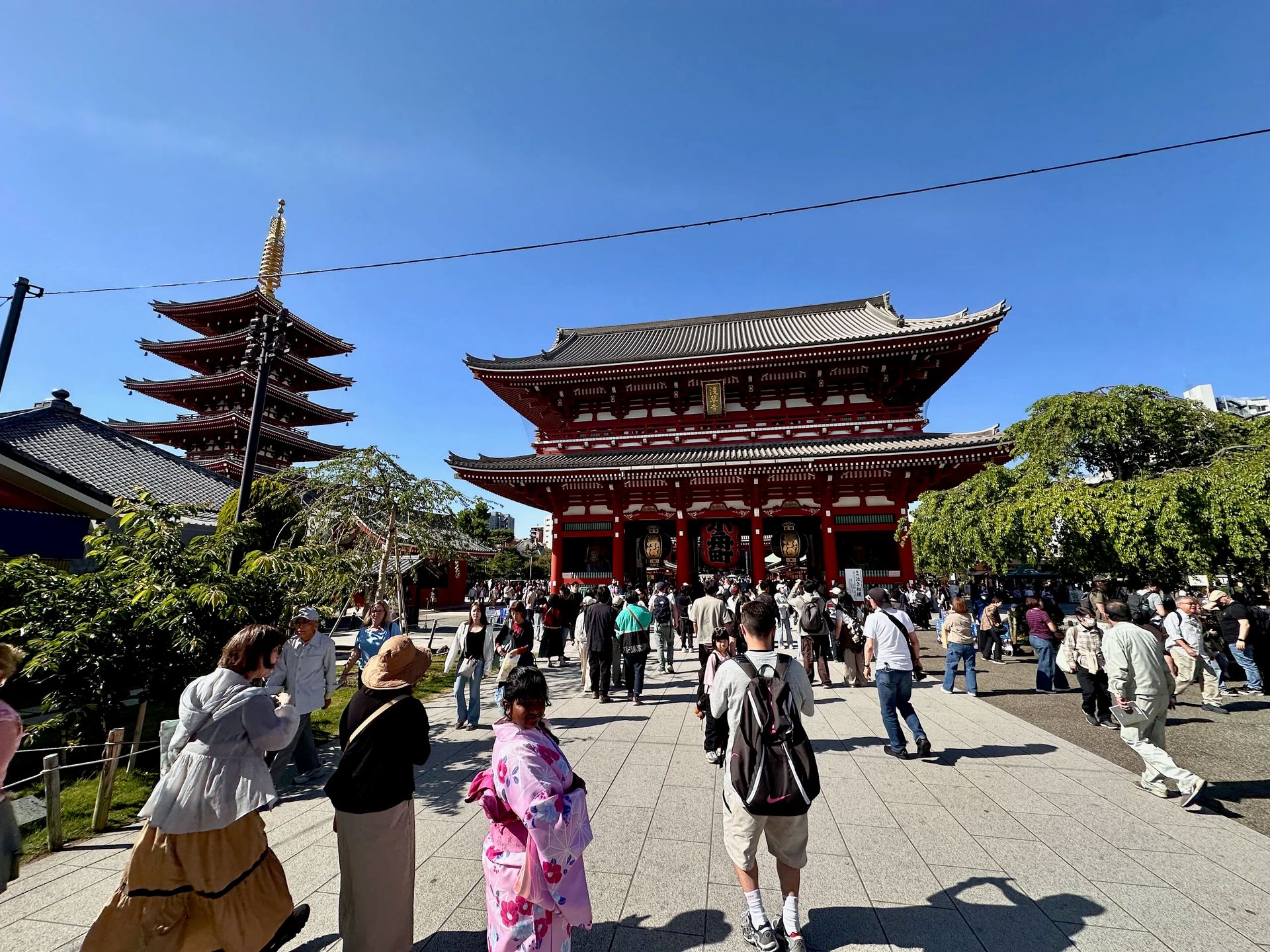
It was therefore much more convenient for us to organize our days around specific parts of Tokyo. If we went to the area around Shibuya and Harajuku, we stayed there longer. The same applied to Akihabara, Asakusa, Ueno, Shinjuku and the more central areas of Ginza and Tokyo Station. Each of these parts of the city is different enough and has enough things to see nearby that you can easily spend several hours there without taking a trip across half of Tokyo every few minutes.
This approach had another advantage: it left time for places we had not saved anywhere beforehand. Tokyo is not a city where we wanted simply to go from point A to point B, take a photo and leave. We found plenty of interesting things along the way precisely because we were not trying to follow our plan to the nearest fifteen minutes every day.
We are not going to list all the temples, museums, viewpoints and districts here, because this article would once again grow to the size of a small book. In a separate post, we show exactly what we managed to see in Tokyo, how we connected the different places and which ones actually stayed in our memories.


Is Tokyo expensive? Our actual spending
Before the trip, we expected Tokyo to be one of the more expensive parts of the whole journey. In the end, it turned out a little differently: the expensive parts were mainly the travel dates and getting to Japan, while everyday life there was not necessarily costly.
Jadzia flew in April, one of the most popular times to visit Japan, and we also had to fit her flight around my business stay. So there was no great hunt for the cheapest date. An Air China ticket on the Warsaw–Beijing–Tokyo route and back cost PLN 4,140. My business-class ticket cost almost PLN 13,000, but the company covered that expense, as well as the first hotel in Akihabara.
Our shared accommodation in Tokyo looked much more normal. We paid PLN 3,050 for 7 nights at Home Story in Tokyo Aerial, or around PLN 435 per night for two people. For Tokyo in April and a separate apartment with a kitchen, we did not consider that particularly expensive. The cherry-blossom season can push accommodation prices up significantly, so booking early really did make sense here.
Everyday spending surprised us much more. Food was not nearly as expensive as we had expected. Regular lunches often came to PLN 50–120 for two people, sushi could cost a similar amount, and breakfast or shopping at 7-Eleven or Lawson often came to between a dozen and a few dozen złoty. This fits with the fact that ordinary meal sets and ramen can still often be found for around 1,000 yen.
Transport was also not something that hurt every time we traveled. We topped up our Suica regularly with small amounts, and with normal sightseeing, individual journeys disappeared somewhere among the other expenses. We are not going to include the entire transport category from our tracker here, because it also includes Kyoto and later Beijing, and we will describe the Shinkansen separately.
The same goes for attractions. Tokyo Skytree cost us PLN 155 for two people, teamLab Planets PLN 245 and the Railway Museum PLN 70. These are not symbolic amounts, but they were not what determined whether the trip became expensive.
Our entire tracker shows PLN 16,381.93, but that total includes not only Tokyo, but also Kyoto, the Shinkansen, flights to Beijing and some expenses in China. So it would make no sense to present it as the “cost of Tokyo”.
After this trip, we would put it this way: Tokyo is mainly expensive when you pay a lot to fly there and book accommodation late. Once you are there, you can eat, use public transport and go sightseeing without feeling that every time you leave the room, it costs a fortune. We expected a bigger financial shock, but in the end everyday prices turned out to be quite reasonable.
Would we return to Tokyo?
Of course we would. On our next trip, though, we would be less interested in ticking off the same places again and more interested in getting a little deeper into the city itself and the wider metropolitan area.
In that respect, Tokyo reminds us of the biggest metropolises in the United States or the Emirates. You can spend a week, two weeks or a month there and still have a huge number of things you have not even touched. And it is not only about museums, temples or more points from a guidebook. Sometimes it is just as worthwhile to get off the train two stops early in the evening, walk around the neighborhood, find somewhere to eat and see a part of the city that had not even been on your map before.
That is exactly what we would like more of on our next trip. Less running after specific points, and more time getting to know different neighborhoods and places outside Tokyo’s most obvious areas. With a city on this scale, one stay gives you a first sense of your bearings rather than the feeling that you can say, “Tokyo—done”.
Regular readers may also have noticed that we did not include a separate section about safety in this article. The reason is simple: during our stay, nothing happened that made us think about it particularly. We felt very safe during the day and in the evening, on the subway, in the streets and when returning to our accommodation late at night.
Japan does, however, have slightly different risks from the ones we usually have in mind when planning a trip. Earthquakes are a normal part of life here, and there are also typhoons and the risk of tsunamis. This is not a reason to give up on traveling there, but before you go, it is worth knowing how to behave during an earthquake and paying attention to local announcements. The official warning systems are highly developed precisely because the country regularly deals with such events.
Another increasingly discussed topic is the number of tourists. In Japan’s most popular areas, overtourism has stopped being an abstract buzzword, and local authorities are increasingly trying to direct visitors beyond the best-known places as well. For us, this is another reason not to limit ourselves to Shibuya, Shinjuku or Akihabara next time, but to see a little more of ordinary Tokyo.
We certainly would not fly to Japan just to spend the entire trip in the capital again. We still want to see more of Tokyo, but more as part of another journey around the country. Japan is simply too large and too diverse to consider the subject closed after Tokyo and Kyoto.
So our first trip was enough for us to reach one conclusion: yes, we will return. Next time, though, we want to see a little less of Japan through a list of attractions and a little more of what it looks like away from the places everyone visits.