

Ten wpis jest również dostępny w języku:
 Polski
Hey! 👋
Our day trip to Nara didn’t quite go as planned. While staying in Kyoto, we wanted to visit the Nintendo Museum, but getting tickets turned out to be a lot harder than we expected. Nintendo uses a lottery system, and you can apply for tickets up to three months in advance. If any tickets are left afterwards, they go on sale separately. We were definitely too late to the party 😄
So instead of spending another day in Kyoto, we decided to visit Nara. We’d already considered going there, but missing out on the Nintendo Museum was what finally made us add it to our plans.
When we thought of Nara, the first thing that came to mind was the deer roaming freely among people, poking their noses into tourists’ bags and getting pretty pushy when they wanted food. But there’s more to Nara than its famous deer. Before Kyoto became the capital, Nara held that title from 710 to 784. The city is still home to plenty of temples and shrines dating back to when it was one of Japan’s most important centres.
You can get to Nara from Kyoto by train in around 35–50 minutes, depending on which service you take. With such a short journey, we didn’t need to book another hotel or plan anything too complicated. We headed there in the morning, spent the day exploring, and returned to our hotel in Kyoto afterwards.
In this post, we’ll share how our day trip went, what we managed to see, how the famous deer behaved, and whether one day is really enough to explore Nara.
If you’ve joined us halfway through our Japan trip, we’ve already written about our first visit to Tokyo and the places we explored there. We’ve also put together two articles about Kyoto: one covering our stay, transport and costs, and another about the places we visited.
Alright, let’s go see what all the fuss is about with those deer. 😄
How to Get from Kyoto to Nara
We took the train to Nara, and given how close it is to Kyoto, it’s hard to think of a better way to get there. The journey takes around 35–50 minutes, depending on the train, so it’s easy to visit for the day and head back to your hotel in the evening. There’s no need to rent a car or book an extra night.
There are two main train options: JR and Kintetsu. Both will get you to Nara, but they arrive at different stations, which can make a difference when you’ve only got one day to explore.
JR Miyakoji Rapid trains run directly from Kyoto Station to JR Nara Station. The journey takes around 45 minutes, and a one-way ticket costs 720 JPY. It’s a regular regional train, so there’s no need to reserve a seat. Just tap through the ticket gates with your Suica or another IC card and hop on the right train.
The other option is Kintetsu Railway. From Kyoto Station, you can take a regular Express train to Kintetsu-Nara for 760 JPY, with the journey usually taking around 45–50 minutes. There are also faster Limited Express trains that get you there in about 35 minutes, but you’ll need a separate reserved-seat ticket and pay an extra fee. Expect to pay around 1,280 JPY or more, depending on the train you choose.
What if you’re travelling from Osaka?
Nara is just as easy to visit on a day trip from Osaka, especially if you’re staying around Namba.
From Osaka-Namba, the Kintetsu Rapid Express takes you directly to Kintetsu-Nara in around 35–40 minutes for 680 JPY. Alternatively, you can catch the Yamatoji Rapid from JR Osaka Station to JR Nara, which takes about 50 minutes and costs 840 JPY.
We wouldn’t recommend travelling all the way from Tokyo to Nara just to see the deer, though. It’s a much longer journey, involving a Shinkansen ride followed by another train. If you’re planning a trip around Japan, it makes far more sense to visit Nara while you’re staying in Kyoto or Osaka.
Nara Park and the Deer That Aren’t Always So Well-Behaved
📍 Map pin: Google Maps
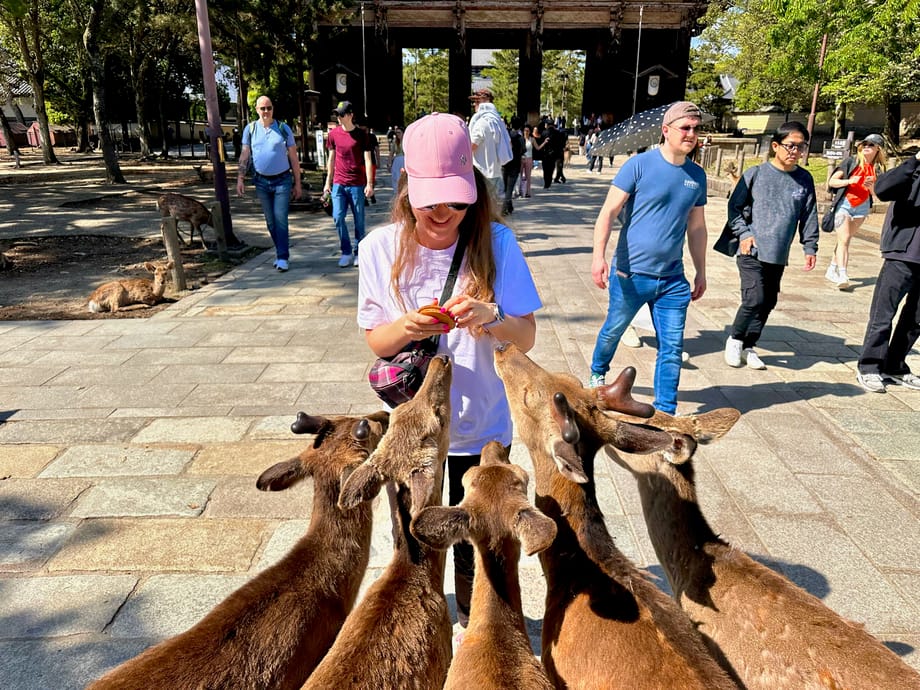
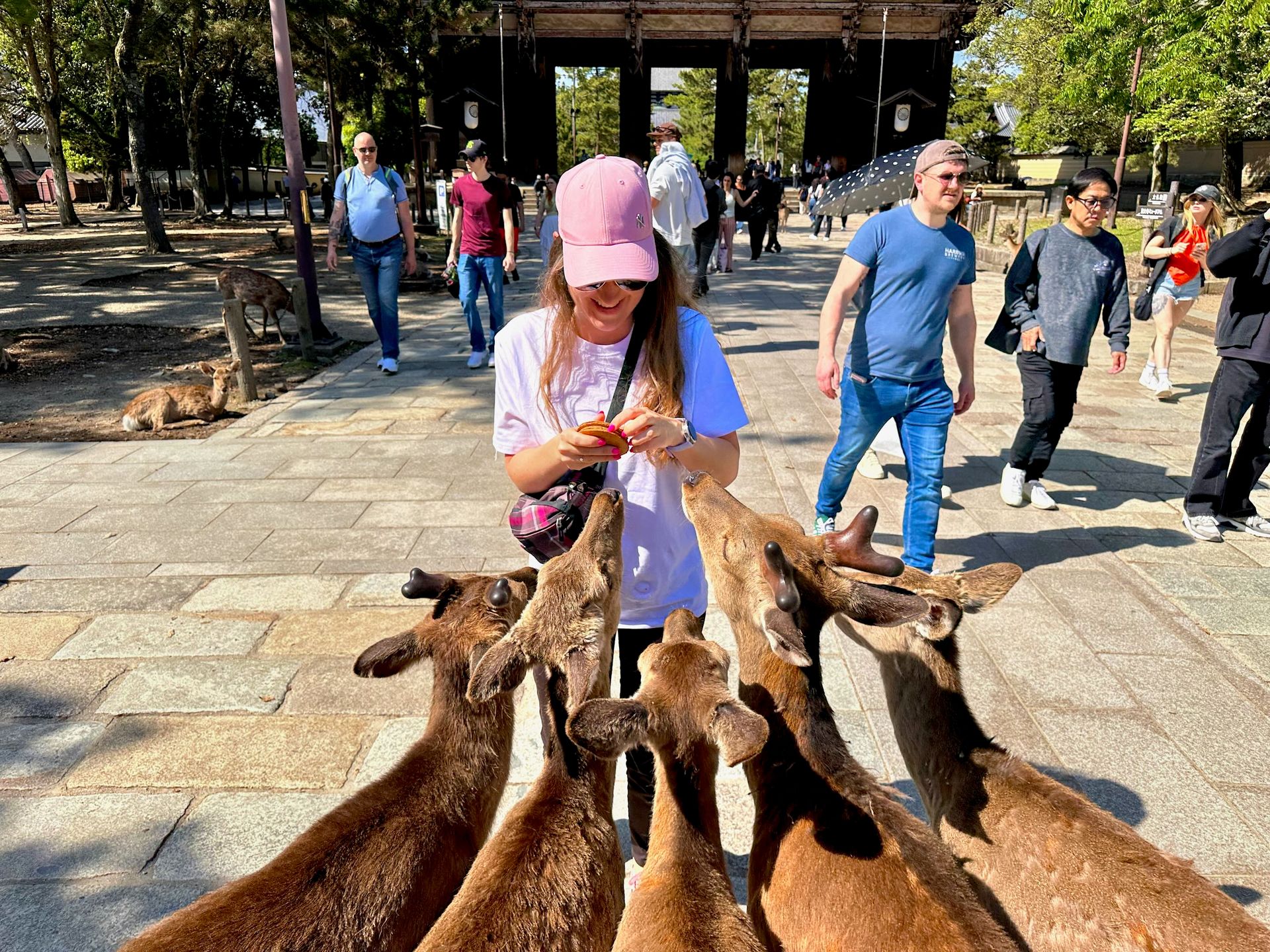
We spotted our first deer pretty much as soon as we arrived at Nara Park. Some were lying around on the grass, others were wandering between tourists, and a few were busy looking for someone with food. They don’t seem particularly bothered by people, unless they spot crackers in your hands. Then suddenly, you’re their new best friend 😄
More than 1,600 sika deer live in and around Nara Park, and they’ve been here for centuries, long before tourists started showing up to feed them. Their presence is closely tied to Kasuga Taisha Shrine. According to local legend, one of the deities arrived in Nara riding a white deer. From then on, deer were seen as messengers of the gods and given special protection. Today, they’re officially designated as a Natural Monument of Japan.
How Do You Feed These Little Foodies?
You’ve probably seen videos of deer bowing to people. Well, they really do it! Some lower their heads before getting a cracker because they’ve learned that it helps them get food. It’s pretty adorable, especially when you’ve got a little deer standing in front of you, looking like the politest animal in the world.
Those good manners don’t last very long if you take too much time handing over the crackers, though 😂
The deer can nudge you, tug at your clothes, or even bite if they decide you’re taking too long to feed them. Some get so pushy that it’s hard to get the next cracker out without being harassed. So don’t wave food in front of their noses or keep them waiting just to get a funny photo.
Once you’ve run out of crackers, show them your open, empty hands. Some deer recognise the gesture and move on to try their luck with another tourist. Keep an eye on paper bags and maps too, as they’ll sometimes try to eat things that definitely shouldn’t be on their menu. Give mothers with fawns and adult males a bit more space.
We absolutely loved meeting the deer. They’re adorable, and watching their behaviour gave us plenty of laughs. It’s hard to stay mad at an animal that politely bowed to you a moment ago and is now trying to get its teeth into the rest of your crackers 😄
We’d happily go back to Nara just for the deer. But even though they’re used to people, they’re still wild animals. Give them their crackers, take a few photos, and let them get back to whatever they were doing.


Can the Deer in Nara Bite?
They certainly can, and Jadzia found that out firsthand 😂 One of the little deer decided to give her a nip, so we can confirm that those cute faces come with teeth, and they’re not afraid to use them.
It usually happens during feeding, when a deer spots your crackers and gets impatient. They might start nudging you, nibbling at your clothes, or even trying to bite. So don’t tease them with food, even if you’re hoping to get a funny photo.
But what about the health of the deer? Japan is considered free of locally transmitted rabies, and the Nara authorities say there have been no recorded cases of the disease being passed on by the local deer. That doesn’t mean you should ignore a bite, though. If a deer breaks your skin, wash the wound thoroughly with soap and water and seek medical advice, as any animal bite carries a risk of bacterial infection.
Tōdai-ji and the Great Buddha
📍 Map pin: Google Maps
After meeting the deer in Nara Park, you can walk straight to Tōdai-ji, one of Japan’s most important Buddhist temples. Even the entrance gate gives you an idea of just how big this place is, but the largest building is still a little further ahead.
That’s Daibutsuden, or the Great Buddha Hall. It’s around 57 metres wide and almost 49 metres tall, and the entire structure is made of wood. Inside sits an enormous statue of Vairocana Buddha, standing nearly 15 metres tall even in a seated position. You don’t really appreciate its size until you see people standing nearby.
Tōdai-ji dates back to the 8th century, when Nara was still Japan’s capital. Emperor Shōmu commissioned the enormous Buddha statue, which was officially consecrated in 752. The project also had a political purpose. The emperor hoped it would help unite the country and bring peace and prosperity during a difficult period marked by epidemics and social unrest.
Over the following centuries, the temple was damaged several times by fires and conflicts. The Great Buddha Hall we see today was completed in 1709. And here’s an interesting detail: when it was rebuilt, they made it narrower than the original because there wasn’t enough money to recreate the entire structure. Looking at the size of Daibutsuden today, it’s hard to imagine it used to be even bigger.
Inside, you can walk around the statue and get a closer look at it from different angles. You’ll also see the huge wooden pillars supporting the roof. One of them has a hole near its base that visitors try to squeeze through. According to local tradition, it’s the same size as the Great Buddha’s nostril, and making it through is supposed to bring good luck. It’s probably one of the more unusual things you can do inside a temple 😄
A ticket to the Great Buddha Hall costs 800 JPY per person, so we paid 1,600 JPY for the two of us. If you’d also like to visit the Tōdai-ji Museum, there’s a combined ticket for 1,200 JPY per person. From April to October, the hall is open from 7:30 AM to 5:30 PM, and during the winter months from 8:00 AM to 5:00 PM.
We’d definitely keep Tōdai-ji on the itinerary for a day trip to Nara. Even if you’ve already visited several temples in Japan, the sheer size of the building and the Buddha statue is something else. Allow around 30–45 minutes for the Great Buddha Hall itself, or a bit longer if you want to explore more of the temple grounds.


Kasuga Taisha and the Surrounding Forest Trails
📍 Map pin: Google Maps
After exploring Nara Park and visiting Tōdai-ji, you can head towards Kasuga Taisha. This Shinto shrine is tucked away among the trees, and the walk there is worth it in itself. Hundreds of stone lanterns line the path, some covered in thick moss. You’ll probably spot a few more deer wandering between them, looking very much at home. 🦌
Kasuga Taisha was founded in 768 and was closely connected to the Fujiwara clan, one of the most powerful families in ancient Japan, for centuries. This is also where the legend of a deity arriving on a white deer comes from. If you’ve been wondering why the deer in Nara are treated with such special respect, the story starts to make a lot more sense here.
The lanterns are probably the most distinctive feature of Kasuga Taisha. There are around 3,000 of them throughout the shrine grounds, from stone lanterns lining the paths to bronze ones hanging beneath the roofs. They were donated by worshippers over the centuries as offerings to the shrine.
Most of the time, the lanterns remain unlit, but during the Mantōrō festival in February and August, they’re all lit up. With that many lanterns glowing at once, we’d love to see what it looks like in person.


The shrine buildings are easy to recognise, with their bright red pillars, white walls and roofs covered in cypress bark. Parts of the complex are regularly restored, following a tradition that goes back centuries. That’s helped the shrine keep its distinctive appearance, even after more than 1,200 years.
You can walk around the public areas of Kasuga Taisha for free. If you want to explore the inner grounds, including corridors lined with hanging lanterns and a room filled with lit lanterns, admission costs 700 JPY per person. The paid area is generally open from 9:00 AM to 4:00 PM, although it may close during religious ceremonies.
Behind the shrine lies Kasugayama Primeval Forest, a woodland that has been protected for over a thousand years. Hunting and logging were banned here as early as the 9th century because of the forest’s religious significance. Not every part is open to visitors, but there are trails nearby if you feel like walking a little further.
Kasuga Taisha fits nicely into a day trip around Nara, especially if you enjoy walking. The path through the trees, with stone lanterns lining the way, is lovely, and you’ll probably come across a few more deer along the way. We wouldn’t make a separate trip just to visit the shrine’s paid inner grounds, though. It makes more sense to combine it with Tōdai-ji and a walk around Nara Park.

Kōfuku-ji and the Surrounding Area of Central Nara
📍 Map pin: Google Maps
Kōfuku-ji is just a few minutes’ walk from Kintetsu-Nara Station, so it’s easy to stop by on your way to Nara Park or before catching the train back. You can wander around the temple grounds freely without buying a ticket.
The temple’s history goes back to 710, when it was moved to Japan’s new capital. For centuries, it was closely linked to the powerful Fujiwara clan, who held enormous influence at the imperial court. At one point, the temple even had its own armed forces and held considerable power over the surrounding region.
The most recognisable part of Kōfuku-ji is its five-storey pagoda, standing around 50 metres tall. The first one was built in 730, but the structure you see today dates back to 1426. Earlier versions were repeatedly destroyed by fires.
Unfortunately, if you’re heading to Nara hoping to see the famous pagoda, you might be disappointed. It’s been undergoing major restoration work since 2023, and the entire structure is hidden behind protective scaffolding. The renovation will take several more years, so don’t expect it to look quite like the photos you’ve seen online.
Apart from the pagoda, there are several other buildings within the complex, including the Central Golden Hall, which was rebuilt and reopened in 2018. You can go inside for an additional fee, but we stuck to exploring the parts of the temple grounds that are open to everyone.
Kōfuku-ji is easy to fit into a walk around central Nara. There’s no need to make a separate trip here, especially if you’re not planning to visit the paid areas. We were happy just wandering around the grounds, although it was a shame that the temple’s most famous landmark was hidden away for such a long renovation.