

Ten wpis jest również dostępny w języku:
 Polski
Hi! 👋
Before you landed here, you’ve probably already read somewhere that renting a car in Morocco is a great idea. And yes — that’s true, but with an asterisk. Online, there are plenty of stories about scooter riders hitting rental cars and disappearing before you can even react, rental companies that suddenly “discover” damage once you hand back the keys, and police who are happy to issue cash fines, not always with a receipt.
We’ve been through some of that ourselves. We won’t spoil it all right away — step by step.
If you’re just getting to know us and have no idea how we ended up in Morocco in the first place, first check out our posts about Marrakech and Essaouira. Here we’re focusing only on the car — what to sign, what not to sign, and why 145 PLN for a week-long rental should set off alarm bells straight away.
Is renting a car even worth it?
That depends on what you want from the trip. If you’re flying to Marrakech for three days, want to walk through the medina, eat tagine, and head back home — you don’t need a car. You can see the city on foot or use the inDrive app. But if you want to go beyond Marrakech, head to the Atlantic, the mountains, or the south — without your own transport, you’ll be relying on someone else’s goodwill and bus timetables. And we don’t like traveling that way.
You can also come to Morocco in your own car — driving from Poland through Spain and taking the ferry from Tarifa to Tangier is a real option for a longer trip. But if you’re flying in, renting on the spot just makes sense. You land, pick up the keys, and you’re free. With one asterisk, which we’ll get to in a second.
That asterisk is Moroccan roads. The stats are blunt — Morocco has more than 80 thousand road accidents a year, with a population similar to Poland, which has half as many. Moroccan officials themselves describe it as a “socio-economic cataclysm.” Those words aren’t accidental.
We’ve rented cars in more than a dozen countries, so we usually know more or less what to expect. Morocco was only our second time in Africa, and we won’t pretend that the warning light wasn’t flashing pretty clearly when we made the booking. Even so, we went into it knowingly — with experience, insurance, and a sense of how to get money back if things go wrong. If this had been our first time ever renting a car, we might have thought twice.
So what about the road chaos? Outside the city, it was actually fine. The roads between Marrakech and Essaouira were in good shape, traffic was light, and driving was pleasant. Motorways and express roads were calmer still. The problem starts when you enter a city — literally at the first intersection.
Where to look and what to compare
In our case, we start with a comparison site — most often Economy Car Rentals (we used to use Rental Cars) — and then we also check what other brokers are showing. The point is to see the whole market, because the same car from the same rental company can have different prices depending on who you book through. There’s no single oracle here — open a few tabs.
When we choose an offer, one rule is non-negotiable: deposit by credit card only. Not cash, not bank transfer. A credit card gives you chargeback — a real tool for getting your money back if the rental company starts playing games after you return the car. If a company decides to keep your cash deposit, chances are you’ll never see that money again.
If you come across an offer with no deposit at all — that’s not a bargain, that’s a red flag (again, at least for us). A rental company like that has nothing to lose, which means you can run into problems at drop-off you haven’t even imagined.

What to check when choosing a rental company
Besides the price and deposit, there are a few things to check before you click “book”:
- Reviews — Google Maps, Trustpilot, travel forums. If most reviews are screaming “they charged me extra after I returned the car” — believe them.
- Spare wheel — in Morocco, a flat tire is a very real possibility, especially off asphalt. Some rental companies hand over cars without a spare wheel and without a repair kit. Check at pickup.
- Constat amiable — the French accident statement form. Ask for it when you pick up the keys. If the rental company looks at you like you’re speaking nonsense — that also tells you something about the company. Or just print it yourselves while you’re still at home.
- Fuel policy — pick up with a full tank, return with a full tank. Other versions are usually a trap.
If you want to support what we do, you can use our Economy Car Rentals link — nothing changes for you, and we get a small commission from the booking:
Documents and requirements
We didn’t need any exotic documents to rent a car in Morocco, but you do need to have a few things ready. Best not to check that only at the rental desk, when someone is already holding your reservation and things are starting to get tense.
We had with us:
- passport — you can’t enter Morocco with a Polish ID card;
- Polish driving licence — for a tourist stay, it should be enough;
- international driving permit — it doesn’t replace your national licence, but it can make things easier with the rental company or the police;
- credit card in the main driver’s name — for the deposit hold;
- car reservation and rental terms — ideally saved offline on your phone;
The licence issue is a little less obvious. A Polish driving licence is recognized in Morocco for a short tourist stay, but we still brought an international driving permit. We’d do the same again. It’s a cheap document, and it can save you a pointless argument if you end up with a rental company that has its own rules or a road check where nobody feels like decoding a European document.
Also make scans or photos of your documents: passport, driving licence, reservation. Not so you can show them instead of the originals, because that probably won’t work, but so you have something on hand if you lose anything.
The second important thing is a credit card. For us, that’s non-negotiable. We use rental companies that block the deposit on a credit card, not ones asking for cash in hand. Cash sounds simple only until there’s a dispute at drop-off over a scratch, a chip, or “new” damage. Then suddenly you have no real leverage at all.
With a credit card, at least you can try to start a chargeback, which means disputing the transaction through your bank. In simple terms: you report that the charge was unjustified or didn’t match the service, and the bank opens a dispute with the card network and the merchant.
The minimum driver age depends on the rental company. In Morocco, the limit is usually 21–23 years old, but for bigger cars, SUVs, automatics, or more expensive models, the company may require 25 years old and a few years of holding a licence.
Insurance
When you rent a car, you need to separate two things that often get thrown into one bucket: the car’s insurance and insurance for your excess / deposit. Those are not the same thing.
The rental car usually already has basic insurance. Without that, a normal company shouldn’t be letting the car onto the road at all. The problem starts when there’s damage, because even if the car is insured, the rental company can still charge you up to the excess amount — the sum you’re responsible for out of your own pocket.
The simplest way to look at it is this:
- car insurance — protects the vehicle itself;
- excess — the maximum amount the rental company can take from you if there’s damage;
- deposit — a hold on your card as security for the rental company;
- excess insurance — a policy you can later use to recover the money if the rental company charges you for damage.
And here’s the main catch: excess insurance usually does not mean the rental company won’t take anything from you.
Most often, it works like this:
- the rental company blocks the deposit on your card;
- if there’s damage, it takes part or all of that amount;
- you collect the documents from the rental company;
- then you report the case to your insurer;
- the insurer reviews it and may reimburse you.
So this isn’t a shield against the rental company at the desk. Think of it more as a way to recover money after the fact.
We covered the deposit with that kind of external protection through a policy in Revolut. In our case, the insurance was handled by xCover. This isn’t an ad for Revolut, because nobody is paying us for it. We just use it, so we’re describing our own case. And does that kind of policy work in real life, not just in the app? We’ll get to that below, because we actually had to use it.
Picking up the car — how not to get caught out
Picking up the car is the moment when it’s easy to wave things off, because you’re tired after the flight, you want to get moving, and you don’t feel like walking around the car with your phone. We do the opposite: the more someone is in a hurry, the slower we inspect the car.
When you rent a car, the most important thing is the pickup report. Every scratch, dent, crack, chip, damaged rim, or dirty mark that could later be treated as damage should be written into the documents. Not just agreed “verbally.” If something isn’t in the report, it may suddenly become your damage at drop-off.
At pickup, we always take photos and a video. Just with the phone, nothing fancy. What matters is that you can see the whole car and close-ups of the damage.
We check, one by one:
- the front of the car, the hood, and the bumper;
- the rear bumper and the trunk lid;
- all doors and sills;
- the roof, if it can be checked properly;
- windows and mirrors;
- rims and tires;
- lights;
- the interior, seats, dashboard, and trunk;
- fuel level;
- mileage;
- any equipment listed in the contract.
At pickup, don’t let anyone brush you off with “that’s just a small scratch” or “that’s normal.” Maybe it is normal — in that case, it should be normally written into the report. If the employee doesn’t want to add something, we take a photo, record a video, and ideally send it straight away by email or WhatsApp to the rental company so there’s a dated trail.
The safest fuel policy is full to full. We pick it up full, return it full, and take a photo of the fuel gauge and the receipt from the last fill-up. If the rental company tops it up after return, the price can be much higher than at a normal station, and then they add a service fee on top.
If there’s a conflict at drop-off, don’t sign anything you don’t agree with. If someone tries to add damage you didn’t cause, ask them to show it to you at the car, compare it with your pickup video, and write your objection into the document. The point isn’t to start a scene — just not to confirm with your own signature something that later becomes the basis for charging your card.

Driving in Morocco — what it’s like
Hmmm… xD Not everywhere is the same. The motorway between big cities and driving through the middle of Marrakech are two completely different experiences, so it makes no sense to throw them into one bucket.
City driving is the hardest… Not because cars are driving completely without rules, because cars are still fairly predictable. The biggest problem is two-wheelers: scooters, small motorcycles, bicycles, and everything that fits between the lanes. They can appear on the left, on the right, in front of your hood, while you’re turning, at a roundabout, while parking.
That’s why we drove defensively in the city (as you’ll read below, that doesn’t always save you). This isn’t about panicking — just constantly assuming that someone is about to do something weird. Especially when turning right, changing lanes, and moving off from the lights. One glance in the mirror isn’t enough there. You need to check the side of the car several times, because a scooter can slip into a space that wasn’t there a second earlier.
Outside the city, things get noticeably calmer. On longer stretches, Morocco is actually pretty nice to drive in, as long as you understand what kind of road you’re on. Motorways are the easiest: toll roads, well maintained, with booths and a normal pace of traffic. That’s not where we had the biggest stress.
The biggest difference starts on single-carriageway roads. On the map they can look harmless, but in practice the travel time gets much longer than the distance would suggest. The road itself may be fine, but then you add trucks, towns, roundabouts, limited-speed sections, animals, pedestrians, and local traffic. Suddenly 180 km isn’t “a couple of hours” — it’s a proper part of the day.
Types of roads
In Morocco, you’ll come across a few types of roads:
- autoroutes, meaning motorways — toll roads, usually the best in terms of quality, with the limit most often up to 120 km/h;
- voies express, meaning faster roads — not motorway level, but better than ordinary local routes;
- routes nationales, meaning national roads — often the main single-carriageway routes between cities;
- routes régionales and provinciales — regional and local roads, where the quality can vary a lot.
This breakdown matters when you’re planning a route. If Google Maps shows a similar distance, but one option goes by motorway and the other by national and regional roads, in Morocco that’s not just the difference between a “nicer route.” It can be the difference between a calm drive and one through towns, behind trucks, and with constant slowing down.

Road rules
Speed limits usually look like this:
- up to 120 km/h on motorways;
- up to 100 km/h outside built-up areas;
- around 40–60 km/h in cities and towns — always watch the signs, because the limits can change quickly.
And here’s the important part: in Morocco, you really do need to watch your speed. Radar checks are common, including in cities, at the entrances to towns, and on roads that look “empty.” Police can stand there with a handheld radar, and a bit farther on they stop drivers. We wouldn’t count on the Polish approach of “a few extra km/h will slide.” We got a fine for going 6 km/h over, and there was no margin for error in the measurement.
How much does it cost?
Car rental prices in Morocco can look suspiciously good. And that’s not an exaggeration — in Marrakech, you can find offers for a dozen or so euros a day, and with a weekly rental the cheapest options can drop to around 70–90 euros for the week. Comparison sites also show rates from around 11–16 euros a day for the cheapest cars at Marrakech airport.
Like we wrote earlier, we most often use Economy Car Rentals, because on many trips it has simply worked best for us: one comparison site, lots of offers, clear booking, and the option to check the terms before clicking. That doesn’t mean every rental company on a comparison site will be good. The comparison site is only the middleman. The car is ultimately handed over by a specific local company, and its rules, attitude, and service make the biggest difference.
In our case, the warning light came on as soon as we saw the price. For 7 days of rental, we paid a little over 150 PLN. The offer was so cheap that it practically begged the question: “where’s the catch?”
And yes, you could say we were asking for it ourselves. Fair enough 😄
The thing is, we went into it knowingly. We knew we had separate excess insurance, the deposit was going onto a credit card rather than being left in cash, and that if something went wrong, we had some way to fight for the money. This wasn’t our first time renting a car, it wasn’t our first time seeing weird stuff at drop-off, and this wasn’t a completely random shot in the dark for us.
If the same rental company had said “cash deposit only,” the whole topic would have ended right there. We don’t leave cash as a deposit, because later you may have very little room to move if someone decides they’re deducting something after all. A credit card plus insurance won’t give you 100% peace of mind, but it does at least give you some tools.
For comparison, when we looked at more normal offers, a weekly rental of a small car in Morocco was more often around 400 PLN and up. That fits much better with what you see in current listings: economy cars in Morocco often start at a dozen to a few dozen euros a day, while bigger cars, SUVs, or better classes cost noticeably more. For example, local listings show economy cars from around 18 EUR per day, while SUVs and 4x4s can start from several dozen euros a day.
An automatic usually costs more too. Our car had a manual gearbox, and that’s one of the things that really lowers the price. In Morocco, the cheapest offers are usually small manual cars. If you want an automatic, a bigger car, or something more comfortable for a longer route, the price can go up quickly.
Our story — the collision
And now we get to the part this whole text was really written for. Because for us, renting a car in Morocco didn’t end with pickup, photos, and a calm return.
We had a collision.
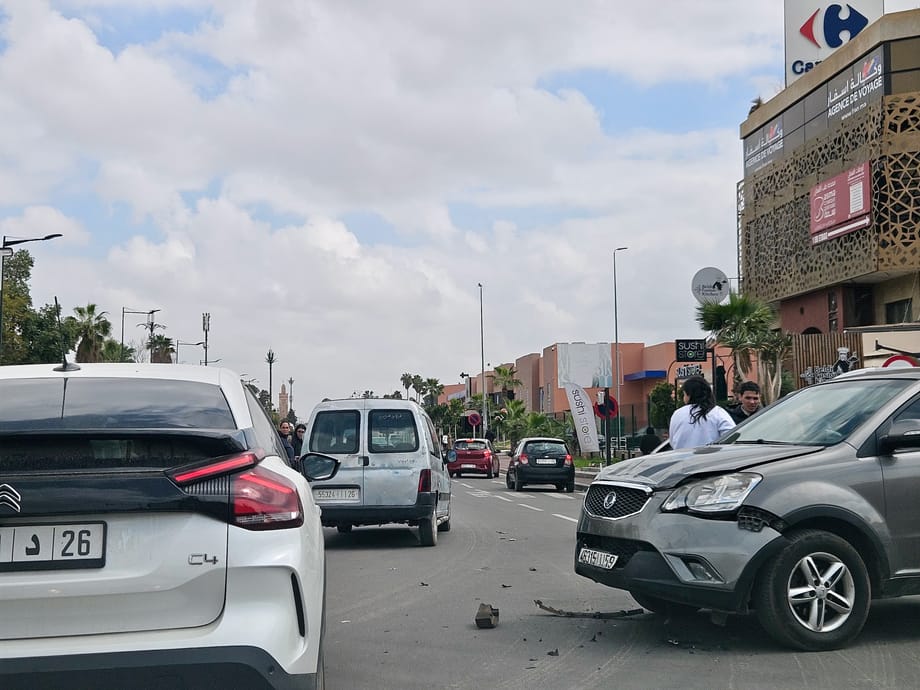
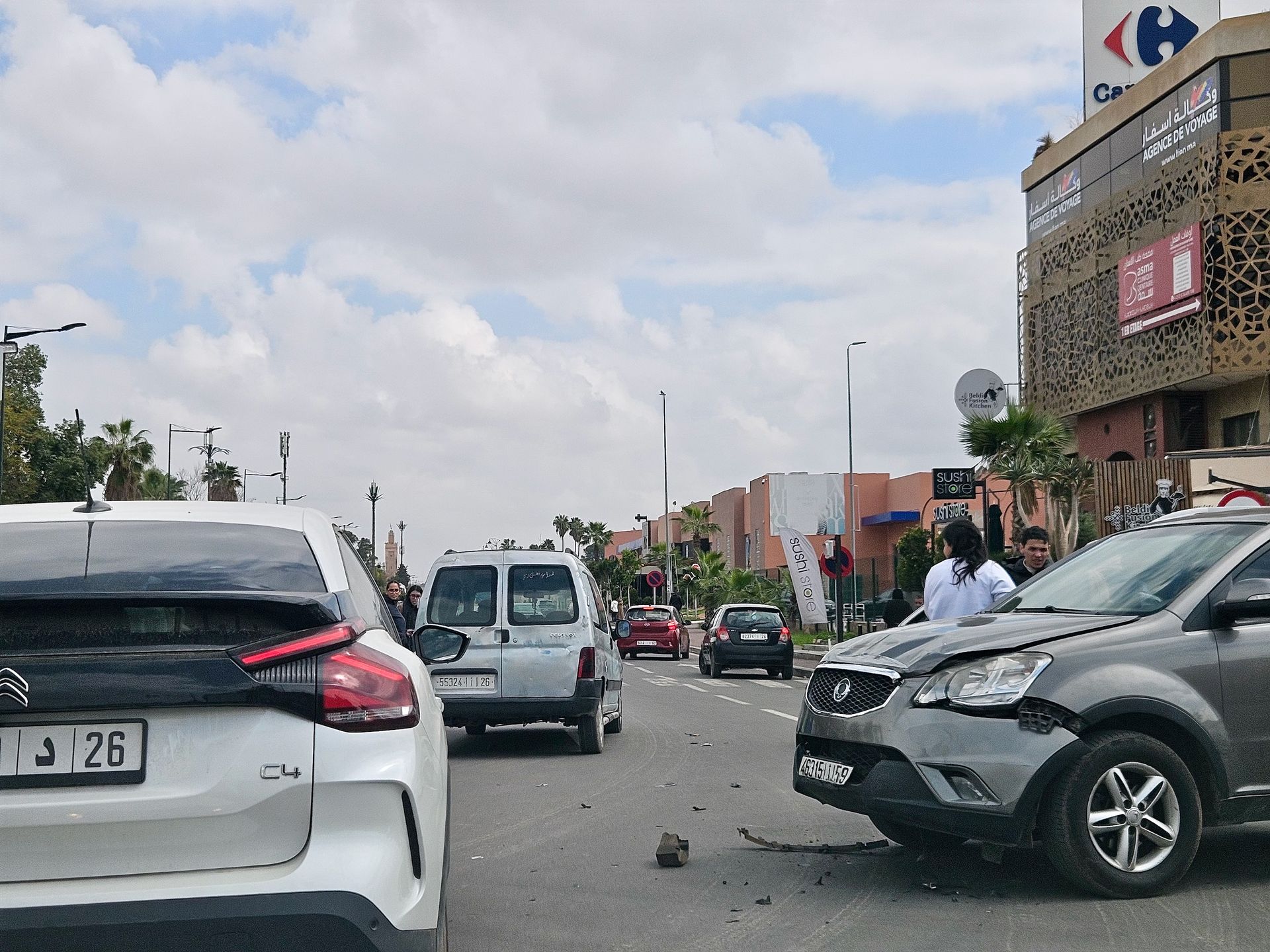
The situation was stupid and, at the same time, very Moroccan in terms of what happened later. We had parked the car, and I was standing by it on the driver’s side. The door was only slightly ajar — not wide open, not sticking halfway into the street. At that moment, a scooter rider caught the footrest of his scooter on the lower corner of the door.
If the door had been opened wider, the damage would have been much worse. And honestly, the scooter rider himself could also have ended up much worse, because he would have gone straight into the edge of the door. As it was, it ended with just a bent piece near the door and the scooter tipping over.
Classic chaos started straight away. The scooter rider tried to push the whole thing onto us, showing that his leg hurt. But that didn’t change the fact that he had driven into our car. The communication barrier was another problem — we simply couldn’t make ourselves understood with him in any language at all (even with DeepL or Google Translate).
And that’s where the trouble started.

Emergency number and police
Our first attempt to call emergency services through the emergency number was terrible. 112 didn’t work for us the way it would in Europe. We got French-language messages, an automated system, button choices, and no proper conversation in English. In a stressful situation, with a damaged rental car and a scooter rider next to you, that’s not a minor detail.
At the scene, one police unit showed up first, then another, and in the end also something like our traffic police. One of the officers was writing something down in a squared notebook. We didn’t get any formal document from the intervention, though. No paper that we could later simply show to the rental company or the insurer.
At the same time, we were in touch with the rental company — by phone and on WhatsApp. We asked what else we should do, what documents to get, and whether they needed anything extra. Instead of clear instructions, we got messages saying everything was clear, there were photos, the case was obvious, and nothing else was needed.
And that was a mistake. Ours and theirs.

Returning the car
Ours, because we trusted too much that since the rental company knew about the case in real time, there wouldn’t be a problem later. Theirs, because instead of saying clearly, “you need this and this document from the police,” they reassured us that photos and a description would be enough. With a rental car, that kind of vague communication can later cost real money.
When we returned the car, the atmosphere changed completely. The rental company employee knew we’d be bringing the car back after a collision, but despite the earlier contact, he started inspecting the car very closely and looking for anything else he could add to the issue. There was also a suggestion that we settle the money on the spot.
We didn’t agree to that.
We didn’t sign anything we didn’t agree with, because from the start we said clearly: this wasn’t our fault, and earlier we had asked the rental company whether we needed any other documents. We were misled, because at the collision scene we were told that nothing else was needed, and at drop-off it suddenly turned out that the missing police confirmation was a problem after all.
After returning the car, I blocked the credit card, but the deposit had already been blocked earlier, so the rental company could still take the funds from that hold. And that’s exactly what happened.
That was when we activated the excess insurance through XCover in Revolut. We described the claim in a lot of detail: what happened, where, when, who was there, what the contact with the rental company looked like, what the police said, and what the damage was. We attached photos, screenshots of the conversations, confirmations, and everything else we had.
About two weeks later, we got the refund from the insurance. So the policy itself worked. And that matters, because these kinds of policies often look good in the app, but the real test only starts when you actually need to get your money back.
Polish consulate in Morocco
The biggest absurdity was the issue of the police document. We asked our Polish consulate in Rabat for help obtaining confirmation of the intervention. The case has been dragging on since March. We got two replies saying they were trying to establish something, and then there was silence. By now it’s July, we’ve sent reminders, and we still haven’t received any real help or the document.
In the end, we filed a complaint with the Ministry of Foreign Affairs about how the consular section handled the case. And we’ll say this directly: after our experience, it’s hard to be surprised that in crisis situations people complain about the lack of support from Polish missions. In our case, this wasn’t about evacuation from the country or some huge drama. We just needed help getting a paper from the police after a collision in a rental car. And even that turned into banging our heads against a wall.
